

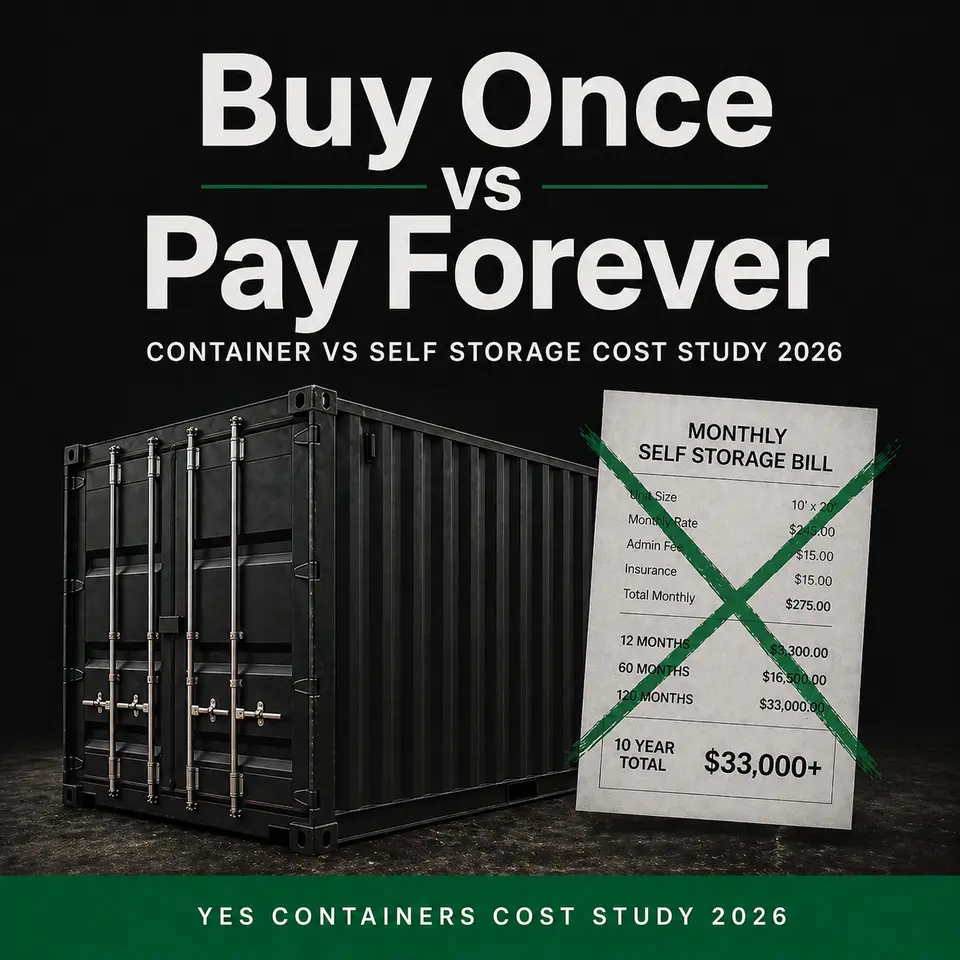

Container vs Self Storage Cost: When Buying a Shipping Container Beats Paying Monthly
Written on May 6, 2026
by Gabriel B.
In the following categories: Shipping Container Studies
Container vs self storage cost is one of the most practically useful comparisons in the shipping container market — and one of the least documented with actual numbers. More than 16.6 million U.S. households currently rent off-site self-storage, paying monthly fees for space they do not own and cannot access on their own schedule. A significant portion of those households have storage needs that are permanent or semi-permanent rather than temporary — and for that portion, a one-time container purchase on their own property almost always becomes the lower-cost option within a predictable timeframe. This study calculates where that break-even point falls, how it varies by market and container size, and what the long-run cost difference looks like across the most common buyer scenarios.
The Scale of the Self-Storage Market and What It Signals
The United States has more self-storage space per capita than any other country in the world. The Self Storage Association reported that 13.4% of U.S. households rented self-storage in 2024 — up from 11.1% in 2022 — representing more than 16.6 million households paying monthly fees for space they do not own. The U.S. self-storage industry now operates more than 2.1 billion square feet of rentable space, according to StorageCafe's 2026 industry report, with nearly 56.8 million additional square feet delivered in 2025 alone.
That growth rate does not reflect a healthy equilibrium between supply and demand — it reflects persistent demand outpacing supply in markets where self-storage is the default option for households and businesses that have not evaluated the container purchase alternative. The container vs self storage cost comparison that most of those 16.6 million households have never run is the subject of this study.
U.S. Self Storage Market Scale Indicators
Sources: Self Storage Association, StorageCafe 2026.
What Self Storage Actually Costs: National Rate Benchmarks
Self-storage monthly rates vary significantly by market, unit size, and facility type. Climate-controlled units command a premium over non-climate-controlled. Urban markets charge more than suburban or rural facilities for equivalent space. Promotional rates at move-in frequently step up after the first one to three months. The figures below represent non-climate-controlled standard unit rates at established facilities — the closest equivalent to what a container purchase replaces for outdoor or semi-permanent storage needs.
| Unit Size | Approx Floor Area | Estimated Monthly Rate | Annual Cost |
|---|---|---|---|
| 5x5 | 25 sq ft | $50 to $80 | $600 to $960 |
| 10x10 | 100 sq ft | $120 to $200 | $1,440 to $2,400 |
| 10x15 | 150 sq ft | $150 to $250 | $1,800 to $3,000 |
| 10x20 | 200 sq ft | $180 to $300 | $2,160 to $3,600 |
| 10x30 | 300 sq ft | $250 to $400 | $3,000 to $4,800 |
Urban and high-demand markets run at the upper end of these ranges or above them. StorageCafe data shows that Atlanta and Phoenix each added more than 2 million square feet of self-storage in 2025 — yet rates in those markets remain elevated because demand growth has outpaced even that level of new supply. New York, Boston, San Francisco, and Los Angeles consistently rank among the most expensive self-storage markets in the country, with 10x10 rates frequently exceeding $300 per month in central locations.
What a Container Costs: The One-Time Purchase Equation
The container side of the container vs self storage cost comparison requires modeling both the container purchase price and the delivery cost — since delivery is the variable most buyers underestimate and the one most likely to change the break-even calculation.
| Container | Floor Area | Est. Purchase Price | Est. Delivery | Total Landed Cost |
|---|---|---|---|---|
| Used 20ft standard | 160 sq ft | $1,500 to $3,000 | $350 to $900 | $1,850 to $3,900 |
| New 20ft standard | 160 sq ft | $2,500 to $5,000 | $350 to $900 | $2,850 to $5,900 |
| Used 40ft standard | 320 sq ft | $2,000 to $4,500 | $450 to $1,100 | $2,450 to $5,600 |
| New 40ft high cube | 320 sq ft | $4,000 to $7,000 | $450 to $1,100 | $4,450 to $8,100 |
Delivery estimates above assume suburban or semi-rural delivery within 50 to 100 miles of the nearest depot. Rural deliveries beyond 150 miles will push total landed cost higher. The benchmark YES Containers uses is approximately $500 for the first 100 miles from the nearest depot and approximately $5 per mile beyond — but site access conditions, terrain, and local market rates all affect the final figure. For exact pricing in your location, the YES Containers delivery page provides location-specific estimates.
The Break-Even Calculation: Container vs Self Storage Cost by Scenario
Break-even in the container vs self storage cost comparison is the point at which cumulative rental payments equal the total landed cost of a container purchase. After that point, every additional month of storage rental is money the container owner is no longer spending.
Break-Even Timeline by Scenario
Break-even calculated as total landed container cost divided by monthly storage rate. Assumes no additional monthly costs after container purchase. Container price and delivery estimates based on 2025 market data and YES Containers benchmarks.
The break-even range across the most common scenarios falls between 11 and 25 months — roughly one to two years. That range compresses toward the lower end in higher-cost storage markets (urban Northeast, California, major metros) where monthly rates are elevated, and expands toward the upper end in lower-cost rural markets where storage rentals are cheaper and delivery distances push container landed costs higher.
After break-even, the container owner accumulates savings at the rate of the monthly storage rental they are no longer paying. A buyer who reaches break-even at 15 months and keeps their container for 10 years accumulates approximately $10,350 in avoided rental costs over the remaining 105 months at a $150 monthly rate — on top of the initial investment having already been recovered.
What the Comparison Misses: The Non-Financial Advantages of Ownership
The container vs self storage cost calculation above focuses purely on cash outlay. It does not capture several practical advantages of container ownership that have real but harder-to-quantify value.
On-site access. A container on your property is accessible at any hour without driving to a facility, finding your unit in a shared corridor, or working within facility operating hours. For buyers using containers to store tools, equipment, or materials they access frequently, the time and fuel saved on storage facility trips has meaningful cumulative value over the ownership period.
No rental rate increases. Self-storage facilities regularly increase monthly rates — sometimes significantly — after promotional introductory periods expire. A container purchase eliminates rent escalation risk permanently. The container owner's cost is fixed at the point of purchase and does not change with market conditions, facility ownership changes, or demand surges in the local storage market.
Asset value. A shipping container retains meaningful resale value. A used 20ft container purchased for $2,200 and maintained in good condition will sell for $1,500 to $2,000 in most markets a decade later. That residual value further reduces the effective cost of ownership when calculated over the full ownership period.
More space per dollar. A used 20ft container at 160 square feet of floor space typically costs less per square foot per month — once amortized over two or more years — than a 10x10 storage unit at 100 square feet. The buyer gets more space while spending less over any holding period beyond break-even.
When Self Storage Still Wins
The container vs self storage cost comparison does not always favor container purchase. Several scenarios make monthly storage rental the better financial choice.
Short-duration needs — renovation displacement, temporary relocation, seasonal overflow lasting three to six months — do not reach container purchase break-even. For buyers with clearly defined, short-term storage needs, renting remains the lower-cost option.
Buyers without suitable placement land cannot use a container regardless of the cost comparison. Renters, urban apartment dwellers, and suburban homeowners with HOA restrictions prohibiting container storage cannot access the purchase option even when it would be financially superior.
Climate-controlled needs are a category where self-storage maintains a practical advantage. Standard containers are not climate-controlled out of the box. Adding insulation and HVAC to a container for sensitive storage — wine, documents, electronics, musical instruments — adds $2,000 to $5,000 or more to the purchase cost, shifting the break-even timeline significantly and potentially making climate-controlled self-storage the better value for small volumes of sensitive items.
The YES Containers Pay-on-Delivery Advantage in the Cost Comparison
One friction point that deters buyers from making the container vs self storage cost switch is uncertainty about condition and a reluctance to pay before seeing the unit. A buyer who has paid upfront and received a container in worse condition than expected has lost negotiating leverage and faces a dispute process rather than a simple rental cancellation.
YES Containers' pay-on-delivery program removes this barrier by allowing buyers to inspect the container at delivery before final payment is processed. Across 51 orders in the study period, YES Containers recorded zero returns — a result that reflects how effectively pre-delivery clarity and inspection rights at delivery reduce the condition uncertainty that keeps some buyers in monthly rental longer than their financials require. Browsing current container inventory and pricing starts at the YES Containers product catalog.
Key Findings
- Container vs self storage cost break-even falls between 11 and 25 months across the most common buyer scenarios — roughly one to two years depending on monthly rental rate, container purchase price, and delivery cost.
- The break-even timeline compresses in high-cost urban storage markets and expands in low-cost rural markets where monthly rental rates are lower and container delivery distances are longer.
- After break-even, every additional month of storage need generates savings equal to the avoided monthly rental rate — accumulating to $10,000 or more in avoided costs over a 10-year ownership period at typical rental rates.
- 13.4% of U.S. households rented self-storage in 2024, up from 11.1% in 2022 — a large and growing pool of buyers who have not evaluated the container purchase alternative for their specific storage duration and market.
- Container ownership provides additional non-financial advantages over rental including on-site access at any hour, elimination of rental rate escalation risk, and residual resale value that further reduces effective cost of ownership.
- Self-storage remains the better option for short-duration needs under six months, buyers without placement land, and those with climate-controlled storage requirements for sensitive items.
- YES Containers' zero-return record across 51 study-period orders demonstrates that pay-on-delivery inspection rights eliminate the primary condition uncertainty that keeps financially qualified buyers in monthly rental longer than necessary.
Browse container options by size and condition starting with the YES Containers product catalog. Compare used 20ft and new 20ft standard containers for the most common residential break-even scenarios, or explore used 40ft units for higher-volume storage comparisons. The full Shipping Container Studies series covers demand data, pricing, and market analysis across the U.S. container market.