

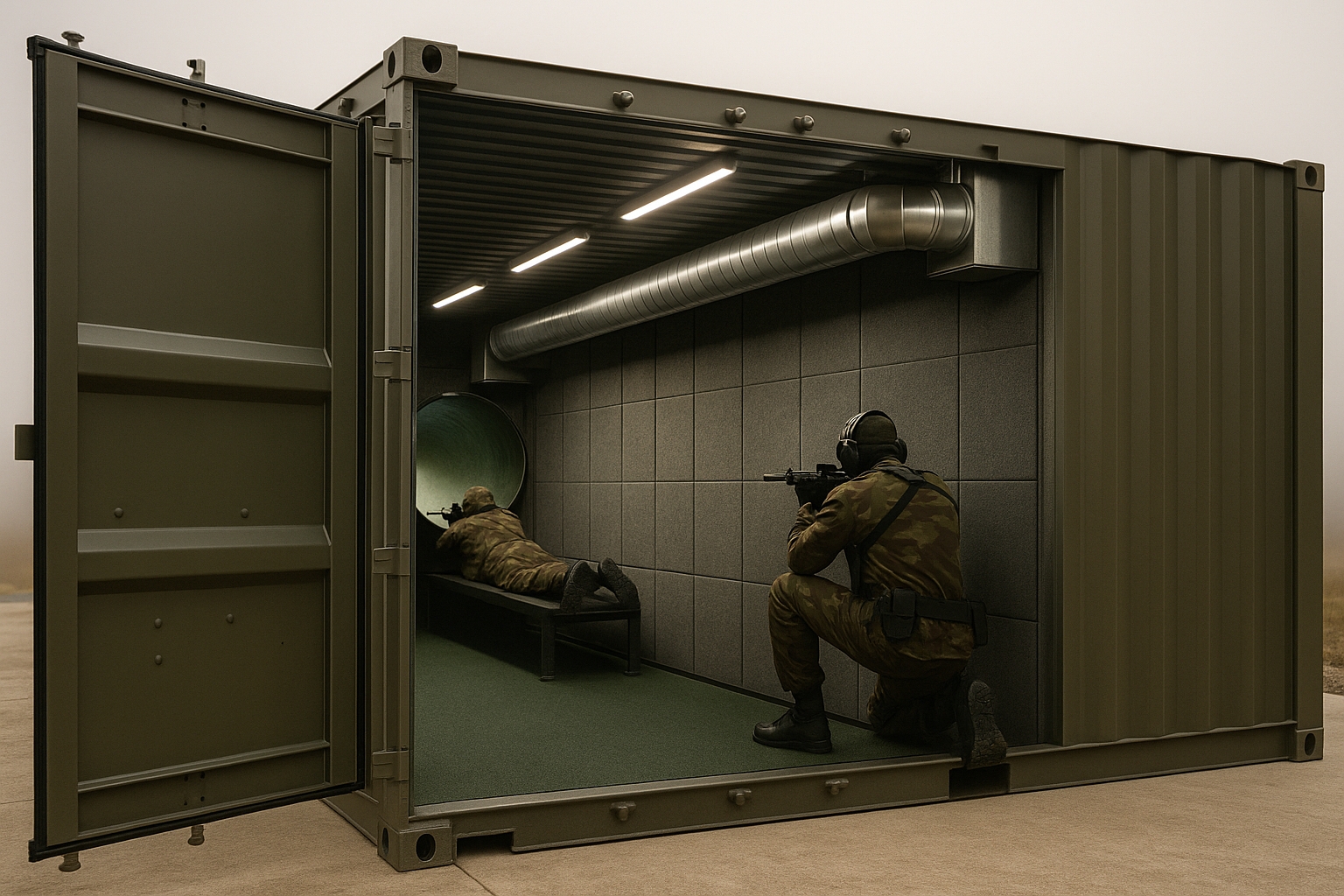

Containerized tubular shooting range: portable live-fire training in a shipping container
Written on September 25, 2025
by Beatrice Zama
In the following categories: Shipping Container Architecture, Shipping Containers Innovation
A containerized tubular shooting range transforms a standard shipping container into a mobile, enclosed, and sound-managed live-fire facility — purpose-built for military and law-enforcement training where permanent ranges aren't feasible. Below: how it works, who it's for, and a buyer checklist.
What is a containerized tubular shooting range?
A containerized tubular shooting range is a self-contained, transportable small-arms range installed inside one or more ISO shipping containers. It's designed for ballistic containment, ventilation and filtration, and noise reduction — so units can train at the point of need, then relocate as missions change. Similar systems are marketed globally for defense and police users.
Why it exists (mobility first)
- Deploy anywhere: Ship by road, rail, or sea; drop on a pad and train. Some foldable and containerized variants can be operational within hours.
- Zero permanent works: No large building project or long permitting timelines — useful for temporary bases and exercises.
- Scalable lanes: Systems range from single-lane function-test boxes to multi-lane live-fire ranges.
Safety & health systems inside the box
Modern containerized ranges integrate:
- Ballistic containment — steel and armored assemblies, traps and backstops to keep all rounds within the structure.
- Ventilation with HEPA filtration engineered to meet OSHA/NIOSH expectations for lead and particulate control.
- Acoustic treatment to cut noise signatures on the line and outside the container.
- Controls & targets: Programmable targetry, lighting, comms, and safety interlocks vary by vendor.
Note: This article is informational only — range design, acceptance testing, and local compliance should be handled by certified specialists.
Who uses it — and when?
- Military & SOF units needing live-fire sustainment at remote or expeditionary sites.
- Law enforcement & training centers with space, zoning, or noise constraints.
- Temporary exercises or surge capacity near ports, training areas, or deployed HQs — some solutions emphasize fast setup and teardown.
Containerized tubular shooting range vs. shoot houses
Live-fire container ranges (enclosed lanes) are different from modular shoot houses — CQB structures, often reconfigurable and sometimes non-live-fire or simunitions-only. Many agencies use both: a lane for marksmanship and zeroing, and a house for decision-making and CQB under strict SOPs.
Buyer checklist (copy to your RFI)
- Ballistic spec: Backstop rating and certified containment to your weapons and calibers.
- Ventilation plan: Airflow (CFM per lane), capture velocity, HEPA spec, filter change intervals, and compliance documentation.
- Noise & siting: Exterior dB levels, acoustic treatments, and pad and foundation requirements.
- Throughput & lanes: Number of lanes, firing distances, and targetry options — some modules scale to multiple lanes.
- Mobility & setup: Transport mode, lift points, and time to operational — some systems are field-ready within hours.
- Lifecycle & service: Warranty, spares, lead-time, and in-country support.
From YES Containers
At YES Containers, our focus is on providing empty shipping containers ready for your project. While we don't perform live-fire range conversions ourselves, we supply the new and used containers that specialized contractors and integrators start with. Most builds begin with a standard delivered 20ft or 40ft unit — we ship nationwide and can get a container on-site fast. Request a quote or call (302) 596-8809 to discuss your project timeline.
Further reading
- Zen Technologies — Containerised Tubular Shooting Range (CTSR) and CSAFR overviews
- MILO Ready Range — fully enclosed, modular live-fire solutions
- Coversix ARCAS modular ranges — ventilation and mobile modules
- SRT Live Fire — containerized range systems and MSAR components
- Continest — foldable, rapidly deployable shooting-range concept
Legal & safety note
This post does not provide construction instructions. Always follow applicable laws, safety codes, and environmental regulations — consult certified range designers and your agency's safety office.

