

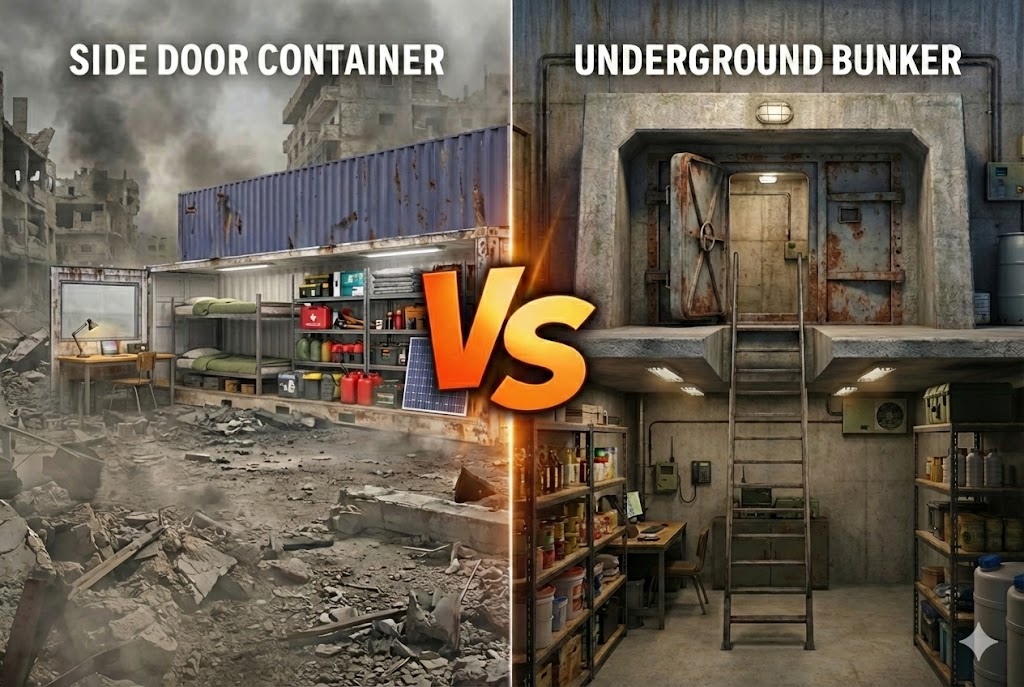

Side Door Containers vs Bunkers: The End of the World Storage Plan
Written on January 29, 2026
by Adrian Stan
In the following categories: Container Use Cases, Shipping Container Architecture, Shipping Container Maintenance & Fabrication, Shipping Containers 101
Side door containers vs bunkers is a comparison more people are making when planning end-of-the-world storage, emergency preparedness, or off-grid resilience. While underground bunkers are often seen as the ultimate survival solution, they are expensive, difficult to maintain, and far less practical than most people expect.
A smarter and far more flexible solution is gaining popularity among landowners, farmers, preppers, and long-term planners: side door shipping containers
At YES Containers, we regularly help customers plan reliable container storage solutions for emergency supplies, off-grid living, disaster preparedness, and long-term resilience.
Over time, one thing has become clear — side door containers consistently outperform bunkers in real-world use.
Let’s explore why.
Accessibility Matters More Than Depth: Side Door Containers vs Bunkers
Bunkers rely on depth for protection, but that depth creates serious limitations. Access is often restricted to a single entry point, ventilation is complex, and loading or reorganizing supplies can become a challenge.
Side door containers vs bunkers becomes a practical discussion the moment accessibility is considered. Side door shipping containers offer full-length side access, completely changing how storage works.
With side doors, you can:
-
Organize supplies with shelving, zones, and clear visibility
-
Access food, water, tools, medical supplies, and fuel quickly
-
Avoid ladders, hatches, and confined entry points
In emergency situations, speed and access matter more than depth.
Modular, Expandable, and Relocatable Storage
Once a bunker is built, it is permanent. If your needs change, your land use shifts, or you relocate, that investment stays behind.
Shipping containers offer unmatched flexibility. Customers browsing shipping containers for sale often choose modular setups that can grow over time.
👉 (INTERNAL LINK: link “shipping containers for sale” to your main sales page)
Side door containers can be:
-
Placed above ground, partially buried, or fully buried
-
Expanded by adding more units as storage needs grow
-
Relocated if your plans or property change
Multiple side door containers can be aligned or connected to create a modular system — something traditional bunkers simply can’t offer.
Better Ventilation and Moisture Control
One of the most common problems with underground bunkers is moisture. Poor airflow leads to condensation, mold, and corrosion, which can destroy supplies over time. Proper airflow and moisture control are also emphasized in public health guidance for long-term emergency supply storage.
Shipping containers, especially used wind and watertight (WWT) containers, are designed to protect cargo in extreme conditions.
Side door containers make it easier to:
-
Install ventilation systems
-
Improve airflow along the full container length
-
Reduce condensation and moisture buildup
This results in a more stable environment for long-term storage.
Cost Comparison: Side Door Containers vs Bunkers
Building a bunker often costs tens or even hundreds of thousands of dollars when excavation, materials, labor, permits, and maintenance are included.
A side door shipping container costs a fraction of that.
With a container, you benefit from:
-
Lower upfront investment
-
Minimal site preparation
-
Fast delivery and setup
-
The option to upgrade gradually over time
Many YES Containers customers choose used WWT side door containers and add shelving, insulation, and ventilation — creating a reliable storage solution without overwhelming costs.
Preparedness should be sustainable, not financially draining.
Stealth Without Heavy Construction
Bunker construction is hard to hide. Excavation, heavy machinery, and permits often draw attention during the build process.
Side door containers can be installed quickly and discreetly.
They can be:
-
Disguised as barns, storage sheds, or utility structures
-
Shielded with fencing, landscaping, or partial burial
-
Placed with minimal site disturbance
This makes them ideal for customers who value privacy and simplicity.
Practical Use Beyond Survival Scenarios
Unlike bunkers, side door containers remain useful even if the worst-case scenario never happens. Government agencies such as FEMA recommend maintaining accessible, well-organized emergency supplies rather than relying solely on underground structures, reinforcing the need for practical above-ground storage solutions.
They are commonly used for:
-
Emergency food and water storage
-
Generator and fuel housing
-
Tools, equipment, and farm supplies
-
Backup storage for rural or remote properties
-
Disaster preparedness and recovery planning
Your investment remains valuable today — not just in an imagined future.
Why Side Door Containers Outperform Standard Containers
While standard containers are strong and secure, side door units offer clear advantages for storage planning.
Side door containers provide:
-
Full side access for bulk storage
-
Easier organization and shelving layouts
-
Faster loading and unloading
-
Improved airflow and visibility
For long-term storage, organization and access are just as important as strength.
Final Thoughts: Prepared, Not Paranoid
Preparedness is not about fear. It’s about resilience, adaptability, and smart planning.
Side door containers vs bunkers is not a theoretical debate — it’s a practical decision. Side door shipping containers offer a scalable, cost-effective, and real-world alternative to traditional bunkers.
If you’re planning long-term storage, emergency preparedness, or off-grid resilience, a side door container isn’t just an option — it’s the smarter strategy.
Explore available side door shipping containers with YES Containers and build a storage plan that works today and tomorrow.
