

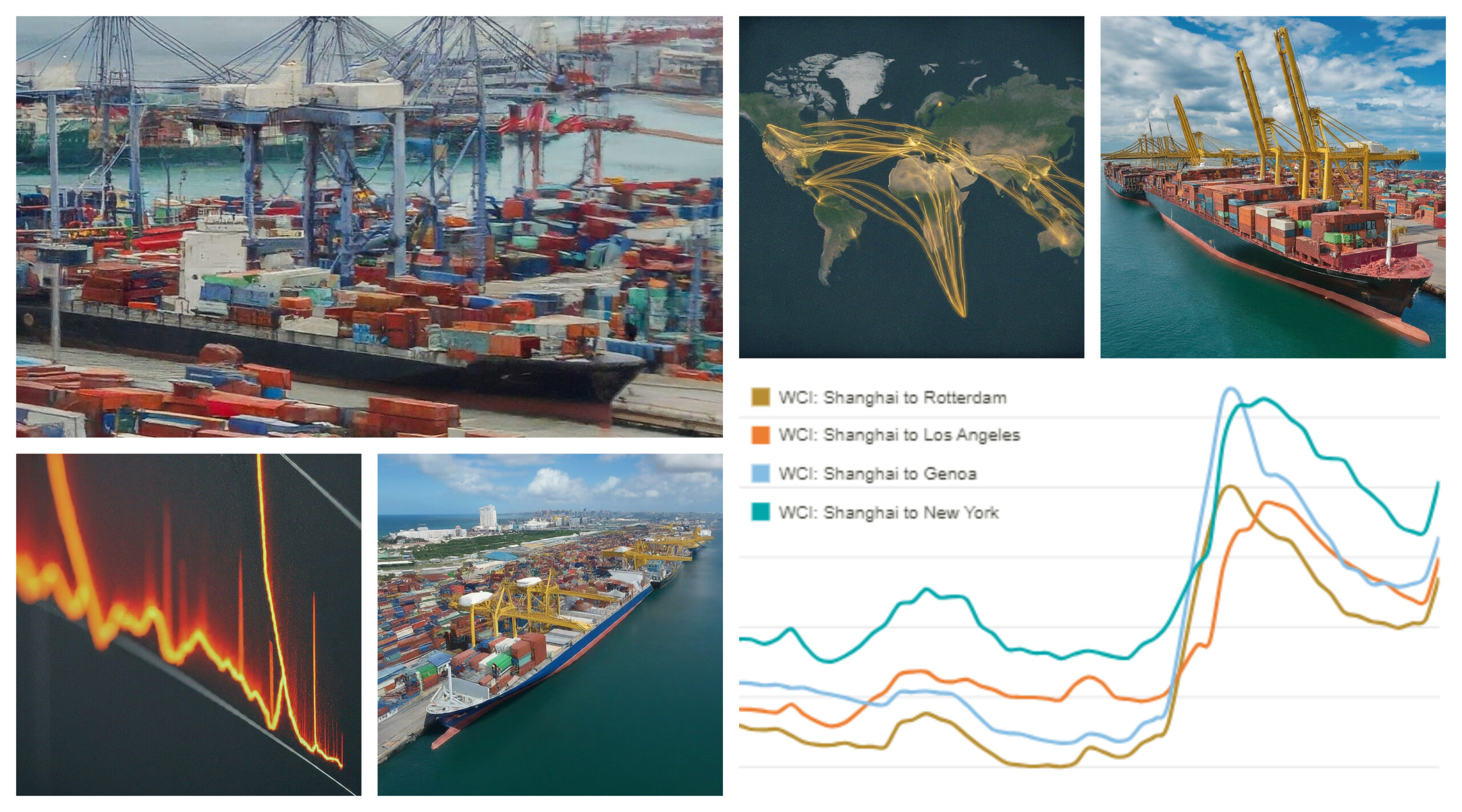

What Happens to Container Prices When Global Spot Rates Surge
Written on July 14, 2025
by Adrian Stan
In the following categories: Container Shipping Industry, News, Shipping Container Sales
Every few years, headlines announce that global container shipping rates have spiked — sometimes doubling or tripling within months. For importers and freight brokers, that news is immediately painful. For someone buying a shipping container for on-site storage, a job site, or a business use, the connection is less obvious but still real. Understanding how freight rate cycles affect what you pay for a container — and when to act — is worth a few minutes of your time before you place an order.
The Difference Between Freight Rates and Container Purchase Prices
These are two distinct markets that influence each other but are not the same thing.
Freight rates are what shippers pay to move cargo inside containers across ocean trade routes. They are quoted per TEU (twenty-foot equivalent unit) or FEU (forty-foot equivalent unit) and fluctuate based on vessel capacity, port congestion, fuel costs, and demand patterns. Indexes like the Drewry World Container Index and the Freightos Baltic Index track these rates on a weekly basis.
Container purchase prices are what you pay to own a container outright — to place on your property, business, or job site as a permanent or semi-permanent asset. Used containers (Wind and Watertight or Cargo Worthy grade) are priced based on regional supply and demand. New one-trip containers are priced based on manufacturing costs in Asia plus the cost of shipping them to the US, which is directly tied to freight rates.
The two markets are connected, but the relationship has a lag and varies by container type.
How Spot Rate Surges Flow Through to Container Purchase Prices
When ocean freight rates spike — as they did during COVID-era disruptions in 2021, the Red Sea rerouting in late 2023 and 2024, and periodically throughout 2025 — the effect on container purchase prices works through two channels.
Channel 1: New One-Trip Container Pricing
New containers are manufactured primarily in China and transported to the US on freight voyages. When freight rates are high, the cost of moving a new container from the factory to a US port increases. Sellers of new one-trip containers absorb some of that cost and pass some of it on. The result is that new container purchase prices tend to rise during sustained freight rate spikes and ease when rates normalize.
This effect is most pronounced when rate spikes are sustained over several months. A short spike of a few weeks may not move purchase prices noticeably. A multi-month surge — like the one that followed Red Sea rerouting, which added weeks to transit times and effectively removed 10–15% of effective global capacity — does tend to push new container prices higher.
Channel 2: Used Container Supply and Demand
Used containers are priced more locally. The supply of used containers in any region depends on how many containers have completed their freight service life and been retired from active shipping use near that region. When freight demand is high, carriers hold onto containers longer rather than retiring them — which can tighten supply of used units in the secondary market. When freight demand softens and containers are retired in larger numbers, used inventory builds and prices ease.
This is a slower mechanism than the new container channel, but it is real over a multi-year horizon. The surge in used container prices in 2021–2022 and the subsequent price correction in 2023 followed this pattern closely.
What a Spot Rate Surge Actually Looked Like for Buyers
| Period | Market Condition | New 20ft One-Trip (approx.) | Used 20ft WWT (approx.) |
|---|---|---|---|
| Pre-COVID (2019) | Normal freight rates | $2,800 – $3,200 | $1,400 – $1,800 |
| Peak surge (2021–2022) | Freight rates 5–10x normal | $5,500 – $7,500 | $3,500 – $5,000 |
| Correction (2023) | Rates normalized sharply | $3,500 – $4,500 | $2,000 – $2,800 |
| Red Sea disruption (2024) | Moderate rate spike | $4,200 – $5,500 | $2,500 – $3,500 |
| 2026 (current) | Elevated but stabilizing | $4,500 – $5,800 | $2,800 – $3,900 |
The historical pattern shows that waiting for a major correction to pre-2020 pricing is unlikely — the structural changes to global shipping since COVID have reset the baseline. But there is meaningful difference between buying during a peak rate environment and buying during a normalization window.
How to Time a Container Purchase Around Rate Cycles
For most buyers, timing the market precisely is not realistic — storage needs do not wait for optimal market conditions. But a few principles help you make a better decision regardless of where rates are in the cycle.
- If you need a used container, regional supply matters more than global rates. Check what inventory is available at depots near you. A well-supplied region will have competitive pricing even during a global rate spike.
- If you need a new one-trip container, rate environment matters more. Watch the Freightos Baltic Index or Drewry WCI for a few weeks before ordering. A sustained downward trend in rates often precedes easing in new container purchase prices by four to eight weeks.
- Buying during a rate spike is still often the right call if your alternative is paying for warehouse space or storage units month over month while you wait. The break-even math usually favors buying sooner rather than later.
- Grade selection affects total cost more than timing for most buyers. A one-trip container bought at the top of a rate cycle will still outperform a WWT unit bought at the bottom if your storage need spans several years. The container grade and longevity guide works through this math in detail.
The Red Sea Factor and What It Means Going Forward
The rerouting of container vessels around the Cape of Good Hope — driven by Houthi attacks on Red Sea shipping beginning in late 2023 — added roughly 10–14 days to Asia-Europe transit times and effectively removed a significant portion of global vessel capacity from active trade. That capacity crunch pushed freight rates sharply higher through much of 2024.
For US container buyers, the Red Sea situation's most direct impact was on new one-trip container pricing, as manufacturing and shipping costs from Asia rose. The situation remained unresolved entering 2026, meaning the transit cost premium for new containers sourced from Asia has not fully unwound. Buyers comparing new versus used containers should factor this in — the price gap between new and used has narrowed from the extremes of 2021–2022 but remains above historical norms.
What This Means If You Are Buying Now
Entering 2026, the freight rate environment is elevated compared to 2019 baselines but below the extremes of 2021–2022. New one-trip container prices reflect this — higher than pre-COVID but not at pandemic peak levels. Used container pricing varies considerably by region and grade.
The practical advice is straightforward: buy based on your actual need and the total cost of your alternative (rented storage, leased warehouse space, delayed operations), not based on a hope that prices will return to a historical low that is unlikely to recur. If you are on the East Coast or in the Southeast, current inventory levels are reasonably strong. If you are buying in a more inland or remote market, confirm availability and factor delivery into your total cost calculation before comparing sellers.
Browse current inventory by location:
View the full catalog at yescontainers.com/products. For a quote specific to your ZIP code and delivery requirements, contact YES Containers at 1-800-223-4755.
Frequently Asked Questions
Do global shipping rate spikes always raise container purchase prices?
Not automatically and not immediately. New one-trip containers are most directly affected because their cost includes ocean freight from Asia. Used container prices respond more slowly and are driven more by regional supply than by global rate indexes. A short spike may not move purchase prices at all; a sustained multi-month surge typically does.
Is now a good time to buy a shipping container?
The better question is whether the cost of waiting exceeds the potential savings from a future price drop. For most buyers with an active storage or operational need, the ongoing cost of the alternative — rented storage, leased space, delayed projects — makes buying now the better economic decision even if rates ease slightly later.
What is the difference between a TEU and an FEU?
TEU stands for twenty-foot equivalent unit and is the standard measurement unit in container shipping. One standard 20ft container equals one TEU. An FEU (forty-foot equivalent unit) equals two TEUs. Freight rates are often quoted per FEU on major trade routes. For buyers, this terminology mostly matters when interpreting freight market news — your purchase price will simply be quoted per container.
How do tariffs affect container prices for buyers?
US tariffs on Chinese goods can affect container purchase prices in two ways: by influencing the volume of cargo moving through the system (affecting used container supply and freight rates) and by directly affecting the cost of containers themselves if containers are subject to tariff treatment. The practical effect for most buyers is indirect and tends to be absorbed into gradual price movements rather than sharp overnight changes.