

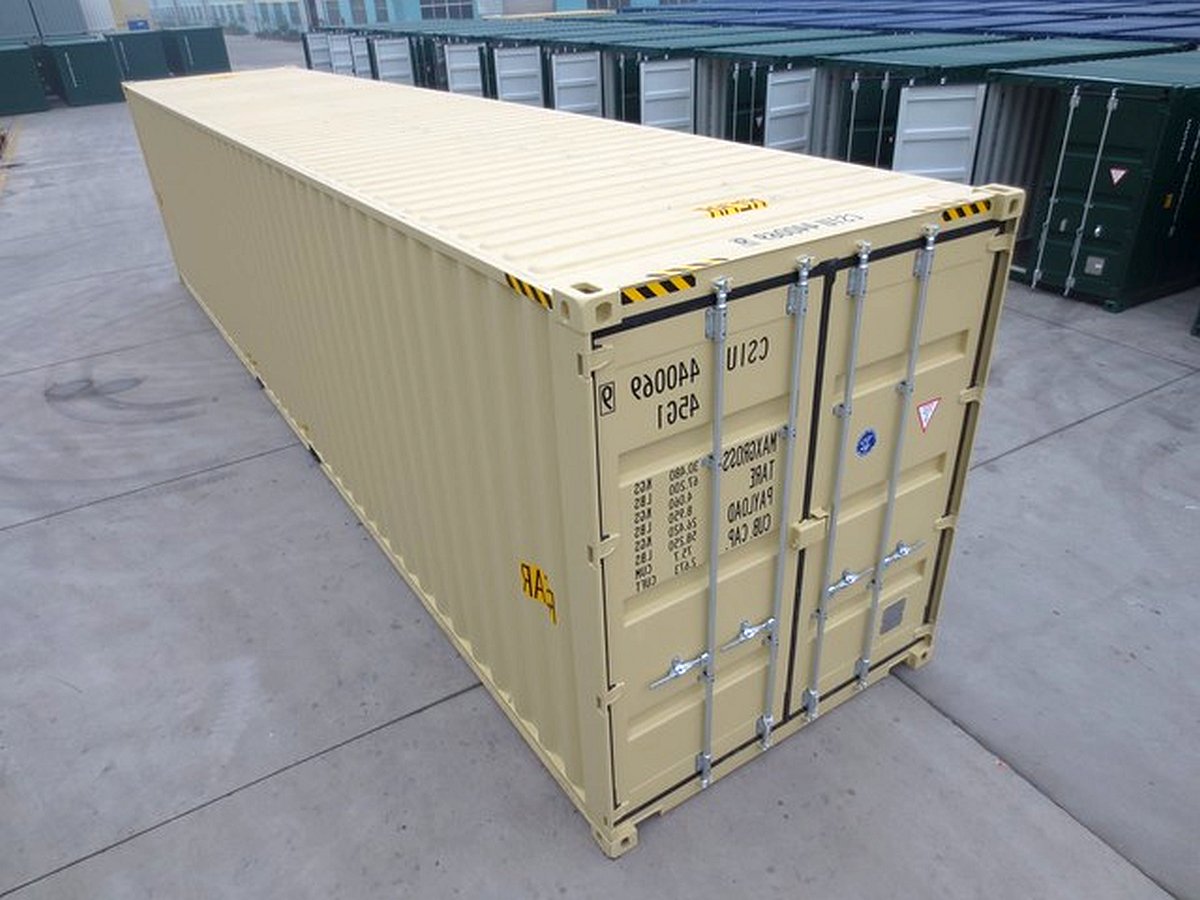

How to Select the Right Shipping Container Size: The Complete Buyer's Reference
Written on September 21, 2025
by Randy Lair
In the following categories: How To
Container size is the first decision and the one that is hardest to undo. Ordering a 20ft container when you needed a 40ft means paying twice for delivery. Ordering a 40ft when your driveway cannot accommodate tilt-bed offloading means a failed delivery and a rescheduling fee. Getting this right before you order saves money, time, and frustration — and it requires more information than most size guides provide.
This reference covers every standard configuration: external and internal dimensions, weight capacities, cost-per-square-foot comparisons, access door options, site requirements for delivery, and the use cases where each size and configuration genuinely makes sense.
External vs. Internal Dimensions: Why Both Matter
Container specifications are quoted in external dimensions — the outside measurements of the steel box. The usable interior space is smaller due to wall thickness, floor framing, and corner post structure. For planning purposes, always work from internal dimensions.
| Configuration | External (L x W x H) | Internal (L x W x H) | Internal Volume | Tare Weight |
|---|---|---|---|---|
| 20ft Standard | 20' x 8' x 8'6" | 19'4" x 7'8" x 7'10" | ~1,172 cu ft | ~4,850 lbs |
| 20ft High Cube | 20' x 8' x 9'6" | 19'4" x 7'8" x 8'10" | ~1,320 cu ft | ~5,070 lbs |
| 40ft Standard | 40' x 8' x 8'6" | 39'5" x 7'8" x 7'10" | ~2,390 cu ft | ~8,160 lbs |
| 40ft High Cube | 40' x 8' x 9'6" | 39'5" x 7'8" x 8'10" | ~2,694 cu ft | ~8,598 lbs |
The door opening is narrower than the interior width — standard container doors open to approximately 7'8" wide and 7'5" tall on a standard unit, or 8'5" tall on a high cube. If you are moving equipment in and out regularly, confirm your largest piece fits the door opening, not just the interior width.
The 20ft Container: What It Actually Holds

A 20ft standard container provides approximately 1,172 cubic feet of internal storage. To put that in practical terms:
- Equivalent to a large two-car garage in floor space (roughly 150 sq ft)
- Fits the contents of a 3–4 bedroom home comfortably
- Holds approximately 10 standard wooden pallets in a single layer
- Accommodates a full set of construction tools and equipment for a mid-size contractor crew
The 20ft is the most versatile size for residential and small commercial buyers. Its primary advantages are delivery maneuverability and access. A tilt-bed truck delivering a 20ft container needs approximately 30 feet of straight run behind the placement point — manageable on most residential driveways. For sites with constrained access, the 20ft is frequently the only viable option.
When the 20ft is the right choice
- Residential storage where driveway access limits delivery clearance
- Single-person or small business tool and equipment storage
- Construction sites with limited staging area
- Pop-up retail, food service, or event applications where a compact footprint is preferred
- First container purchase where the buyer wants to confirm the use case before committing to a larger unit
When the 20ft is not enough
- Storing vehicles, trailers, or large equipment that exceeds the 19'4" internal length
- Commercial inventory storage where two 20ft containers would be needed — a single 40ft is almost always cheaper in total delivered cost
- Container conversions requiring significant interior square footage for workspace or office use
Browse 20ft options: new 20ft standard and new 20ft high cube available across depot locations.
The 40ft Container: Cost Efficiency at Scale

A 40ft standard container provides approximately 2,390 cubic feet — just over double the 20ft in floor space. The cost-per-square-foot economics favor the 40ft significantly for buyers who have the site to accommodate it.
| Comparison | Two 20ft Containers | One 40ft Container |
|---|---|---|
| Total internal volume | ~2,344 cu ft | ~2,390 cu ft |
| Typical combined price | Higher (two units) | Lower (single unit) |
| Delivery cost | Two separate deliveries | Single delivery |
| Site footprint | Flexible placement | Single 40ft run required |
| Access flexibility | Two separate door sets | One door set (or double door) |
If the site can accommodate a 40ft delivery — approximately 50 feet of straight run behind the placement point — the 40ft is almost always the better economic choice when the storage need exceeds what a 20ft can hold. The exception is when two separate access points are operationally important, or when the site physically cannot accommodate the 40ft delivery clearance.
When the 40ft is the right choice
- Commercial and industrial storage requiring maximum space at minimum per-unit cost
- Farm and agricultural equipment storage where long implements need the full interior length
- Container office or workshop conversions requiring meaningful interior square footage
- Multi-pallet inventory storage — a 40ft holds approximately 20–22 pallets in a single layer
- Any application where a buyer would otherwise need two 20ft containers
Browse 40ft options: new 40ft high cube and new 40ft double door high cube across depot locations nationwide.
Standard Height vs. High Cube: The One-Foot Difference That Matters More Than It Sounds
Standard containers are 8'6" tall externally (7'10" internal ceiling height). High cube containers are 9'6" externally (8'10" internal ceiling height). One additional foot of interior clearance changes several use cases entirely.
| Factor | Standard Height | High Cube |
|---|---|---|
| Interior ceiling height | 7'10" | 8'10" |
| Standing comfort for tall users | Marginal at 7'10" | Comfortable at 8'10" |
| Pallet racking (standard height) | 2 levels typically | 3 levels possible |
| Overhead delivery clearance required | Lower — easier on constrained sites | Higher — confirm clearance on delivery path |
| Conversion to office/living space | Functional but low-feeling | Comfortable — standard room feel |
| Typical price premium | — | $200–$600 more than standard |
The high cube premium is worth it in almost every non-storage application. For pure material storage where workers are not regularly moving around inside the container, standard height is adequate. For any workspace, conversion, or regular interior access, the extra foot of headroom is worth the modest premium. For a full comparison, the high cube vs. standard container guide covers this in detail.
Door Configurations: Access Matters as Much as Size
Standard containers have double cargo doors at one end — two panels that open outward to provide access across the full width of the container interior. For many applications this is sufficient. For others, the door configuration is as important as the size.
Standard End Doors
Two doors at one end, opening to approximately 7'8" wide and 7'5"–8'5" tall depending on height. Adequate for most storage and shipping applications. The limitation is that items loaded deep into the container must be removed in reverse loading order — last in, first out.
Double Door (Tunnel) Containers
Doors at both ends — giving through-access to the full container length. Useful when frequent access is needed from both sides, when items need to be loaded from one end and retrieved from the other, or when the container is placed between two areas and both-end access improves workflow. Common in retail and pop-up applications.
Side Door Containers
A full-length door along the side of the container, in addition to or instead of the end doors. Allows lateral access across the entire container length — useful for storing items side by side that would otherwise require moving other items to retrieve. Forklift-accessible from the side without repositioning loads. The 40ft high cube side door is one of the most requested configurations for commercial storage buyers.
Open Side Containers
The full side panel opens, providing maximum width access. The open-side configuration is primarily used for industrial staging, heavy equipment loading by forklift or crane from the side, and applications where the load cannot be driven in through the end doors. The 40ft high cube open side is the standard choice for these applications.
Site Access Requirements by Container Size
Knowing the container dimensions is only half the equation. Delivery access determines which size is physically possible at your site.
| Container Size | Straight Run Required | Overhead Clearance (full path) | Ground Requirement |
|---|---|---|---|
| 20ft Standard | ~30 feet | 14 feet minimum | Firm, level — supports delivery truck axle load |
| 20ft High Cube | ~30 feet | 15 feet minimum | Same as above |
| 40ft Standard | ~50 feet | 14 feet minimum | Firm, level — greater truck weight than 20ft delivery |
| 40ft High Cube | ~50 feet | 15 feet minimum | Same as above |
The straight-run requirement is measured from the placement point looking back in the direction the truck approaches — the truck needs that clear distance to tilt the bed and slide the container off. Overhead clearance must be measured along the entire delivery path, not just at the placement point — a single low branch or utility line mid-driveway is enough to prevent delivery.
When tilt-bed delivery cannot work due to site constraints, crane delivery is the alternative. Crane delivery eliminates the straight-run requirement and most overhead constraints but requires advance scheduling and adds cost. If your site has any questionable access, discuss it with your supplier before ordering rather than on delivery day.
Cost-Per-Square-Foot Comparison
The economics of size selection become clear when purchase price is divided by interior floor area.
| Container | Approx. Floor Area | Typical Used Price | Cost per sq ft | Typical New Price | Cost per sq ft |
|---|---|---|---|---|---|
| 20ft Standard | ~148 sq ft | $2,800–$3,500 | ~$19–$24/sq ft | $4,500–$5,500 | ~$30–$37/sq ft |
| 40ft Standard | ~298 sq ft | $3,500–$4,800 | ~$12–$16/sq ft | $5,800–$7,200 | ~$19–$24/sq ft |
| 40ft High Cube | ~298 sq ft | $3,800–$5,200 | ~$13–$17/sq ft | $6,200–$7,800 | ~$21–$26/sq ft |
The 40ft container consistently delivers more storage per dollar spent than the 20ft — the purchase price is not twice as high, but the floor area is twice as large. The single delivery cost also makes the 40ft more efficient than two 20ft units for buyers who need the volume. The 20ft's advantage is access and placement flexibility, not economics.
Choosing by Use Case: Quick Reference
| Use Case | Recommended Size | Recommended Configuration |
|---|---|---|
| Residential storage (household items, seasonal goods) | 20ft | Standard or high cube depending on headroom preference |
| Contractor tool and equipment storage | 20ft or 40ft | Standard height; side door useful for frequent access |
| Agricultural equipment storage | 40ft | Standard or high cube; open side for large equipment |
| Commercial inventory (palletized goods) | 40ft | High cube for racking; side door or open side for forklift access |
| Container office or workspace conversion | 20ft or 40ft | High cube required; double door useful |
| Pop-up retail or food service | 20ft | High cube; double door or side door for customer access |
| Construction site staging | 20ft or 40ft | Standard height; open side for equipment staging |
| Container home or living space | 40ft (or multiple 20ft) | High cube essential; new one-trip recommended |
| Tight residential access | 20ft | Standard height to minimize clearance requirements |
The Size Decision in Three Questions
If the tables and configurations above feel like too much to process at once, work through these three questions:
- What is the largest single item you need to fit inside? If it exceeds 19'4" in any dimension, you need a 40ft. If it exceeds 7'10" in height, you need a high cube.
- What is your site's straight-run clearance behind the placement point? Under 40 feet points to a 20ft container. Over 50 feet opens the 40ft option.
- Will workers move around inside regularly? If yes, choose high cube regardless of size — the headroom difference from 7'10" to 8'10" is significant over a full working day.
Browse by Size and Location
YES Containers stocks all major configurations across 40+ depot locations. Delivery is priced to your ZIP code with no national average estimates.
- Chicago, IL — 40ft high cube open side
- Phoenix, AZ — 40ft high cube side door
- Portland, OR — 40ft high cube open side
- Boston, MA — 40ft high cube side door
View the full catalog at yescontainers.com/products or call 1-800-223-4755 to confirm which configurations are currently in stock at the depot nearest to you.
Frequently Asked Questions
What is the internal length of a 40ft container?
The internal length of a standard 40ft ISO container is approximately 39 feet 5 inches — slightly less than the external 40ft due to the door frame and corner post structure. This is the usable length for loading. A 40ft container cannot hold an item that is exactly 40 feet long.
Is a high cube container harder to deliver?
Slightly — it requires one additional foot of overhead clearance along the full delivery path. In most open residential and commercial sites this is not a constraint. On sites with low tree canopy, utility lines at the driveway entrance, or structures close to the delivery path, the high cube's extra height needs to be confirmed before ordering. Standard height containers have slightly more delivery flexibility on constrained sites.
Can I fit a car inside a shipping container?
A standard passenger car fits inside a 20ft or 40ft container with room to spare in width and height. The practical constraint is length — a large pickup truck or SUV that exceeds 19 feet may be tight or impossible in a 20ft container (19'4" internal length) and would need a 40ft unit. Confirm your vehicle's length against the 19'4" internal length before ordering a 20ft for vehicle storage.
What does "one-trip" mean and does it affect size selection?
One-trip refers to the container's history — it made one voyage from the Asian manufacturer to a US port and has been retired into the secondary market essentially new. One-trip is a condition grade, not a size designation. All sizes are available in one-trip, WWT, and CW grades. For conversions, occupied spaces, and applications where interior condition matters, one-trip is the recommended grade regardless of size.
Do I need a permit to place a shipping container on my property?
It depends on your municipality, zoning, and how the container will be used. Temporary placement for active construction is typically treated more permissively than permanent residential placement. Some jurisdictions require a building permit for any container placed longer than a defined period, and HOA communities may have additional restrictions. Check with your local building or zoning department before ordering.
