


Shipping Containers for Boeing and Aerospace MRO Operations in Mesa, AZ — A Defense Industry Guide
Written on June 16, 2026
by Anna Nichita
In the following categories: Container Buyers Guides
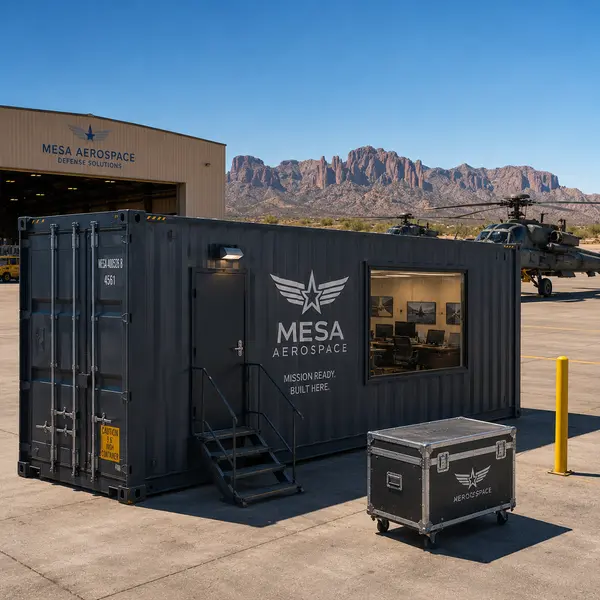
Mesa, Arizona is home to the Boeing AH-64 Apache attack helicopter production facility — one of the most significant defense manufacturing operations in the American Southwest. The Boeing Mesa facility produces and modifies Apache helicopters for the US Army and international customers, and it anchors a defense and aerospace supply chain that extends through the East Valley and into the broader Phoenix metropolitan area. Mesa Gateway Airport, located in southeast Mesa on the former Williams Air Force Base, serves as the hub for a cluster of aircraft maintenance, repair, and overhaul (MRO) operations that make Mesa one of the most active aerospace industrial centers in the region.
This guide covers how Boeing supply chain partners, Gateway Airport MRO operators, and defense contractors in Mesa use shipping containers — with detail specific to the logistics requirements of aerospace manufacturing and MRO operations that differ from general industrial use. For pricing and delivery from the Phoenix depot 14 miles west, the Mesa container delivery page covers current 40ft inventory and the quote process.
Aerospace Manufacturing Supply Chain Applications
The Boeing Mesa facility operates as a final assembly and modification center — components arrive from Boeing suppliers and partner companies throughout the country, and the Mesa facility assembles and modifies the finished aircraft. That supply chain model creates specific staging requirements for components that arrive before the assembly window is ready for them:
Rotorcraft component staging. Apache helicopter components — rotor assemblies, drive train components, avionics systems, weapons system interfaces — arrive from Tier 1 suppliers on coordinated delivery schedules. When a component arrives ahead of the installation sequence, it needs a controlled, secure, organized staging hold close to the facility. A container positioned at the facility perimeter provides a weather-protected hold that keeps sensitive components in manufacturer-specified storage conditions through the buffer period, without requiring space allocation inside the controlled facility environment.
Government-furnished equipment (GFE) staging. US Army and Foreign Military Sale contracts involve government-furnished equipment — weapons systems, avionics, and specialized components that the government provides to Boeing for installation. GFE has specific custody and accountability requirements: it must be inventoried, tracked, and stored in a controlled environment. A container with a documented lock-and-key protocol and an access log serves as a compliant GFE staging environment for components awaiting installation sequencing.
Modification kit staging. Boeing Mesa performs significant modification work on fielded Apache helicopters — block upgrades, system modernizations, and configuration changes that bring older airframes up to current specifications. Modification kits — organized sets of components for a specific modification package — arrive ahead of the aircraft and need to be held in kit integrity until the aircraft enters the modification line. A container dedicated to a specific modification kit keeps the components organized and accessible without mixing with other kits or facility inventory.
MRO Operations at Mesa Gateway Airport
Mesa Gateway Airport hosts a cluster of aircraft maintenance, repair, and overhaul operations — commercial airline heavy maintenance, aircraft painting, avionics modification, and helicopter overhaul — that use containers in ways that reflect the specific logistics of MRO work:
Aircraft-on-ground (AOG) parts staging. MRO operations manage AOG situations — aircraft that cannot fly because of a specific parts shortage — as their highest-priority logistics challenge. Parts ordered for AOG resolution arrive at the MRO facility on expedited shipment and need to be staged immediately upon arrival for transfer to the hangar floor. A container positioned at the MRO facility receiving dock serves as an organized AOG parts hold that keeps urgent components immediately accessible without disrupting the normal parts receiving and storage workflow.
Rotable parts management. MRO operations work with rotable components — expensive, repairable parts that cycle between service, removal, overhaul, and reinstallation. Managing rotable inventory requires clear physical segregation between serviceable, unserviceable, and in-process components to maintain airworthiness certification. A container dedicated to rotable staging provides a physical segregation point that keeps regulatory compliance straightforward — serviceable rotables in one area, unserviceables in another, with clear visual and physical separation between the two states.
Tooling and GSE storage. Aircraft MRO operations use specialized ground support equipment — engine test stands, aircraft jacking equipment, avionics test sets, specialized torque equipment — that is expensive, precision-calibrated, and needs organized storage between uses. A 40ft high-cube container provides sufficient volume for a meaningful GSE inventory at 9ft 6in interior height, with enough vertical clearance for tall equipment that must be stored upright. The steel construction keeps GSE in better condition than outdoor exposure or unconditioned storage areas in the Mesa desert environment.
Defense Contractor and Supply Chain Applications
The broader defense contractor ecosystem that supports Boeing Mesa and the Gateway Airport operations uses containers across a range of supply chain functions:
Classified component staging (non-classified containers). While containers themselves are not approved for classified material storage without specific modifications and documentation, the supply chain that feeds classified programs includes many unclassified components — structural parts, commercial off-the-shelf electronics, ground support consumables — that need organized staging adjacent to controlled facilities. A container at the facility perimeter serves as an organized unclassified parts hold that keeps controlled facility space available for operations requiring classified environments.
Technical data and documentation staging. Defense programs generate significant volumes of technical documentation — engineering drawings, test records, acceptance data packages — that must be maintained and accessible throughout the program lifecycle. A container configured as a secure document storage unit, with appropriate environmental controls for paper and digital media, provides an organized documentation hold at or near the program facility.
Field support equipment staging. Boeing and its defense contractor partners provide field support — technical assistance, parts support, training equipment — to Army installations operating the Apache. Field support operations stage equipment at Mesa before deployment to installations. A container at the Mesa facility serves as a centralized staging point for field support kits awaiting deployment authorization.
Delivery to Aerospace Facilities in Mesa
Aerospace and defense facility deliveries in Mesa require coordination that differs from standard commercial delivery:
- Security clearance and visitor control. Boeing Mesa and the controlled facilities at Gateway Airport have visitor control procedures. The delivery truck driver does not hold a facility clearance — delivery is coordinated through an unclassified receiving point at the facility perimeter, not through a classified area. Confirm the receiving point and access procedure with the facility security officer or receiving department before scheduling delivery.
- Vehicle inspection. Some defense facilities require vehicle inspection before entry. The delivery truck and its cargo (an empty shipping container) are generally straightforward to inspect, but the inspection process adds time to the delivery — schedule a delivery window that accommodates the inspection time without creating a scheduling conflict.
- ITAR compliance awareness. International Traffic in Arms Regulations (ITAR) govern the export control requirements around defense articles and technical data. A container itself is not an ITAR-controlled item. However, if the container will be used to stage ITAR-controlled components, discuss the storage requirements with your export compliance officer before positioning the container — specific access control and documentation requirements may apply to ITAR item storage.
For standard residential and commercial deliveries throughout Mesa — Dobson Ranch, Eastmark, Red Mountain, the Gilbert Road corridor — standard delivery requirements apply. Current 40ft inventory and pricing from the Phoenix depot are at the Mesa container page. For aerospace facility delivery coordination, call (800) 223-4755 before placing the order online. Mesa Development Services permit questions: (480) 644-4273.