


Shipping Containers for Warehouse and Logistics Operations in San Bernardino, CA — Inland Empire Guide
Written on June 7, 2026
by Anna Nichita
In the following categories: Container Use Cases
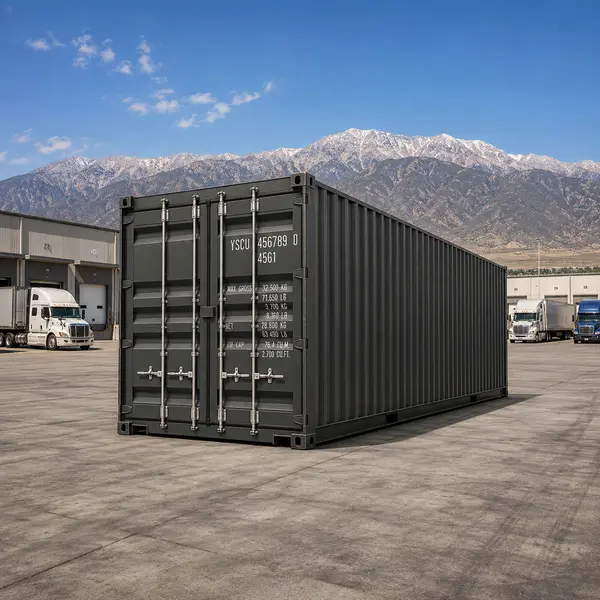
The Inland Empire is the logistics backbone of Southern California. San Bernardino sits at its western anchor — where the I-10, I-215, and I-15 converge and where goods arriving at the Port of Long Beach disperse east toward the rest of the country. The concentration of warehouse space, distribution centers, last-mile fulfillment hubs, and freight infrastructure in and around San Bernardino is among the densest in the United States, and shipping containers have become standard yard equipment across that entire ecosystem.
This guide covers how warehouse operators, last-mile carriers, and logistics businesses in San Bernardino use shipping containers — with detail on which configurations match which operational use cases, what the delivery and site requirements look like for an industrial yard, and how the economics of container purchase compare to alternatives in the Inland Empire market. For current inventory and pricing from the Long Beach depot 57 miles west, the San Bernardino container delivery page covers available configurations and the quote process.
Why Logistics Operators in San Bernardino Use Shipping Containers
The San Bernardino logistics corridor generates container storage demand from a specific set of operational pressures that differ from general commercial or residential use:
- Peak season overflow capacity. E-commerce fulfillment volumes spike 3–4x between October and January. Permanent building square footage is sized for average throughput, not peak — a 40ft container positioned in the truck yard provides immediate overflow capacity for pre-season inventory buildup without a construction or lease timeline.
- Carrier equipment and supplies staging. FedEx and UPS last-mile operations in San Bernardino maintain significant inventories of driver supplies, packaging materials, scanning equipment, and vehicle maintenance parts. A container near the outbound staging area keeps these supplies accessible without pulling them from the main facility's operational space.
- Damaged goods and returns segregation. E-commerce return rates run 15–30% by product category. Returns processing requires segregated holding space away from active fulfillment operations — a container positioned at the returns dock creates a controlled hold for unprocessed returns without consuming sortation floor space.
- Temporary labor infrastructure. Peak-season headcount expansions require temporary break rooms, equipment cages, and supply stations that aren't in the permanent facility layout. Modified containers fill these needs without permanent construction.
The San Bernardino International Airport Logistics Park
The redevelopment of the former Norton Air Force Base into the San Bernardino International Airport and its surrounding logistics park has created one of the more active container markets in the inland corridor. The logistics park hosts cold chain operators, heavy cargo handling, and freight forwarding businesses that work directly with air cargo movement — a different demand profile from standard e-commerce fulfillment:
Temperature-transition staging. Cold chain operators moving product between air cargo and ground transport frequently need a temperature-neutral staging hold between the aircraft and the refrigerated truck. A standard container doesn't provide active refrigeration, but it does provide a weather-sealed, shaded transition environment that slows temperature rise during short-duration transfers better than open dock exposure.
Bonded cargo hold. Freight awaiting customs clearance or transfer documentation needs a controlled, lockable hold. A container with a lock box provides a compliant, auditable holding environment for bonded freight — more economical than renting warehouse space for individual shipments awaiting clearance.
Ground support equipment storage. Aviation logistics operations accumulate significant inventories of ground support equipment — dollies, cargo loaders, tow bars, nets, and strapping — that needs dry, organized storage between flights. A container near the apron or cargo handling area provides accessible storage without requiring a dedicated building.
Cross-Dock and Distribution Center Applications
San Bernardino's position on the I-10 corridor makes it a natural cross-dock location for freight moving between the Port of Long Beach and destinations east of California. Cross-dock and transshipment operations use containers in several distinct ways:
Trailer yard overflow. Cross-dock operations with constrained trailer yard capacity use containers as fixed supplemental storage for loads that miss their outbound window. A 40ft container holds one full truckload of standard palletized freight at 2,390 cubic feet — equivalent to a 53-foot trailer at approximately 70% cube utilization. The container holds the load securely without tying up a trailer.
Split-load consolidation. Loads that arrive as partial shipments from multiple origins need a consolidation hold before the outbound vehicle is loaded. A container serves as a fixed consolidation point that eliminates the need to hold an outbound trailer at dock while partial loads accumulate.
Hazmat segregation. Freight containing hazardous materials requires physical segregation from non-hazmat freight under DOT and OSHA regulations. A dedicated container for hazmat holds provides a compliant segregation point — confirm applicable regulations with your safety officer, as specific requirements vary by hazard class and quantity.
Choosing the Right Container Configuration for Logistics Use
Configuration choice matters more in a logistics environment than in most other container applications — the frequency and method of access drive the selection:
- 40ft high-cube — the default for most Inland Empire logistics applications. 9ft 6in interior height accommodates vertical racking, pallet stacking to 96-inch height, and tall equipment. The extra 300 cubic feet over a standard 40ft unit adds up across a high-turn operation.
- 40ft standard — appropriate where overhead clearance at the placement location limits the high-cube. Lower profile can also simplify integration with existing rack systems at standard 8ft 6in heights.
- Double-door — cargo doors at both ends allow drive-through access. Useful for high-frequency access operations where waiting for one end to clear before accessing the other creates throughput delays.
- 20ft standard — fits constrained yard footprints. Common for carrier supply staging at last-mile hubs where a 40ft unit would block truck circulation. Two 20ft units placed end-to-end provide the same volume as a 40ft at a smaller combined footprint cost.
Delivery and Site Requirements for Logistics Yards in San Bernardino
Industrial yard deliveries in San Bernardino are generally straightforward compared to residential or urban commercial deliveries — wide access roads, compacted aggregate surfaces, and established heavy vehicle clearances. A few logistics-specific considerations:
- Gate security procedures. Facilities with controlled access require pre-authorization of the delivery truck. Call (800) 223-4755 before ordering to confirm gate access requirements — driver name, truck plate, proof of insurance — so the delivery isn't held at the gate on arrival day.
- Dock height and placement proximity. If the container needs to be positioned adjacent to a dock door, confirm that the tilt-bed truck can maneuver into the required position without conflicting with active dock traffic. Container placement within 4–6 feet of a dock face typically requires a specific approach angle.
- Surface stability. Compacted aggregate and concrete surfaces handle the delivery truck weight without issue. Recently disturbed yard surfaces — after grading, utility work, or heavy rain — may need temporary matting along the approach. Confirm surface conditions before scheduling.
- Overhead obstructions. Canopy structures over dock doors, overhead power lines along the yard perimeter, and truck wash arches are the most common overhead clearance issues at San Bernardino logistics facilities. The delivery truck requires 15 feet of clearance throughout the entire approach.
Container Economics for Inland Empire Logistics Operators
The standard comparison for logistics operators is container purchase versus trailer repositioning cost or short-term container lease. In the San Bernardino market:
A used 40ft standard container purchased from the Long Beach depot costs approximately $1,667 delivered to most San Bernardino addresses. A short-term container lease in the Inland Empire runs $150–$250 per month plus delivery and pickup fees — purchase price is recovered in 8–12 months of equivalent lease cost, after which the purchased container carries no recurring cost and retains resale value in the active Southern California secondary market.
Purchased containers can be repositioned within a yard, transferred between facilities, or resold without restriction — flexibility that leased containers don't provide. For operations with year-round storage needs or recurring peak-season capacity requirements, purchase is the more economical position over a 1–3 year horizon in this market.
Current inventory and pricing for San Bernardino delivery are at the San Bernardino container page. For multi-unit orders or logistics facility delivery coordination, call (800) 223-4755.