

Shipping Containers for Government Infrastructure Projects: Procurement, Compliance, and Field Deployment
Written on March 20, 2026
by Adrian Stan
In the following categories: Container Shipping Industry
Government infrastructure projects — road and bridge construction, utility upgrades, public building renovations, military base improvements, and disaster recovery operations — use shipping containers for the same reasons private sector projects do: secure, weatherproof, on-site storage that deploys faster than any permanent structure. But the procurement process for government container purchases involves rules, documentation requirements, and compliance considerations that don't apply to commercial buyers.
This guide covers how public sector agencies and contractors working on government projects actually procure containers, what compliance requirements apply, and how the field deployment model works for infrastructure projects ranging from municipal maintenance operations to large federal construction programs.
How Government Agencies Buy Shipping Containers
Direct Purchase for Small Projects
For most state and local government agencies, container purchases below their small purchase threshold — typically $25,000–$250,000 depending on jurisdiction — can be made through simplified acquisition procedures. This means a purchasing officer can request quotes from multiple vendors, select the best value, and issue a purchase order without a formal competitive bid process.
For these purchases, government buyers need:
- Written documentation of at least three vendor quotes (for most jurisdictions above the micro-purchase threshold)
- Vendor SAM.gov (System for Award Management) registration confirmation for federal purchases
- A clear statement of work covering container specifications, delivery requirements, and acceptance criteria
YES Containers works with state and local government agencies, municipalities, and public sector contractors. Contact the team at 800-223-4755 or through the quote request form to initiate a government procurement quote with the documentation your purchasing office requires.
Competitive Bidding for Larger Purchases
For container purchases above your jurisdiction's simplified acquisition threshold, formal competitive bidding typically applies. Government procurement staff preparing an Invitation for Bid (IFB) or Request for Proposals (RFP) for container storage should specify:
- Container grade and condition. WWT (Wind and Water Tight), Cargo Worthy (CW), or New/One-Trip. Define which minimum grade is acceptable for your application — WWT for general field storage, CW for applications requiring structural certification.
- ISO dimensions. Specify exterior and interior dimensions to ISO standard rather than relying on generic size descriptions — this ensures bidders are quoting equivalent products.
- Delivery requirements. Address, access conditions, required delivery window, and whether a specific placement orientation is required.
- Inspection and acceptance criteria. Define what constitutes acceptable condition at delivery — door operation, seal integrity, floor condition, absence of holes or major structural damage.
- Warranty terms. Specify minimum warranty period for weather-tightness.
Contract Vehicle Purchases
Federal agencies and many state agencies have access to contract vehicles that allow container purchases without a separate competitive bid process. The most commonly used for container procurement:
- GSA Schedules (Multiple Award Schedule). GSA Schedule 51V (Hardware Superstore) covers portable storage containers. Federal agencies can order directly from schedule-holders at pre-negotiated prices.
- State purchasing cooperative agreements. Many states have cooperative purchasing agreements for construction materials and equipment that include containers. Texas SmartBuy, NASPO ValuePoint, and similar state cooperative programs are worth checking before initiating a separate competitive bid.
- IDIQ contracts. Large federal infrastructure projects often operate under Indefinite Delivery/Indefinite Quantity contracts that allow task-order purchases of storage equipment including containers.
Buy American Act and Domestic Content Requirements
Federal government purchases and federally funded state and local projects are subject to the Buy American Act (BAA) and its implementing regulations. For shipping containers, the BAA requirements create a specific compliance question: most new shipping containers are manufactured in China, which is not a domestic manufacturer under BAA definitions.
How this typically resolves in practice:
- Used containers are often treated as domestic goods for BAA purposes when they have been in domestic use — the "substantial transformation" doctrine can apply when a container has been modified, refurbished, or significantly processed in the US before purchase. This is a fact-specific determination and should be reviewed with your contracting officer.
- Non-availability exceptions are available when domestic manufacturers cannot meet the requirement at reasonable cost or in sufficient quantity. Container procurement regularly qualifies for non-availability exceptions given the limited US-based container manufacturing capacity.
- Trade Agreements Act (TAA) compliance applies to purchases covered by TAA-eligible contract vehicles. TAA allows purchase from designated countries' manufacturers — currently excluding China. This is a more significant constraint for new container purchases than BAA non-availability exceptions.
For any government container purchase where BAA or TAA compliance is a question, your contracting officer or agency legal counsel should review the specific procurement before award. This guide provides general orientation, not legal advice on specific compliance questions.
Field Deployment for Government Infrastructure Projects
Road and Bridge Construction
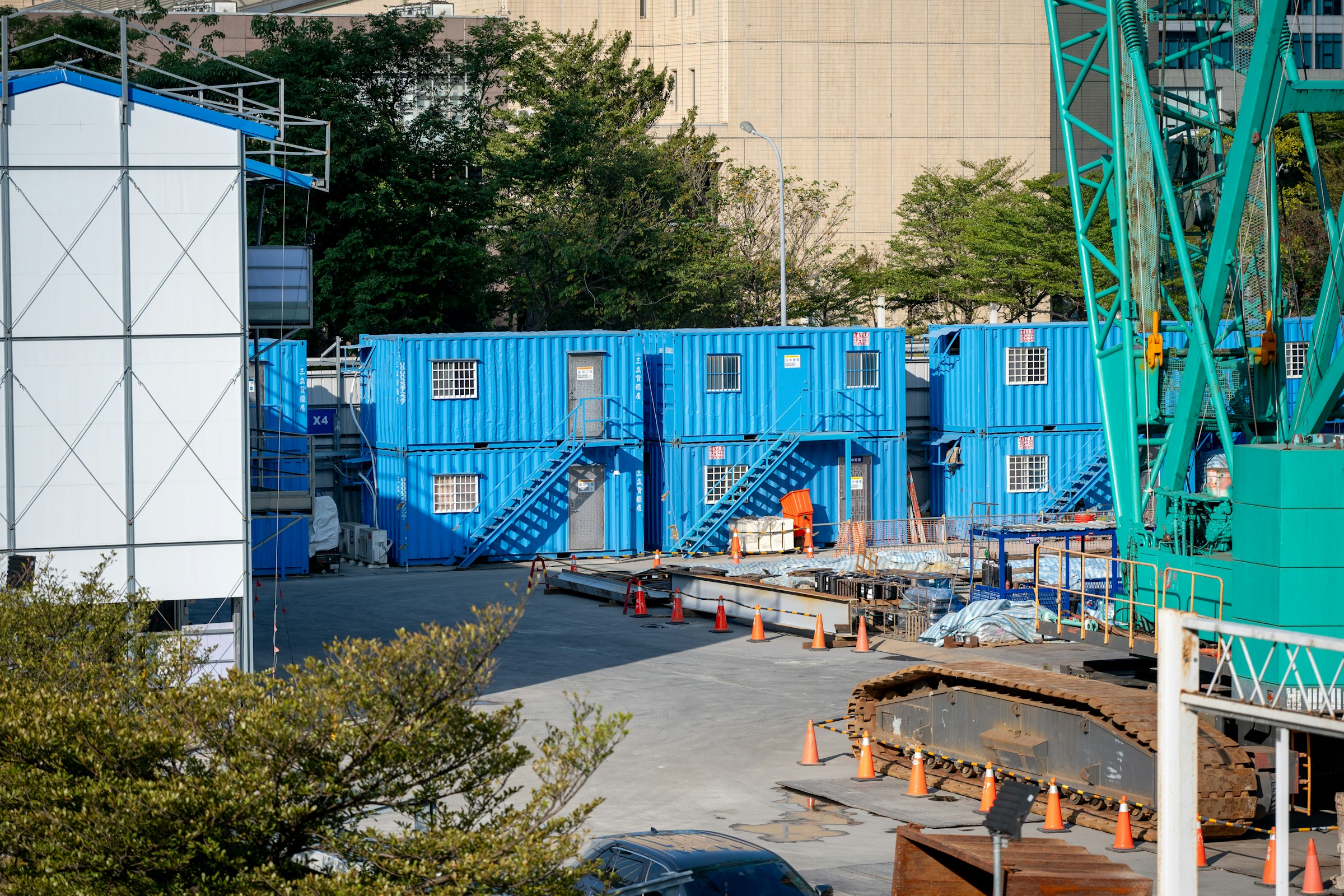
FHWA-funded road and bridge projects use containers for materials staging, tool and equipment storage, and temporary site offices at construction zones that span months or years. The deployment model typically involves one to three containers positioned at the active construction zone, relocated as the project progresses along the alignment.
Prevailing wage requirements under the Davis-Bacon Act apply to laborers and mechanics working on federally funded construction — including workers involved in container modification and installation if that work is performed on-site as part of the construction project. Pre-fabricated container modifications (windows, doors, electrical pre-wiring) done off-site before delivery are generally not subject to Davis-Bacon; on-site modification work by contractors may be. Review with your project labor compliance officer if in-place modifications are planned.
Water and Wastewater Infrastructure
EPA-funded water and wastewater projects — both construction and the ongoing maintenance operations of public water utilities — use containers for chemical staging, equipment storage, and emergency response pre-positioning. The chemical storage compliance requirements covered in the utility infrastructure guide apply equally to municipal water systems: secondary containment for liquid chemicals, appropriate ventilation, and state environmental agency documentation.
Emergency Management and Disaster Response
FEMA Public Assistance (PA) Program funding for disaster recovery projects includes eligible costs for temporary storage equipment used in debris management, emergency protective measures, and facility restoration. Government agencies coordinating container procurement under FEMA PA funding should document:
- Disaster declaration number and incident period
- Connection between the container purchase and an eligible PA category (Category A debris removal, Category B emergency protective measures, or Category C–G permanent work categories)
- Competitive procurement or documented exception justification
- Actual use documentation for the container during the project period
Proper documentation from the start of container procurement protects against audit findings and reimbursement clawbacks in the PA closeout process. The disaster recovery contractor guide covers the operational deployment side of emergency container logistics.
Military and Federal Facility Projects
Military construction (MILCON) and federal facility maintenance projects use containers extensively for staging areas on active installations. Access to military installations for container delivery requires coordination with the installation's Directorate of Public Works (DPW) and in most cases a base access pass for the delivery driver and vehicle. Allow additional lead time — typically two to four weeks — for access coordination beyond standard commercial delivery scheduling.
OCONUS (overseas) military projects have different procurement and logistics requirements outside the scope of this guide.
Container Specifications for Government Projects
| Container Type | Starting From | Government Application | Key Specification Note |
|---|---|---|---|
| Used 20ft Standard | From $1,534 | Road project tool staging, small maintenance sites | Fits in constrained right-of-way staging areas; easiest to relocate as project progresses |
| Used 40ft Standard | From $1,837 | Multi-trade construction staging, materials storage | Maximum storage capacity; WWT grade appropriate for most public sector applications |
| Used 40ft High Cube | From $1,837 | Equipment with height requirements, racking systems | Same price as standard at some depots — worth specifying high cube by default |
| New 40ft High Cube | From $3,352 | Site offices, inspection facilities, clean interior required | Specify when BAA/TAA non-availability exception is documented; clean interior for occupied space |
Prices shown reflect current Houston depot pricing as a representative US market reference. Government procurement quotes should reference your specific delivery address for accurate delivered pricing.
Documentation for Government Procurement Records
Government purchasing files should include:
- Specifications used for the solicitation or quote request
- At least three competitive quotes (or sole-source justification if applicable)
- Price reasonableness determination
- Vendor SAM.gov registration (for federal purchases)
- Buy American/Trade Agreement compliance determination or documented exception
- Delivery confirmation and acceptance documentation
YES Containers can provide quote documentation, product specifications, and delivery confirmation in formats compatible with government procurement files. Call 800-223-4755 to discuss documentation requirements for your specific procurement, or request a quote online.