

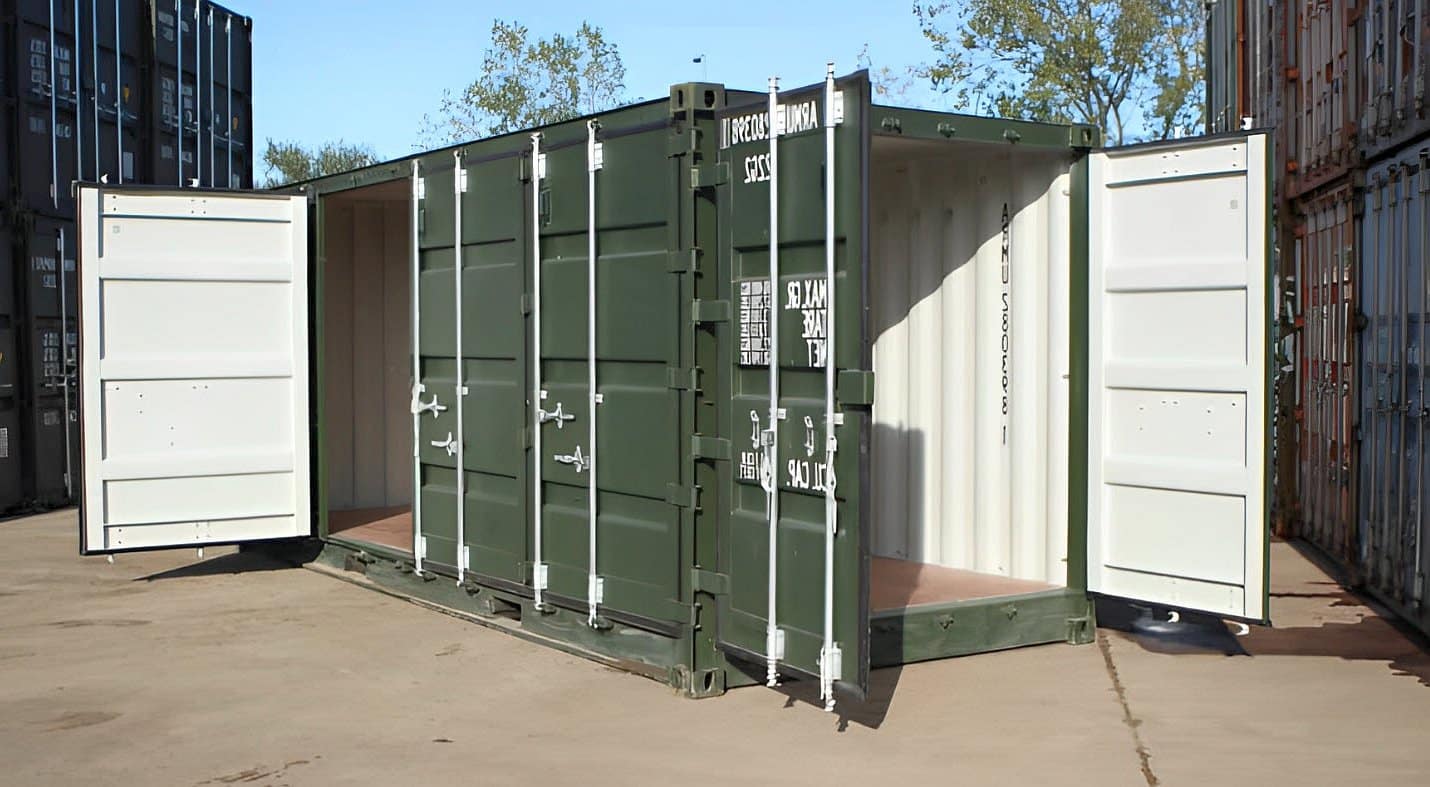

What Is a Conex Box? The History, Military Origins, and Why the Name Still Matters
Written on February 16, 2026
by Adrian Stan
In the following categories: Did you know?
The term "Conex box" gets used casually to mean any steel storage container, but it has a specific origin that's worth understanding — both for historical context and because that history directly explains why the standard ISO shipping container is the shape and size it is today. The Conex story is one of the early chapters in the containerization revolution that reshaped global trade in the second half of the twentieth century.
Where "Conex" Comes From
"Conex" is a contraction of "Container Express" — the name of a logistics system developed by the United States Army in the early 1950s. The system was formally introduced around 1952 to address a persistent problem in military logistics: moving large volumes of equipment and supplies efficiently across long distances without constant repacking at every transfer point.
The original Conex container was a steel box approximately 8.5 feet long, 6.25 feet wide, and 6.5 feet tall — significantly smaller than the 20ft and 40ft containers that dominate global trade today. It was designed to be handled by standard military forklifts, loaded once at the origin point, transferred between trucks, rail cars, and ships without unloading, and delivered as a sealed unit to the end destination.
The system was deployed extensively during the Korean War (1950–1953) and became standard in US military logistics through the Vietnam War era. By the late 1960s, the US military had hundreds of thousands of Conex containers in the supply chain. The efficiency gains over the previous pallet-and-breakbulk system were dramatic — the same cargo that required dozens of longshoremen to handle in loose stacks could move in sealed containers handled by a handful of operators with mechanical equipment.
How the Military Conex Influenced the Commercial Container Revolution
The commercial containerization revolution that transformed global trade is most commonly associated with Malcolm McLean, a trucking entrepreneur who pioneered the standardized commercial intermodal container in 1956. McLean's insight — that the entire truck trailer body (or a box equivalent to it) could be loaded directly onto a ship without unloading cargo — produced the first commercial container shipping service on April 26, 1956, when the Ideal-X sailed from Newark to Houston carrying 58 containers on deck.
The US military's Conex system preceded and influenced this commercial development. The Army had already demonstrated the core principle — standardized, sealed boxes that transfer between transport modes without unloading — at large scale through the Korean and Vietnam supply chains. McLean's commercial innovation built on this proof of concept and scaled it with larger containers optimized for ocean-going vessels.
The ISO standardization that followed — establishing the 20ft and 40ft container dimensions that dominate global trade today — was driven by the need to create a single specification that both commercial shipping lines and military logistics could use. The International Organization for Standardization published the container dimensions and corner casting specifications in the 1960s, and those dimensions have remained the global standard ever since.
Why the Name Persisted in Civilian Use
The Vietnam War produced an enormous surplus of military Conex containers. As the US military drew down its forces and logistics footprint in the late 1960s and early 1970s, large numbers of surplus Conex boxes entered the civilian market through government surplus sales. Construction companies, farmers, and businesses bought them at auction prices for on-site storage — and the name "Conex" traveled with the boxes.
In the construction industry particularly, "Conex box" became the standard term for a job site storage container. The association stuck through subsequent decades even as the surplus military containers were replaced by commercially-sourced ISO containers. Today, a construction superintendent asking for a "Conex" on a job site is asking for a standard 20ft or 40ft ISO shipping container — the same unit everyone else calls a shipping container — using terminology that traces directly to the 1950s Army logistics system.
Original Conex vs. Modern ISO Container: What Changed
The original military Conex boxes were smaller than modern ISO containers and built to military specifications rather than commercial intermodal standards. The modern containers sold under the "Conex box" name are ISO-standard containers:
| Feature | Original Military Conex | Modern ISO Container ("Conex") |
|---|---|---|
| Length | ~8.5 ft | 20ft or 40ft standard |
| Width | ~6.25 ft | 8ft standard |
| Height | ~6.5 ft | 8'6" standard or 9'6" high cube |
| Material | Steel, military spec | COR-TEN weathering steel, ISO spec |
| Door type | Swing doors, military hardware | Double cargo doors, cam-lock rods |
| Intermodal compatible | Limited (truck/rail/ship but non-standard) | Fully compatible with global handling equipment |
| Stacking rating | Limited | 8 high loaded (ISO standard) |
Genuine original military Conex boxes from the 1950s–1970s are occasionally available through military surplus channels and are collectible, but they're not interchangeable with modern ISO containers for storage or construction purposes — their smaller dimensions and non-standard specifications make them less useful than the 20ft and 40ft ISO units that share their name.
Where the Term "Conex" Is Used Today
"Conex box" is most commonly used in:
- Construction and trades: The most common civilian context. Job site storage containers are almost universally called "Conex boxes" in the construction industry regardless of their actual origin.
- Military and government: Active military logistics still uses Conex terminology for storage containers. The modern military also uses MILVAN (military van container) and other specific designations for different container types.
- Agricultural and rural: In farming communities, particularly in the central and western US, "Conex" is common terminology for farm storage containers.
- General storage buyers: Many buyers search for "Conex box for sale" specifically — these buyers are looking for the same product as those searching for "shipping container for sale."
Buying a "Conex Box": What You're Actually Getting
When you purchase what's marketed as a Conex box from a commercial container supplier today, you're buying a standard ISO intermodal container — not a military surplus Conex from the 1950s. The specifications that matter for your purchase:
- Condition grade: WWT (Wind and Water Tight) for most storage applications; cargo-worthy (CW) if you need structural certification; new one-trip if you want clean interiors
- Size: 20ft for compact/constrained sites; 40ft for maximum volume; high cube if height matters
- Door configuration: Standard cargo doors on one end; double door (both ends) for pass-through access; side door for mid-container access
The history is interesting, but the purchase decision comes down to the same variables as any container — condition, size, and delivered cost to your location. Browse by size: used 20ft · used 40ft · new 40ft high cube. For more on what the terms mean, see the companion guides: cargo container vs. shipping container and what is a sea can.
Request a quote with your location, or call 800-223-4755.
