


Arctic Shipping Route 2026: The Ship Just Arrived — 4 Days Late, and at the Wrong Port
Written on September 9, 2026
by Adrian Stan
In the following categories: Container Shipping Industry, Did you know?, FAQ, Fresh, News
Arctic Shipping Route 2026: The Ship Just Arrived — 4 Days Late, and at the Wrong Port
Last updated: 9 September 2026 · By Adrian Stan, Founder, YES Containers
The Arctic shipping route just delivered its first scheduled container ship — and it arrived late, at the wrong port. The Dubai Tower docked in the United Kingdom today, Wednesday 9 September 2026, at 11:29 UTC. Sea Legend's published schedule had it in Felixstowe on 5 September. It moored at Teesport, on England's northeast coast, four days later. The voyage ran 7,844 nautical miles in 21 days from its last Chinese port, and about 25 days from Ningbo — against a service marketed on a 20-day transit.
Still far faster than the Suez Canal. Just not the brochure number, and not the brochure port.
The voyage at a glance

| Item | Detail |
|---|---|
| Vessel | Dubai Tower (IMO 9433066) |
| Operator | Sea Legend Line Limited (Hong Kong, founded 2022) |
| Service | China–Europe Arctic Express (CAX), branded the "Ice Silk Road" |
| Size | 1,740 TEU capacity · 575 ft (175 m) · built 2010 · Liberia flag |
| Cargo | Roughly 1,300 containers of electric vehicles, lithium batteries and renewable energy equipment |
| Left Ningbo-Zhoushan | 15 August 2026 |
| Left final Chinese port (Qingdao) | 19 August 2026 |
| Route | Bering Strait → Northern Sea Route along Russia's Arctic coast → Barents Sea → Norwegian Sea → North Sea |
| Scheduled arrival | Felixstowe, 5 September 2026 |
| Actual arrival | Teesport, 9 September 2026, 11:29 UTC |
| Distance run | 7,844 nautical miles · 21 days · avg 15 knots |
| Coldest temperature recorded | −1.3°C |
Position and timing data confirmed against live AIS tracking for the Dubai Tower and Reuters coverage of the arrival.
What is the China–Europe Arctic Express?
The China–Europe Arctic Express (CAX) is the first scheduled, repeating container service between Asia and Europe to use the Arctic shipping route instead of the Suez Canal. Sea Legend has programmed eight weekly westbound sailings from Ningbo-Zhoushan between 15 August and 3 October 2026, with the final European arrival set for 24 October.
Seven vessels are licensed for the season, ranging from roughly 962 TEU to 4,890 TEU, with ice classes 1A, 1C and 1D: Dubai Tower (running two voyages), Riyadh Mukaab, Athens Odeon, Istanbul Bridge, Tiger Maanshan, Tiger Bintulu and Tiger Lianyungang. The full 2026 CAX sailing programme was published in July.
This follows a single proof-of-concept run in 2025. The 4,890 TEU Istanbul Bridge left Ningbo-Zhoushan on 23 September 2025 carrying about 4,000 TEU and reached Felixstowe on 13 October — roughly 20 days, after slowing for Storm Amy in the Norwegian Sea. It then called at Hamburg and reached Gdansk on 19 October, 26 days out from China.
The distinction matters. 2025 was one ship proving a point. 2026 is a published timetable, and a timetable can be measured against.
How long does the Arctic shipping route take compared to Suez?
| Route | China → North Europe transit |
|---|---|
| Arctic shipping route (marketed) | 20–21 days |
| Arctic shipping route (Dubai Tower, actual) | 21 days from Qingdao, ~25 from Ningbo |
| Suez Canal | 30–40 days |
| Cape of Good Hope | ~50 days |
| China–Europe rail freight | ~25 days |
Even at 25 days, the Arctic shipping route beats Suez by a wide margin. That is the honest headline. The route is genuinely faster — it simply isn't yet as fast, or as predictable, as advertised. The first scheduled sailing is the fairest test anyone has, and it slipped four days and changed destination port.
Why is this happening now?
Three forces are stacked on top of each other.
Ice. Summer Arctic sea ice has retreated far enough to open a reliable window for a few months a year. Russia's Rosatom administers the Northern Sea Route in 28 designated sections and completed permitting for the 2026 season, which runs into November.
Risk on the old routes. Red Sea attacks and Middle East instability pushed a lot of Asia–Europe tonnage onto the long way around Africa. The Arctic sidesteps both Suez and Hormuz entirely.
Fuel. Fuel is roughly 70% of a ship's at-sea cost. Cut the distance by a third and the arithmetic changes on its own. There's a cargo argument too: without refrigeration, box interiors on the Suez route can reach 60°C, while the Arctic run stays cold. That suits lithium batteries, solar modules and EV components — which is broadly what the Dubai Tower was carrying.
Arctic container transits hit a record 23 in 2025, up from 15 in 2024. Sea Legend isn't alone anymore either: South Korea's PanStar Group ran a pilot from Busan on 22 August 2026 with a Hamburg arrival targeted for 12 September, cutting a typical 43-day run to about 24.
Why the Arctic shipping route still won't replace the Suez Canal
Here's the part most coverage skips — and today's arrival makes it sharper, not softer.
- It's seasonal. Eight sailings, August to October. A lane that works four months a year is a supplement, not a backbone.
- The ships are small. 1,740 TEU is a rounding error next to the 20,000+ TEU vessels on the Asia–Europe mainline, and the Dubai Tower sailed with about 1,300 boxes aboard.
- Voyage one slipped. Weather delayed departure, the ship ran four days late, and it discharged at a different port than the one on the schedule. Shippers buy reliability, not best-case math.
- Insurance, ice class and icebreaker support add real cost that partly eats the fuel savings.
- The big carriers have opted out. CMA CGM, MSC and Hapag-Lloyd have all publicly pledged to avoid Arctic trans-shipment routes.
- The politics are heavy. The route runs the full length of the Russian Arctic coast under Russian permitting.
- Environmental groups warn that rising traffic accelerates the very ice loss that opened the route.
Our read: the Arctic shipping route is a real, useful, time-sensitive premium lane for specific cargo in a specific season. It is not a Suez replacement, and anyone selling it as one is ahead of the evidence.
What does the Arctic shipping route mean for shipping container prices in the United States?
Directly? Very little — and we'd rather tell you that plainly than sell you a scare.
A few thousand containers moving from China to northern Europe over eight weeks does not move the U.S. container market. The U.S. supply of used and one-trip containers is set by different things entirely: how many boxes carriers reposition into American ports, how many are retired from service each year, steel prices, chassis and trucking capacity, and how far a container has to travel inland from the nearest depot.
Where it is worth watching, over years rather than months:
- Box repositioning follows trade lanes. Any lasting shift in where containers get unloaded eventually changes where surplus boxes pile up — and surplus depots are where the U.S. used-container supply comes from.
- Shorter voyages mean faster turns. A container completing more round trips per year spends fewer of its working years in any one place, which affects how quickly boxes age out of the fleet and into the resale market.
- Route diversification calms freight spikes. More viable lanes generally mean less violent rate swings, and container resale prices track ocean freight rates loosely but persistently.
None of that changes what a 20ft box costs in Ohio this month. It's context, not a forecast — and we'll say so clearly if that ever changes.
What actually determines what you pay for a container in the U.S.
If you're buying a container for storage, a jobsite, a farm, a shop or a build, four things set your delivered price:
- Condition. One-trip (used once from the factory, near-new) versus cargo-worthy versus wind-and-water-tight. The gap between conditions is usually larger than the gap between sizes.
- Size and type. 20ft standard, 40ft standard, 40ft high cube, side door, full open side. High cubes add a foot of interior height; open-side units trade some structure for full-length access.
- Distance from the nearest depot to your ZIP code. This is the biggest swing factor, and it's why any advertised price without a ZIP code attached is a guess.
- Site access. A tilt-bed delivery needs roughly 100 feet of straight clearance for a 40ft box. If your site can't take that, you need a crane or a different plan — better to know before the truck rolls.
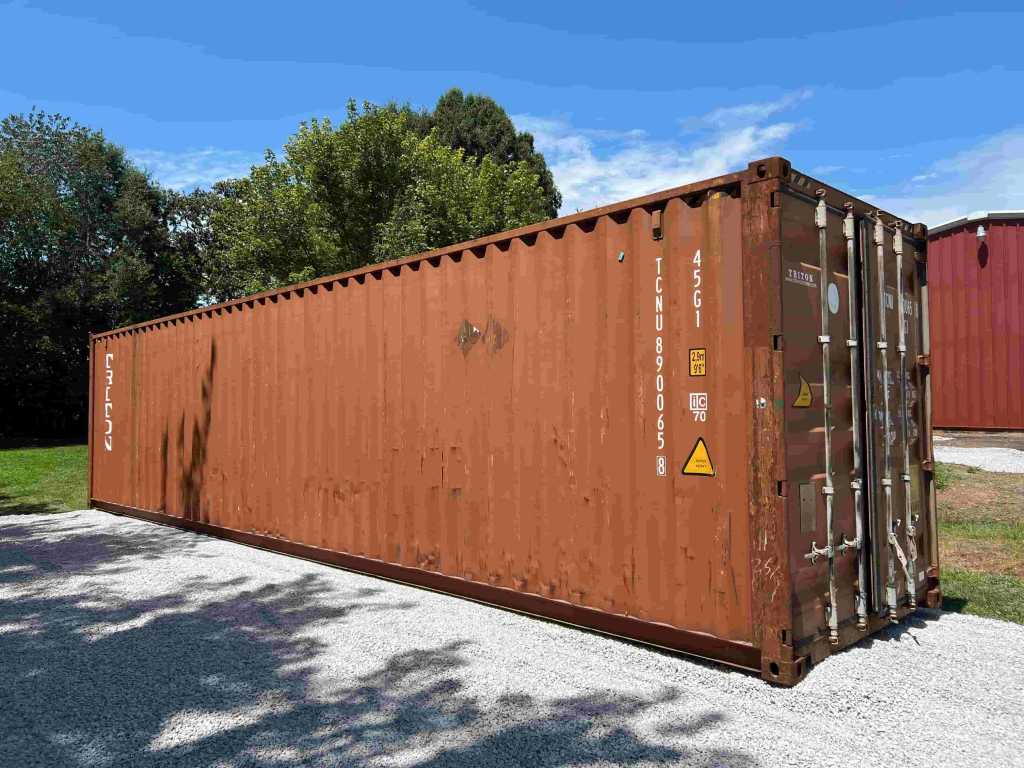
At YES Containers we deliver new one-trip and used containers to all 48 continental states, and we run Pay on Delivery: you pay when the container is on your ground, not before. New customers can use code NEW100, and we hold a standing discount for military and first responders.
Get a delivered price to your ZIP code → or call 800-223-4755.
Frequently asked questions
Did the Arctic shipping route ship arrive? Yes. The Dubai Tower docked at Teesport in the United Kingdom on 9 September 2026 at 11:29 UTC, completing the first scheduled container voyage on the Arctic shipping route from China to Europe. It arrived four days after its published Felixstowe date of 5 September, and at a different port than scheduled.
How long did the Arctic voyage actually take? 21 days from Qingdao, its final Chinese port, covering 7,844 nautical miles at an average of 15 knots. From its original Ningbo-Zhoushan departure on 15 August, the total was about 25 days — against a marketed transit of 20 days.
What is the Northern Sea Route? The Northern Sea Route runs from the Bering Strait along Russia's Arctic coast to the Barents Sea, connecting the Pacific to northern Europe over the top of Russia. It is administered by Rosatom in 28 sections, and vessels need a permit and sometimes icebreaker escort.
How much time does the Arctic shipping route save? About 10 to 20 days versus the Suez Canal, and roughly 25 days versus the Cape of Good Hope. The first scheduled 2026 sailing came in at 21 days port-to-port against 30 to 40 days via Suez.
Is the Arctic shipping route safe? It is navigable in the summer window with an ice-classed hull, polar certification, a trained crew and icebreaker support on standby. It is not comparable to Suez for year-round reliability, and major carriers including CMA CGM, MSC and Hapag-Lloyd have said they will avoid it.
Will Arctic shipping make shipping containers cheaper in the U.S.? No, not in any measurable way in 2026. U.S. container prices are driven by depot inventory, steel costs, retirement rates and inland trucking distance, not by an eight-week seasonal service between China and Europe.
How much does a 20ft shipping container cost in the United States? It depends on condition and how far you are from the nearest depot — delivery is often the largest single line item. Get a delivered quote against your actual ZIP code rather than working from a national average.
What's the difference between a one-trip and a used shipping container? A one-trip container has made a single loaded voyage from the factory, so it's structurally near-new with clean paint and tight seals. A used cargo-worthy container has years of service on it: sound and watertight, but with dents, patches and surface rust. One-trip costs more and looks it.
What's the difference between a 20ft and a 40ft container? A 20ft holds roughly 1,170 cubic feet, a 40ft roughly 2,390. A 40ft high cube adds about a foot of interior height. The 40ft is usually cheaper per cubic foot; the 20ft is easier to place and needs less delivery clearance.
Do I need a permit to put a shipping container on my property? It depends entirely on your county and municipality. Some jurisdictions treat a container as a temporary structure requiring nothing; others require a permit, a setback, or screening. Check with your local zoning office before you buy.
How is a shipping container delivered? Most deliveries use a tilt-bed truck that slides the container off onto level ground. A 40ft delivery needs roughly 100 feet of straight, firm clearance and about 14 feet of width. Tight or sloped sites may need a crane or forklift instead.
Sources
- Reuters — Dubai Tower arrival at Teesport, 9 September 2026
- MyShipTracking live AIS data, Dubai Tower (IMO 9433066)
- Linerlytica — Sea Legend's eight CAX sailings for the 2026 season
- The Maritime Executive — Sea Legend's "Ice Silk Road" service launch
- Arctic Portal — China launches regular Arctic container service to Europe
- Polar Journal — China launches Arctic liner service to Europe