


The Container Home Market Study: $18.8 Billion in 2024 and Where the Growth Is Actually Happening
Written on May 9, 2026
by Gabriel B.
In the following categories: Shipping Container Studies
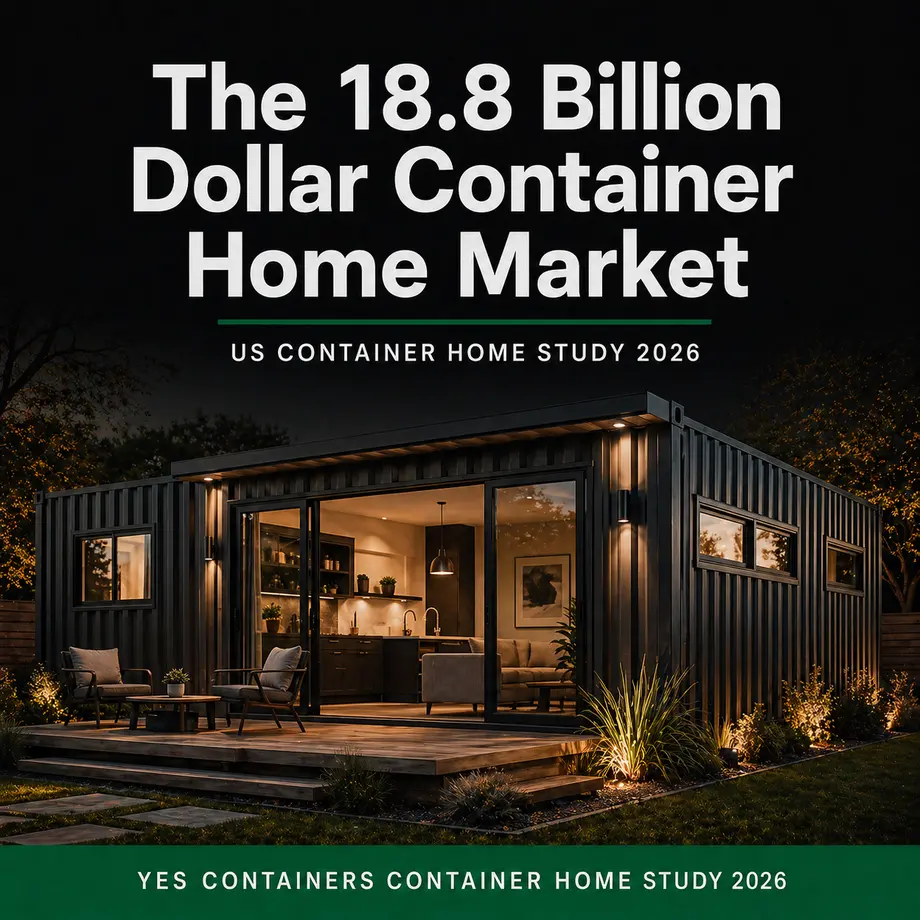
The container home market in the United States reached an estimated $18.82 billion in 2024 and is projected to reach $36.79 billion by 2034 — a near doubling driven by housing affordability pressure, remote work demand for accessory structures, and a wave of state-level ADU policy reform that is making alternative residential structures easier to permit than at any point in the country's history. This study examines where that growth is happening, who is driving it, what container homes and ADUs actually cost relative to traditional construction, and which states have created the most favorable regulatory environments for buyers considering a container home or accessory dwelling unit project.
The Container Home Market in Context
The container home market is a subset of the broader alternative and modular housing industry — itself a response to a housing affordability crisis that the Harvard Joint Center for Housing Studies described in 2025 as the worst since the mid-1990s. Homebuying fell to generational lows in 2024 as mortgage rates, insurance costs, and property taxes combined to make traditional homeownership inaccessible for a growing share of the population. Approximately 22.6 million renter households were cost-burdened in 2023 — paying more than 30% of income on housing — with 27% classified as severely cost-burdened at more than 50% of income.
That affordability pressure does not automatically translate into container home demand. Most cost-burdened renters cannot access container home projects because they lack land. What it does create is sustained interest in lower-cost alternative structures among the property-owning middle class — homeowners who have land but cannot afford traditional additions, buyers who want more living space than their mortgage allows, and rural property owners building primary or secondary structures where traditional construction costs are prohibitive relative to land value.
US Container Home Market Size and Projections
Sources: Industry analysis, Harvard Joint Center for Housing Studies 2025. Market size figures are modeled estimates — the container home segment is not separately tracked by federal statistical agencies.
The Three Sub-Segments of the Container Home Market
The container home market is not a single product category. It encompasses three structurally different sub-segments that overlap in the public conversation but differ significantly in cost, regulatory complexity, buyer profile, and geographic concentration.
Backyard accessory dwelling units and studios. The largest and fastest-growing sub-segment by unit count. A container ADU placed in a residential backyard — used as a guest house, rental unit, home office, or studio — requires significantly less regulatory navigation than a primary container home and is accessible to a much broader buyer population. ADU reform legislation has focused almost entirely on this category, making it the primary policy beneficiary of the land-use liberalization wave sweeping through state legislatures.
Primary container homes on owned land. Full container homes used as primary residences require the most complete regulatory navigation — building permits, structural engineering, foundation work, MEP systems, and in many jurisdictions review by the same process as a traditional stick-built home. This sub-segment has the highest per-unit cost, the longest project timeline, and the smallest buyer pool — but generates the highest average transaction value and the most media coverage relative to its actual unit volume.
Off-grid and rural container structures. Container homes and habitable container structures on rural land, agricultural property, or recreational land occupy a regulatory middle ground that varies significantly by jurisdiction. Many rural counties have minimal or no residential building code enforcement for structures on agricultural land, making off-grid container home projects practically accessible without the full permit process that urban and suburban projects require. This sub-segment is the least documented in published data and the most active in rural states with large agricultural land areas.
ADU Policy Reform: The Regulatory Tailwind Driving Container Home Market Growth
The single most significant driver of container home market growth since 2020 has not been a design trend or a material cost advantage — it has been ADU policy reform at the state level. A wave of legislation across more than a dozen states has materially reduced the barriers to building accessory dwelling units on existing residential lots, creating the regulatory environment in which container ADU projects can be permitted with far less friction than they faced five years ago.
California leads the national ADU permit count by a significant margin, accounting for an estimated 32% of all U.S. ADU permits according to industry tracking data. Washington state follows at approximately 6%, Oregon at 3%. The Furman Center's land use reform tracker identified meaningful ADU-related legislation in Arizona, California, Colorado, Iowa, Maine, Massachusetts, Montana, Oregon, and Washington in 2025 alone.
ADU Policy Reform Activity and Container Home Market Relevance by State
Sources: Industry ADU permit tracking, Furman Center land use reform tracker 2025, U.S. Census Bureau QuickFacts. Reform activity does not guarantee local permitting approval — municipality rules apply in all cases.
The critical caveat that the container home market conversation frequently glosses over: state-level ADU reform establishes a more permissive statewide framework but does not override local zoning codes in most cases. A property owner in Seattle can more easily navigate ADU permitting than they could in 2019 — but still must comply with Seattle-specific rules around setbacks, height limits, owner-occupancy requirements, and design standards. The reform wave makes container ADU projects more viable in principle; it does not make them automatic.
What Container Homes and ADUs Actually Cost
Container home cost is one of the most misrepresented figures in the alternative housing conversation. Social media coverage of container homes focuses heavily on outlier projects — both the impressively cheap and the impressively expensive — without establishing a reliable baseline for what a code-compliant, habitable container structure actually costs in the U.S. market.
| Project Type | Container Cost | Estimated Conversion Cost | Total Estimated Range |
|---|---|---|---|
| Basic backyard studio or office | $3,000 to $5,000 | $8,000 to $20,000 | $11,000 to $25,000 |
| Finished ADU with bathroom and kitchenette | $4,000 to $7,000 | $30,000 to $65,000 | $34,000 to $72,000 |
| Single container primary home | $4,000 to $8,000 | $50,000 to $120,000 | $54,000 to $128,000 |
| Multi-container home 2 to 4 units | $12,000 to $28,000 | $100,000 to $250,000 | $112,000 to $278,000 |
| Off-grid rural container cabin | $2,000 to $5,000 | $15,000 to $45,000 | $17,000 to $50,000 |
Conversion costs vary enormously by project scope, local labor rates, permit requirements, and finish level. The figures above represent mid-market U.S. contractor pricing for standard conversion packages — insulation, electrical, HVAC or mini-split, framing for interior walls, windows and doors, and basic plumbing where included. They do not include land cost, foundation work beyond basic container supports, site preparation, permitting fees, or interior finish upgrades beyond functional levels.
The critical comparison is not container home cost versus traditional home cost — it is container home cost versus the alternatives available to the specific buyer. A suburban homeowner adding a backyard studio in Colorado paying $20,000 total for a container and basic conversion is comparing that against a $60,000 to $120,000 traditional addition estimate that also requires full architectural drawings and structural permitting. A rural property owner in North Carolina building an off-grid cabin on agricultural land paying $35,000 for a converted container is comparing against $80,000 to $150,000 for a comparable stick-built structure with access road grading and well and septic installation.
The Buyer Profile: Who Is Actually Building Container Homes
Container home buyer demographics differ from the broader container market in important ways. The backyard ADU and studio sub-segment skews toward higher income homeowners — buyers with the property, the capital, and the regulatory sophistication to navigate local permitting. The YES Containers dataset confirms this at the transaction level: Denver, where the highest AOV in the dataset was recorded at $8,475 per unit for new 40ft high cube containers, is one of the strongest container ADU markets in the country and has a $94,718 median household income.
The off-grid and rural cabin sub-segment attracts a different buyer — property owners with rural land and a practical rather than aesthetic motivation. These buyers are not following social media container home trends. They are solving a real shelter or storage problem on land they already own, at a cost that traditional construction cannot match in remote locations. They are more likely to be purchasing used containers and doing more of the conversion work themselves.
The primary container home sub-segment attracts the most media attention and the smallest actual buyer pool. Full container home builds as primary residences require a combination of available land, regulatory tolerance, construction capital, and design commitment that limits the realistic buyer population to a small fraction of the housing market even in the most favorable regulatory environments.
Where Container Home Demand Is Strongest by Market
Container home market demand concentrates in states and markets where at least three of four favorable conditions exist simultaneously: high traditional construction costs that make alternatives financially attractive, ADU policy reform that creates a viable permitting pathway, homeownership rates that create a sufficient buyer pool with placement land, and income levels that support the conversion investment above and beyond the container purchase cost.
California meets all four conditions for the backyard ADU sub-segment — which explains its 32% share of national ADU permits. The state's construction costs are among the highest in the country, its ADU reform is the most aggressive nationally, its homeownership rate of 55.9% creates a large suburban property-owning buyer pool, and its income levels support substantial conversion investment. California container buyers in the ADU category are purchasing almost exclusively new containers — primarily new 40ft high cube units — because appearance standards and permit condition requirements favor new over used for habitable applications.
Colorado, Washington, and Oregon all meet three of the four conditions for the backyard studio and ADU sub-segment — with income levels, ADU reform activity, and construction cost premiums all supporting the conversion market. The Pacific Northwest and Mountain West are the most active non-California container conversion markets in the country by both permit activity and anecdotal dealer order evidence.
Texas and Florida have large homeowning populations and some rural land availability but less consistent ADU reform activity at the state level. Container home demand in both states concentrates more in rural off-grid structures than in suburban ADU applications — a pattern driven by local ordinance variability rather than statewide policy direction.
Container Home Market Estimated Sub-Segment Breakdown
Modeled estimates. Container home sub-segment data is not tracked by federal statistical agencies. Figures based on permit tracking, industry analysis, and market structure inference.
The Modification Stack: What a Container Home Actually Requires
Every container home project — regardless of sub-segment or market — requires a core set of modifications that convert a steel shipping box into a habitable structure. Understanding this modification stack is essential for buyers evaluating container home feasibility because it is where most cost estimation errors occur.
The non-negotiable modifications for any habitable container structure are insulation — either spray foam, rigid board, or a combination — to address the thermal bridging that makes uninsulated containers uninhabitable in most U.S. climates; electrical work including panel, wiring, outlets, and lighting to code; and some form of climate control, typically a mini-split heat pump system for both heating and cooling. These three elements alone can cost $15,000 to $30,000 depending on labor market and project scope before any finish work is considered.
Beyond the core stack, habitable projects typically require structural reinforcement where openings are cut for windows, doors, and pass-throughs between containers; foundation or support systems beyond basic corner blocks; plumbing rough-in for any bathroom or kitchen application; and finish work including flooring, wall finishing, and ceiling treatment that determines whether the interior reads as a functional workshop or a livable space.
The modification stack is why the container purchase price is the smallest cost component in most container home projects. A new 40ft high cube container at $5,000 to $7,000 represents 10% to 20% of the total project cost for a finished ADU. That proportion is important context for buyers who start the container home research process focused on container price and discover mid-project that the modification budget is three to five times the container cost.
Key Findings
- The U.S. container home market reached an estimated $18.82 billion in 2024 and is projected to reach $36.79 billion by 2034 at a 6.91% CAGR — driven by housing affordability pressure, remote work demand, and ADU policy reform.
- Backyard ADU and studio conversions are the largest container home sub-segment by unit count at approximately 55% of the market — the primary beneficiary of state-level ADU reform legislation and the most accessible entry point for first-time container home buyers.
- California accounts for an estimated 32% of all U.S. ADU permits and is the dominant container home market nationally — supported by the highest construction cost pressure, most aggressive ADU reform, and a large suburban homeowning population.
- ADU policy reform in Arizona, Colorado, Oregon, and Washington in 2025 has materially improved the regulatory environment for container ADU projects in those states — establishing more permissive statewide frameworks even where local rules still apply.
- Container purchase cost represents 10% to 20% of total project cost for a finished ADU — meaning the modification budget at $30,000 to $65,000 for a complete ADU project is the primary financial decision, not the container price itself.
- Off-grid and rural container structures account for approximately 25% of the container home market and are the most active sub-segment in rural states — driven by agricultural land availability and the absence of residential building code enforcement in many rural county jurisdictions.
- Housing affordability remains the macro driver behind container home market growth — with approximately 50% of U.S. renter households cost-burdened in 2023 and homebuying at generational lows in 2024, interest in lower-cost alternative residential structures shows no sign of declining.
For container home and ADU projects, new 40ft high cube containers are the most common starting point — providing the extra interior height that makes finished habitable spaces more comfortable and simplifies insulation and HVAC installation. Browse current availability and pricing at the YES Containers product catalog or explore containers available in your state through the Shipping Container Studies location pages. The full study series covers market data across use cases, geographies, and buyer profiles across the U.S. container market.