

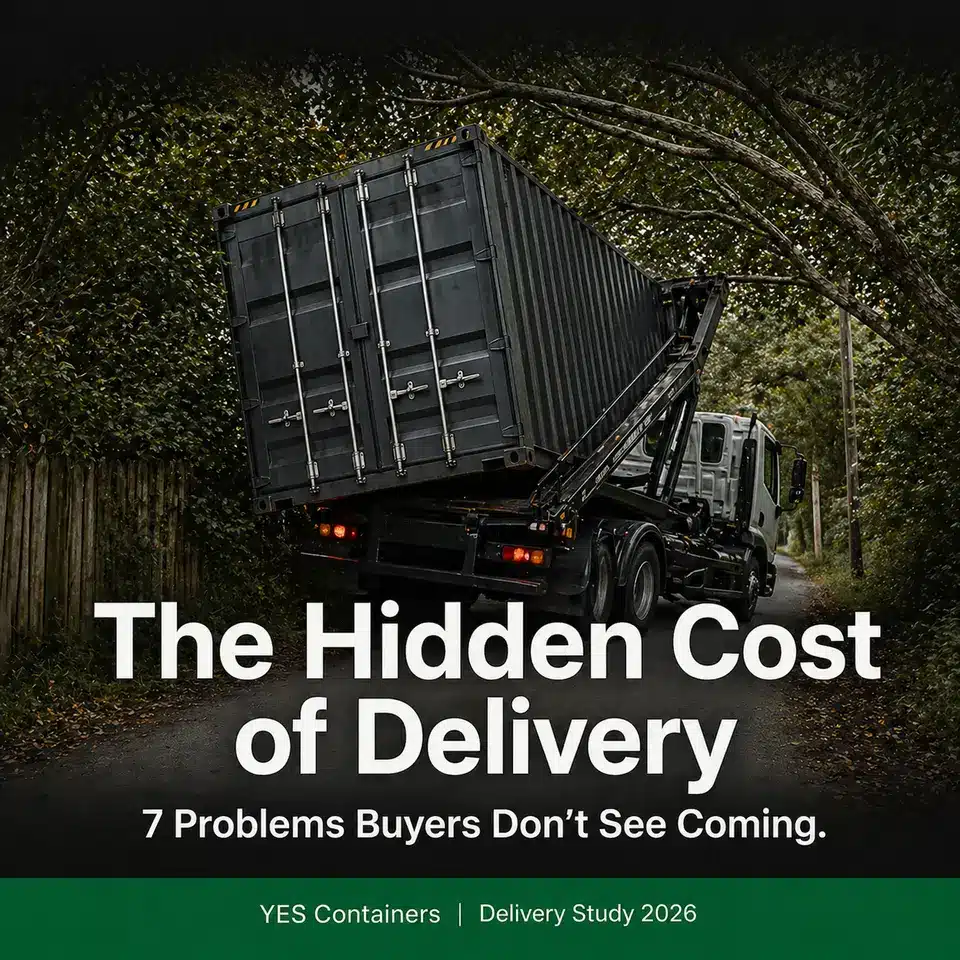

Container Delivery Problems: The 7 Issues That Catch Buyers Off Guard
Written on April 27, 2026
by Gabriel B.
In the following categories: Shipping Container Studies
Container delivery problems are responsible for more buyer frustration than any other part of the purchase process — including price. The container itself is usually fine. What goes wrong is the move: a truck that cannot make the turn, a site that was not prepared, a delivery cost that came in higher than expected, or a placement that required equipment nobody budgeted for. This study documents the seven most common container delivery problems, what causes them, what they typically cost, and how to identify them before they become your problem.
Why Delivery Is the Riskiest Part of Buying a Container
Container delivery problems are structurally different from most product delivery issues because the variables are almost entirely site-specific. A dealer can quote a container price with reasonable national consistency. Delivery cost and delivery complexity depend on your specific ZIP code, your specific driveway, the specific road between the depot and your property, and the specific day weather and ground conditions allow for placement.
Public dealer guidance from across the industry consistently identifies delivery logistics — not container condition — as the primary source of post-purchase complaints. Container xChange notes that delivery pricing is adjusted for local transportation costs and inventory levels. YES Containers' own fulfillment data shows zero returns across 51 orders in the study period, but delivery site preparation is the variable most frequently discussed during the pre-sale process. The gap between what buyers expect and what delivery actually involves is the core problem.
The 7 Most Common Container Delivery Problems
1. Delivery Cost Higher Than Expected
The most common of all container delivery problems is not a physical complication — it is a financial surprise. Buyers frequently research container prices thoroughly and underestimate or ignore delivery cost until the quote arrives. Container price and delivery price are separate line items, and in some markets — particularly rural areas far from depots — delivery can add 30% to 60% or more to the base container cost.
Typical delivery ranges vary significantly by distance and site type. Short-haul urban deliveries within 25 to 50 miles of a depot may run $300 to $500. Rural deliveries covering 150 to 300 miles can reach $1,000 to $1,500 or more before any site access complications are factored in. A buyer who shops a used 20ft container at $2,200 and receives a delivery quote of $950 for a rural address is looking at a 43% delivery premium on the base price — a figure that would have changed their size or condition decision if they had known it upfront.
YES Containers' delivery page provides location-specific pricing so buyers can model total landed cost before committing. The general benchmark: approximately $500 for the first 100 miles from the nearest depot, and approximately $5 per mile beyond that, though local conditions and access complexity affect final pricing.
2. Insufficient Turning Radius
A tilt-bed delivery truck carrying a 40ft container needs significant straight-line clearance and turning radius to place the container on site. This is one of the most underestimated container delivery problems for buyers with residential driveways, curved access roads, or rural lanes that were designed for farm equipment rather than 18-wheel configurations.
The minimum straight-line approach for a standard tilt-bed delivery is typically 60 to 80 feet beyond where the container will land — the truck needs room to pull forward after tilting the bed. Driveways with sharp turns, gate openings under 14 feet wide, or soft shoulders that prevent the truck from straightening out can make standard tilt-bed delivery impossible and require crane-assisted placement instead.
Crane delivery solves the turning radius problem but adds a fixed cost — typically $300 to $600 or more depending on the market and lift requirements — regardless of the container's price or distance traveled. Urban buyers in dense neighborhoods are more likely to need crane delivery than rural buyers, but rural buyers with heavily wooded driveways or narrow farm lanes face the same constraint.
3. Overhead Obstructions
Low-hanging tree limbs, overhead utility lines, and low-clearance structures are among the most physically dangerous container delivery problems and among the most commonly overlooked during site planning. A tilt-bed truck raises the container to approximately 13 to 14 feet at its highest point during the tilt sequence. Any overhead obstruction in that path — including branches that appear manageable when looking straight ahead — can halt delivery entirely.
Utility lines are the most serious variant of this problem. Delivery trucks are legally prohibited from making contact with power lines, and in many cases the power company must be contacted in advance to assess clearance or temporarily de-energize lines. Buyers with overhead lines running along their driveway or across the intended placement area need to identify this before scheduling delivery, not the morning the truck arrives.
4. Soft or Unstable Ground
Ground stability is one of the container delivery problems that causes the most damage — to the delivery equipment, to the surrounding property, and occasionally to the container itself. A loaded delivery truck can weigh 60,000 to 80,000 pounds. Soft ground, saturated soil after rain, sandy surfaces, and poorly compacted gravel can cause trucks to sink, lose traction, or create ruts that require repair.
This problem is more common in rural delivery locations where access roads are unpaved or where the placement area is on lawn, pasture, or agricultural land. Buyers should assess ground conditions at both the access route and the final placement area — not just where the container will sit, but along every foot of the route the truck must travel to get there and back out.
Basic site preparation — compacted gravel, railroad ties, or concrete blocks at the four corner points — significantly reduces both the delivery complication risk and the long-term stability of the container on site. YES Containers' delivery preparation guidelines cover the minimum site requirements for a standard tilt-bed drop.
5. Gate Width and Access Point Restrictions
Gate width is one of the most easily preventable container delivery problems and one of the most frequently overlooked. Standard delivery trucks require a minimum gate or access point width of 12 to 14 feet. Many residential and rural gates — designed for farm equipment, passenger vehicles, or pedestrian access — are narrower than this threshold.
This problem is most common in properties with existing perimeter fencing, gated communities, HOA-managed neighborhoods, and older rural properties where the original access infrastructure predates modern delivery vehicle dimensions. Buyers should measure their narrowest access point before scheduling delivery and confirm with their dealer whether the planned delivery vehicle can clear it.
6. No Turnaround Space
Container delivery problems related to turnaround space are closely related to turning radius issues but distinct in their cause. Even when a truck can navigate to the delivery point, it must also exit the property. A delivery truck that can only reverse out of a long, narrow driveway faces a significantly increased risk of damage to the truck, the property, or both — and many drivers will refuse the delivery rather than accept that risk.
Buyers with single-access properties — one driveway in, the same driveway out — need to confirm with their delivery provider whether a turnaround is required and whether the property configuration supports it. In some cases, adjusting the container placement point by 20 to 30 feet can open up enough space for the truck to complete a three-point turn. In others, crane delivery is the only viable option.
7. Permit and HOA Delays
The final category of common container delivery problems is administrative rather than physical. In urban and suburban markets, container placement often requires a permit, HOA approval, or both — and buyers who schedule delivery without securing these approvals first face delays that can be measured in days or weeks.
Permit requirements vary significantly by municipality. Some jurisdictions treat a storage container as personal property requiring no permit for temporary placement. Others classify permanent container placement as a structure requiring a building permit with associated fees, inspections, and setback compliance. HOA rules add a further layer — many HOAs prohibit visible container storage entirely or require specific screening, color, or placement conditions.
The map below from the state-level container regulation study in this series provides a starting framework, but local rules override state generalizations in almost every case. Confirming permit requirements before scheduling delivery is the single most effective way to avoid the administrative version of container delivery problems.
Container Delivery Problems — Estimated Frequency by Site Type
High
Med
Med
High
Med
Med
High
Low
Low
High
Frequency ratings are qualitative estimates based on dealer guidance and YES Containers delivery data. Not published incidence rates.
Rural vs. Urban Delivery Problem Profile
Container delivery problems do not distribute evenly between rural and urban sites — they cluster differently by geography, with each environment generating a distinct set of complications.
| Delivery Problem | Rural Risk | Urban Risk | Primary Cause |
|---|---|---|---|
| High delivery cost | High | Medium | Distance from depot |
| Turning radius failure | Medium | High | Narrow streets, tight lots |
| Overhead obstructions | Medium | Medium | Trees (rural), utility lines (urban) |
| Soft or unstable ground | High | Low | Unpaved access, pasture, saturated soil |
| Gate width restriction | Medium | Medium | Old farm gates, HOA gate systems |
| No turnaround space | High | High | Single-access driveways |
| Permit and HOA delays | Low | High | Municipal codes, HOA rules |
How to Eliminate Most Delivery Problems Before Scheduling
The majority of container delivery problems are identifiable and avoidable with a site assessment before scheduling. Buyers who walk their delivery route with these seven issues in mind — measuring gate width, identifying overhead obstructions, assessing ground stability, confirming turnaround space, and verifying permit requirements — eliminate most of the risk before the truck ever leaves the depot.
- Measure your narrowest access point — gate, driveway entry, or road edge. It needs to be at least 12 to 14 feet wide for standard delivery.
- Walk the full delivery path looking up, not just ahead. Identify any tree limbs or utility lines that fall within 14 feet of ground level along the route.
- Check ground conditions after rain, not just on a dry day. If your access road or placement area becomes soft when wet, plan for gravel reinforcement before delivery.
- Confirm where the truck will turn around. If your driveway is a dead end, discuss crane delivery options with your dealer before committing to a delivery date.
- Contact your municipality and HOA before scheduling. Even a five-minute phone call to your local building department can confirm whether a permit is required for your intended use and placement duration.
- Request an all-in delivered price quote — container plus delivery — before comparing dealers. A lower container price with a higher delivery charge can easily exceed a competitor's higher container price with a lower delivery charge.
YES Containers' pay-on-delivery program allows buyers to inspect the container at delivery before final payment is processed — removing one major friction point even when other delivery complications arise. For delivery logistics and site requirements, the YES Containers delivery page covers tilt-bed specifications, minimum site requirements, and how to prepare your location for a successful drop.
Key Findings
- Container delivery problems cause more documented buyer frustration than container condition issues, according to published dealer guidance and YES Containers' pre-sale inquiry patterns.
- Delivery cost surprise is the most common problem — rural buyers face the highest risk due to long depot-to-site distances, with delivery adding 30% to 60% or more to base container price in some markets.
- Rural sites generate more physical delivery complications: soft ground, narrow access roads, low tree limbs, and insufficient turnaround space.
- Urban and suburban sites generate more administrative complications: permit requirements, HOA restrictions, utility line clearance, and tight turning radii in dense neighborhoods.
- Most container delivery problems are identifiable in advance with a methodical site assessment covering access width, overhead clearance, ground stability, turnaround space, and permit requirements.
- YES Containers recorded zero returns across 51 orders in the study period — reflecting how pre-delivery site preparation guidance and pay-on-delivery inspection rights reduce post-delivery disputes.
For state-specific delivery considerations and market-level demand data, browse the full Shipping Container Studies series. View available containers with location-specific pricing, or explore the container pickup option if your site access makes standard delivery impractical.