


63% of U.S. Shipping Container Demand Is Storage — A Full Use Case Breakdown
Written on April 27, 2026
by Gabriel B.
In the following categories: Shipping Container Studies
Shipping container use cases in the United States are more varied than most coverage suggests — but they are not evenly distributed. Storage, across its commercial, residential, and agricultural forms, accounts for roughly 63% of domestic container demand by estimated unit count. Everything else — offices, homes, pop-up retail, disaster response, pools — sits in the long tail. This study maps that distribution and explains what drives each use case, what buyers in each category actually purchase, and how the mix shifts by geography.
Why Use Case Data Is Hard to Find
No federal agency tracks container sales by end use. The market is fragmented across thousands of dealers, depots, and brokers with no central reporting body. What exists instead are strong proxies: self-storage demand data, construction spending figures, housing research, and niche-market size estimates for segments like container homes and containerized data centers. The figures in this study are modeled estimates based on those proxies, with sources cited where available and methodology stated where figures are inferred.
The Full Container Use Case Breakdown
Estimated U.S. Container Demand by Use Case
Modeled estimates. National use-case split is not publicly audited. Source: YES Containers analysis based on StorageCafe, U.S. Census Bureau, Grand View Research, and Harvard JCHS data.
Commercial and Construction: The Largest Container Use Case at ~40%
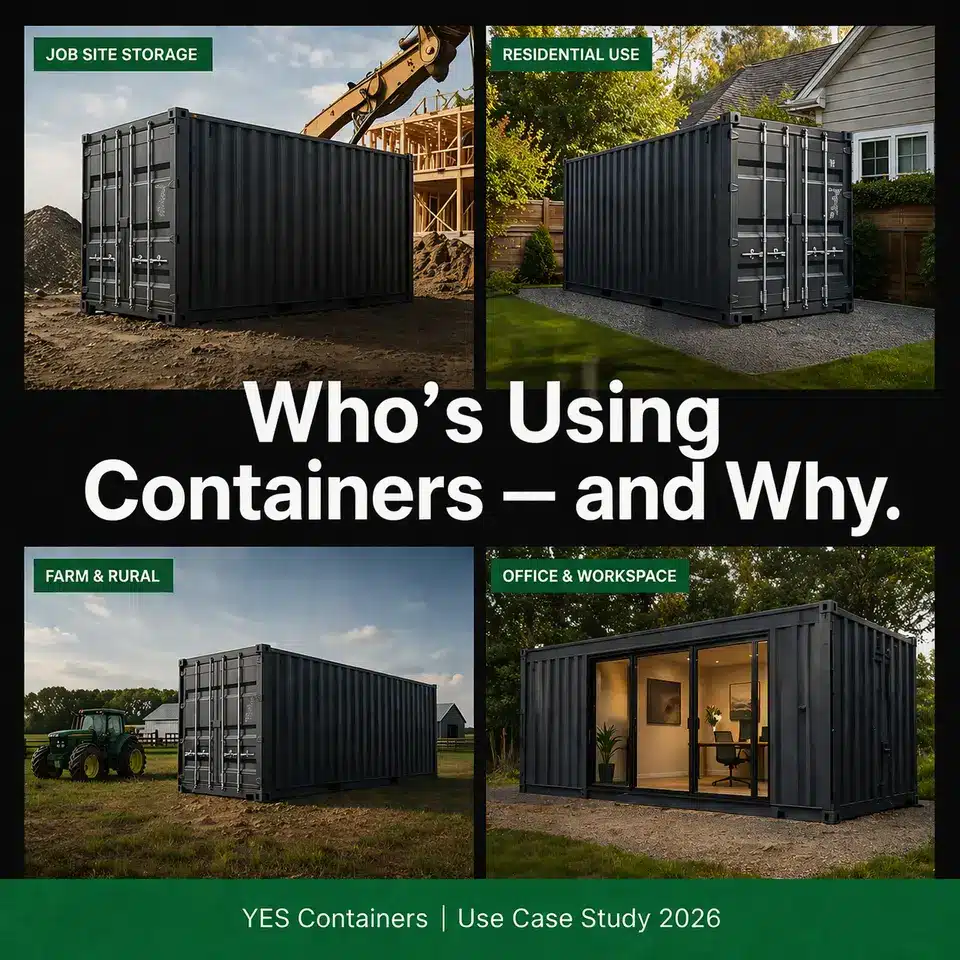
Job sites are the single largest destination for containers in the U.S. Tools, materials, safety equipment, and high-value supplies need a lockable, weatherproof structure that can be placed quickly, moved when the project ends, and replaced without a lease. A container fills that role better than a temporary building and cheaper than renting enclosed storage space off-site.
The scale of U.S. construction activity supports this. Residential construction spending alone was running at a $945 billion annualized rate in early 2026, according to U.S. Census Bureau data. Add commercial, infrastructure, and industrial construction and the total addressable base for job-site container use cases is enormous. Beyond active job sites, this segment includes retail inventory overflow, logistics staging yards, warehousing buffers, and any commercial application where flexible on-site space is needed without a permanent structure.
Buyers in this category overwhelmingly choose used 40ft standard containers — maximum floor area at the lowest cost per square foot, with structural integrity and lock security mattering far more than cosmetic condition. Multi-unit orders are common, particularly for contractors managing simultaneous sites across multiple locations.
Residential Backyard Storage: ~23% and Growing
The residential storage use case is growing faster than any other high-volume segment, driven directly by self-storage market pressure. According to the Self Storage Association, 13.4% of U.S. households rented off-site storage in 2024 — up from 11.1% just two years prior. That is more than 16.6 million households paying monthly fees for space they could own outright.
The financial case for switching from a storage unit rental to a container purchase strengthens the longer the storage need persists. A homeowner paying $150 to $200 per month for a 10x10 unit reaches break-even on a used 20ft standard container in roughly two to three years — and ends up with twice the floor space, on-site access at any hour, and no ongoing monthly cost. For placements lasting five or more years, the financial gap between renting and owning becomes significant.
Homeownership is effectively a prerequisite for this use case since placement requires land control. Published self-storage research suggests more than three-quarters of storage tenants are already homeowners, making the crossover audience for container purchases large and identifiable.
Agricultural and Rural Storage: ~8% and Undercounted
The agricultural use case is the most consistently undercounted segment in published container market data. Farm equipment, seed, feed, pesticides, and irrigation supplies all need secure, weatherproof storage — and on rural properties where a permanent outbuilding is costly or subject to agricultural zoning rules, a container is often the fastest and most practical solution.
This segment does not appear in dealer surveys because most rural purchases happen as direct, practical transactions without the digital research trail that urban buyers leave. But delivery address data tells a clearer story. YES Containers has fulfilled orders to rural addresses across Louisiana, Alabama, Tennessee, and Virginia — states where rural county populations are large relative to total state population. North Carolina, where approximately 40% of residents live in rural counties, is YES Containers' top revenue state by order count, with a significant portion of that demand traceable to non-urban zip codes.
Container choice in this use case leans toward used 20ft and used 40ft standard units — durable, cost-efficient, and functional on uneven ground with basic site preparation.
Conversion Use Cases: Offices, Homes, ADUs, and Studios (~8%)
Conversion container use cases represent a smaller share of total demand by unit count but attract disproportionate media coverage and represent the highest average transaction values in the residential segment. The conversion category spans backyard home offices, artist studios, guest houses, accessory dwelling units, and full container homes.
The backyard office sub-segment is the most commercially active right now. With roughly 15% of the U.S. workforce fully remote as of 2024 and work-from-home accounting for 29% of all U.S. workdays in 2023, demand for dedicated home workspace has outpaced what a spare bedroom can provide. A converted new 40ft high cube container with insulation, electrical, and a glass door costs a fraction of a traditional addition and requires no permanent foundation in many jurisdictions.
ADU conversions are gaining policy support. Arizona, California, Colorado, Oregon, and Washington all passed meaningful land-use reforms in 2025 that make accessory dwelling units easier to permit in principle. Container ADUs are not exempt from local building codes, but the regulatory environment is more permissive than it was five years ago in a growing number of states.
Pop-Up Retail and Hospitality: ~5%
Container retail and hospitality builds are one of the most photographed use cases — and one of the smallest by unit volume. Container coffee shops, food halls, pop-up boutiques, and event bars generate compelling imagery, but the total number of active container retail installations in the U.S. is small relative to the storage segments above.
Where this use case is most active: high foot-traffic urban and suburban markets with outdoor dining culture and flexible commercial zoning. Nashville, Austin, Atlanta, and Denver appear consistently in container retail case studies. Configuration matters here — new 20ft side door containers and new 40ft open side units are the most practical for customer-facing applications.
Government, Military, and Disaster Response: ~5%
This use case is episodic rather than consistent. Demand spikes after major storms, wildfires, and infrastructure failures, then recedes. NOAA recorded 27 billion-dollar weather events in the U.S. in 2024 alone. Each one creates short-window demand for containers as equipment staging platforms, emergency supply storage, and temporary command infrastructure.
Federal agencies, FEMA contractors, and state emergency management offices are recurring buyers. Speed and structural integrity take priority over condition grade — cargo-worthy used units are typically preferred for large-volume emergency deployments where cost efficiency matters and appearance does not.
Pools, Data Centers, and Niche Uses: ~11% Combined
Container pools are searched frequently online but represent well under 2% of national unit volume. The modifications required — waterproofing, structural reinforcement, filtration integration — make each pool build a significant custom project. They concentrate in warm-climate markets: Florida, Texas, Arizona, and coastal California.
Containerized data centers are a small but growing high-value segment. Edge computing and remote IT infrastructure deployment have created demand for modular, deployable server environments that a modified container can provide. The North American containerized data center market was projected to grow from $4.48 billion in 2023 to $13.10 billion by 2028. Individual unit counts remain low relative to storage demand, but average transaction values are the highest in the market.
How Container Use Cases Shift by Geography
The mix of container use cases changes significantly based on population density, land availability, and regional economic activity. Rural buyers overwhelmingly purchase for storage and agricultural use. Suburban buyers split between backyard storage and conversion projects. Urban and inner-suburban buyers concentrate on job-site and commercial applications where site access and permitting are the dominant concerns.
| Geography | Dominant Use Cases | Typical Container |
|---|---|---|
| Rural / exurban | Farm storage, equipment, hunting property, workshop | Used 20ft or 40ft standard |
| Suburban | Backyard storage, garage overflow, home office, pool | New 20ft standard or 40ft high cube |
| Urban / inner suburban | Job-site storage, commercial overflow, pop-up retail, ADU | New 20ft or 40ft, specialty configs |
| Disaster-prone regions | Emergency storage, equipment protection, rapid staging | Used 40ft standard, cargo worthy |
Key Findings
- Storage container use cases — commercial, residential, and agricultural combined — account for an estimated 63% or more of U.S. demand by unit count.
- Commercial and construction storage is the largest single use case at approximately 40%, driven by hundreds of billions in annual U.S. construction activity.
- Residential backyard storage is the fastest-growing high-volume use case, supported by 16.6 million U.S. households currently paying for off-site storage rentals.
- Agricultural container use cases are consistently undercounted in published data but visible in delivery address patterns across rural-heavy states.
- Conversion use cases — offices, ADUs, studios, homes — represent roughly 8% of demand by unit count but are growing faster than any other segment by market value.
- Pop-up retail and disaster response container use cases are real but small, concentrated in specific geographies and triggered by specific market or weather events.
- Container use cases shift significantly by geography — rural buyers skew toward storage, suburban buyers split between storage and conversion, urban buyers concentrate on job-site and commercial applications.
For a detailed look at how these container use cases break down by state and metro area, see the Shipping Container Studies series. To explore containers by use case, start with the YES Containers product catalog.