


Container Buyer Regrets: What People Wish They Had Known Before Purchasing
Written on April 28, 2026
by Gabriel B.
In the following categories: Shipping Container Studies
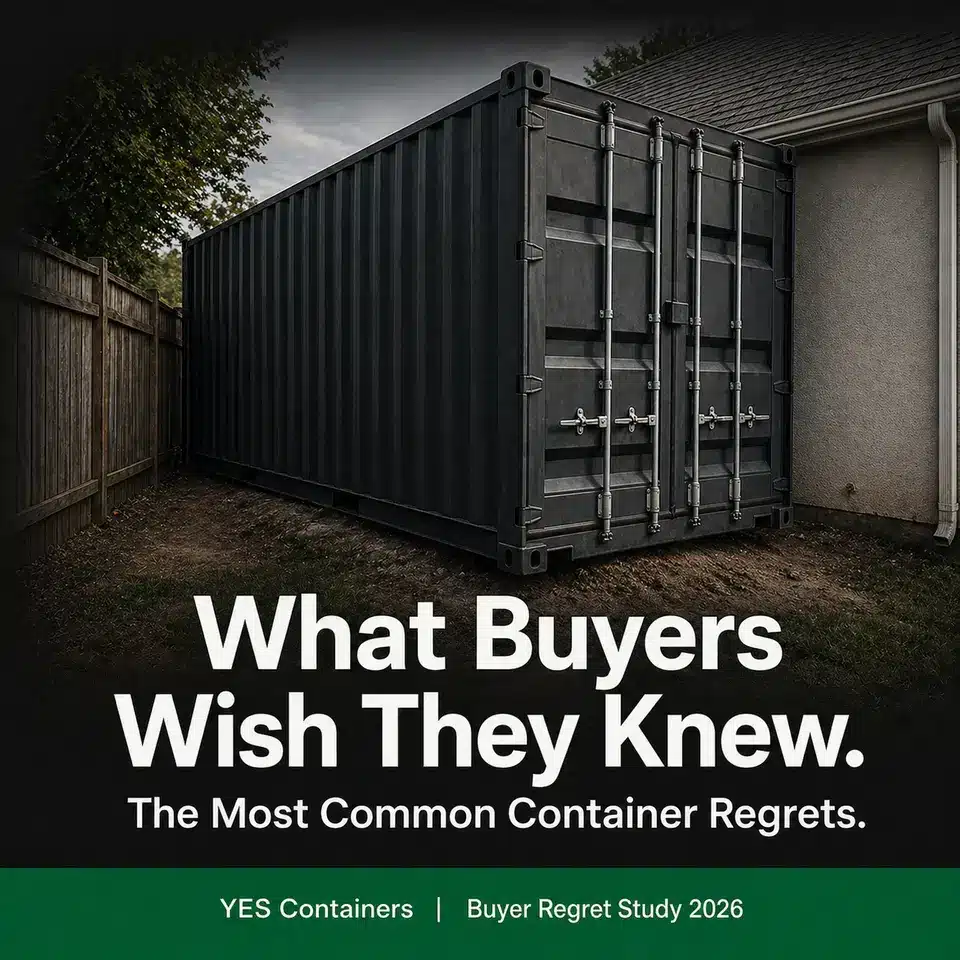
Container buyer regrets rarely center on price. Buyers who feel they overpaid are a minority. The more common pattern — documented in dealer guidance, industry forums, and YES Containers' pre-sale inquiry data — involves decisions that seemed reasonable at purchase and created friction afterward: the wrong size, the wrong condition grade, a placement that created daily inconvenience, or a delivery cost that arrived higher than expected. This study identifies the most common container buyer regrets, what causes them, and what information at the time of purchase would have changed the outcome.
Why Regret Data Is Hard to Measure in This Market
Container buyer regret is not formally tracked in any published industry dataset. There is no national survey of container purchasers equivalent to the J.D. Power studies that exist for automotive or appliance categories. What is available is a combination of dealer-reported inquiry patterns, online forum analysis, and the pre-sale questions that buyers ask most frequently — which tend to reflect prior experience or secondhand knowledge of problems others encountered.
YES Containers recorded zero returns across 51 orders during the November 2025 to April 2026 study period. That figure speaks to post-delivery satisfaction, but it does not capture the subtler regrets that buyers live with after a successful delivery: the container that works fine but is in the wrong spot, the size that seemed adequate but filled up faster than expected, or the used unit that turned out to have an odor problem nobody mentioned.
The regrets documented below are drawn from dealer guidance patterns, published buyer research in adjacent categories, and the pre-sale questions YES Containers encounters most consistently. They are framed as qualitative patterns rather than quantified incidence rates.
Regret 1: Buying the Wrong Size
The single most cited container buyer regret across dealer inquiry data is size selection. Buyers systematically underestimate how quickly a container fills when used for active storage — tools, seasonal items, furniture, equipment, and supplies accumulate faster than the dimensions suggest on paper. A 20ft standard container offers 1,172 cubic feet of internal volume and 160 square feet of floor space. That sounds like a lot until a riding lawn mower, a set of patio furniture, three bicycles, and two seasons of holiday decorations occupy it.
The size regret cuts in both directions. Some buyers purchase a 40ft container for a residential property and find it visually overwhelming on a standard suburban lot, difficult to permit, and more expensive to deliver than a 20ft unit would have been for the same actual storage need. Others purchase a 20ft unit for a use case — farm equipment storage, contractor material lockup — that clearly required 40 feet from the start.
Container Size — Internal Capacity Comparison
Internal dimensions are approximate standard ISO specifications. Actual usable volume varies slightly by manufacturer and condition grade.
The corrective pattern for size regret is consistent: when in doubt between two sizes, most buyers who lived with the decision for 12 months report preferring the larger option. The price difference between a used 20ft and a used 40ft standard container is often $500 to $1,000 at purchase — a gap that feels significant upfront and insignificant once the smaller unit is full. Browse used 20ft and used 40ft standard containers side by side to compare current pricing before deciding.
Regret 2: Choosing Used When the Use Case Required New
Used container buyer regrets tend to cluster around three specific condition issues that are difficult to fully assess from photos or written grade descriptions: residual odor from prior cargo, floor condition, and surface rust that was more extensive than the grade implied.
Residual cargo odor is the most frequently mentioned post-delivery surprise among used container buyers. Containers that carried agricultural products, chemicals, or perishables in their working life can retain odors that are faint when the container is open and more noticeable when closed and sealed. Wind-and-watertight graded containers are not inspected for odor — the grade certifies structural integrity and weatherproofing, not sensory condition.
Floor delamination is a related issue. Used container floors are typically tropical hardwood that has been exposed to decades of forklift traffic, moisture, and cargo weight. Buyers using a container for storage where floor condition does not matter — farm equipment, building materials, tools — rarely have an issue. Buyers who discover after delivery that they planned to use the floor as a workspace surface, install finished flooring over it, or use it for food or clean equipment storage find that delaminated or chemically treated wood creates a problem they did not budget for.
For use cases where odor, floor condition, or interior appearance matter — backyard offices, studios, retail installations, food storage, or any human-occupancy application — new one-trip containers eliminate these variables. The price premium is real but bounded: new 20ft units typically run $800 to $1,500 more than comparable used units at current market prices.
Regret 3: Poor Door Orientation Planning
Door orientation is one of the most overlooked container buyer regrets and one of the easiest to prevent. Standard containers have doors at one end only. Once a container is placed, the door faces a fixed direction — and if that direction turns out to be toward a fence, a building wall, a slope, or a property boundary, accessing the container becomes a daily inconvenience that no amount of organization inside will fix.
The regret version of this problem almost always involves a buyer who focused on where the container would sit and not on which direction the doors would face once it was there. A container dropped parallel to a fence line with doors facing the fence leaves only a few feet of clearance for a standard swing-open door — and container doors swing approximately 270 degrees when fully open, requiring clear space on both sides of the opening.
Specialty container configurations address some of these problems before they happen. Side door containers add a door along the long face of the unit, making access possible regardless of end-door orientation. Double door high cube units open at both ends, eliminating the single-entry constraint for buyers who need to load and unload from opposite sides.
Regret 4: Inadequate Site Preparation
Site preparation buyer regrets follow a predictable pattern: the buyer focused on the container purchase, treated site preparation as a secondary concern, and discovered after delivery that the ground conditions created ongoing problems. The two most common variants are containers that settled unevenly on soft ground over time, and containers placed without adequate drainage that developed interior condensation or floor moisture issues.
A container placed directly on soil or grass without leveling support will follow the ground as it shifts with seasonal freeze-thaw cycles, moisture changes, and compaction. A container that starts level and drifts off-level over 12 months develops door alignment problems — doors that were easy to open at delivery become stiff or difficult as the frame distorts slightly under uneven load.
The minimum site preparation that prevents most of these problems is straightforward: four concrete blocks, railroad ties, or compacted gravel pads at the corner castings, positioned to keep the container base off direct soil contact and allow air circulation beneath the floor. This takes less than a day to prepare and costs a fraction of the repair work an unlevel or moisture-damaged container requires later.
Regret 5: Not Accounting for Condensation
Condensation is the container buyer regret that surprises buyers most because it is not immediately obvious at delivery and worsens over time. Steel containers are highly efficient at conducting temperature change. In climates with significant temperature swings between day and night — or between seasons — moisture in the air inside the container condenses on the steel walls and ceiling when temperatures drop, then drips onto stored items below.
This problem is most pronounced in containers used for storing items sensitive to moisture: documents, electronics, upholstered furniture, clothing, and wood products. Buyers who purchase a container as a climate-neutral storage solution and load it with moisture-sensitive items frequently discover the problem only after damage has occurred.
The solutions — insulation, ventilation, desiccant packs, or vapor barrier lining — are all available and cost-effective when planned before loading. The regret version happens when buyers discover the need after the fact. Containers used in high-humidity states including Florida, Georgia, and Louisiana are particularly prone to condensation issues without basic ventilation or insulation treatment.
Regret 6: Buying From a Marketplace Without Inspection Rights
A category of container buyer regrets that does not involve the container itself involves the purchase channel. Buyers who purchase through aggregator marketplaces, Craigslist listings, or unverified online sellers without inspection rights — paying in full before seeing the unit — occasionally receive containers that do not match the described condition grade. The container may be structurally sound but visually worse than expected, have undisclosed floor damage, or arrive with door hardware problems not visible in photos.
This regret is structurally different from the others because it is channel-dependent rather than decision-dependent. A buyer purchasing through a dealer with a pay-on-delivery option, like YES Containers' pay-on-delivery program, retains the right to inspect the container at delivery before final payment is processed. That single feature eliminates the condition-mismatch version of post-purchase regret almost entirely — which is reflected in YES Containers' zero-return record across the study period.
Regret 7: Ignoring Zoning and HOA Rules Until After Delivery
The final common container buyer regret category is administrative: buyers who purchase and take delivery of a container without confirming local zoning or HOA rules, and subsequently receive a notice requiring removal, screening, or modification. Container removal — picking up a container that has already been placed — costs roughly the same as delivery and generates a net loss on the entire transaction.
Zoning rules for containers vary significantly by municipality and property type. Some jurisdictions classify storage containers as temporary structures exempt from building permits for placements under a defined duration. Others treat any container on a residential lot as a permanent structure subject to setback rules, lot coverage limits, and permit requirements. HOA rules operate independently of municipal zoning and in many cases are more restrictive — prohibiting visible containers entirely or requiring specific color and screening conditions.
Confirming both municipal zoning and HOA requirements before purchase — not before delivery, but before purchase — is the only way to eliminate this regret entirely. A five-minute call to the local building department and a review of HOA covenants costs nothing and protects a purchase that may run $3,000 to $8,000 or more including delivery.
Pre-Purchase Checklist — Avoiding the Most Common Regrets
Key Findings
- Container buyer regrets center on size, condition grade, placement, site preparation, and purchase channel — not purchase price.
- Size regret is the most commonly cited issue: buyers who size down tend to regret it within 12 months; buyers who size up rarely do.
- Used container condition regrets cluster around residual odor, floor delamination, and surface rust — issues not fully captured by wind-and-watertight grade descriptions.
- Door orientation and site preparation are the two most preventable regrets — both are fully addressable before delivery with minimal planning effort.
- Condensation is the container buyer regret most likely to cause actual property damage, particularly in high-humidity states, and the one buyers are least likely to anticipate at purchase.
- Buying through a channel with inspection rights at delivery eliminates condition-mismatch regret almost entirely — reflected in YES Containers' zero-return record across 51 orders in the study period.
- Zoning and HOA failures are the most financially costly regret category — container removal costs equal delivery and produce no usable outcome.
For guidance on selecting the right container for your specific use case, browse the YES Containers product catalog or explore the full Shipping Container Studies series for data on pricing, regional demand, and delivery logistics across the U.S. market.