


Container Buyer Demographics: Who Actually Purchases a Shipping Container in the U.S.
Written on April 27, 2026
by Gabriel B.
In the following categories: Shipping Container Studies
Container buyer demographics in the United States are poorly documented in public data. No trade body surveys container purchasers by age, income, homeownership status, or occupation the way automotive or housing research does. What exists instead are strong proxies — self-storage tenant profiles, homeowner renovation surveys, remote work data, and order patterns from active dealers. This study combines those sources with YES Containers' own customer data to build the clearest available picture of who is actually buying containers and what drives their decision.
The Core Problem with Container Buyer Data
The U.S. container sales market is fragmented across thousands of dealers, depots, brokers, and online marketplaces. No central registry captures buyer demographics. Unlike housing or automotive purchases, container transactions do not require financing disclosure, registration, or permit filing in most cases — leaving a significant data gap that proxy sources can only partially fill.
The figures in this study are modeled estimates or directional inferences from adjacent markets. Where a number comes from a published source, that source is cited. Where it is an inference, that is stated. The overall demographic profile that emerges is consistent across multiple proxy datasets even where exact percentages are unavailable.
Homeownership: The Single Strongest Predictor
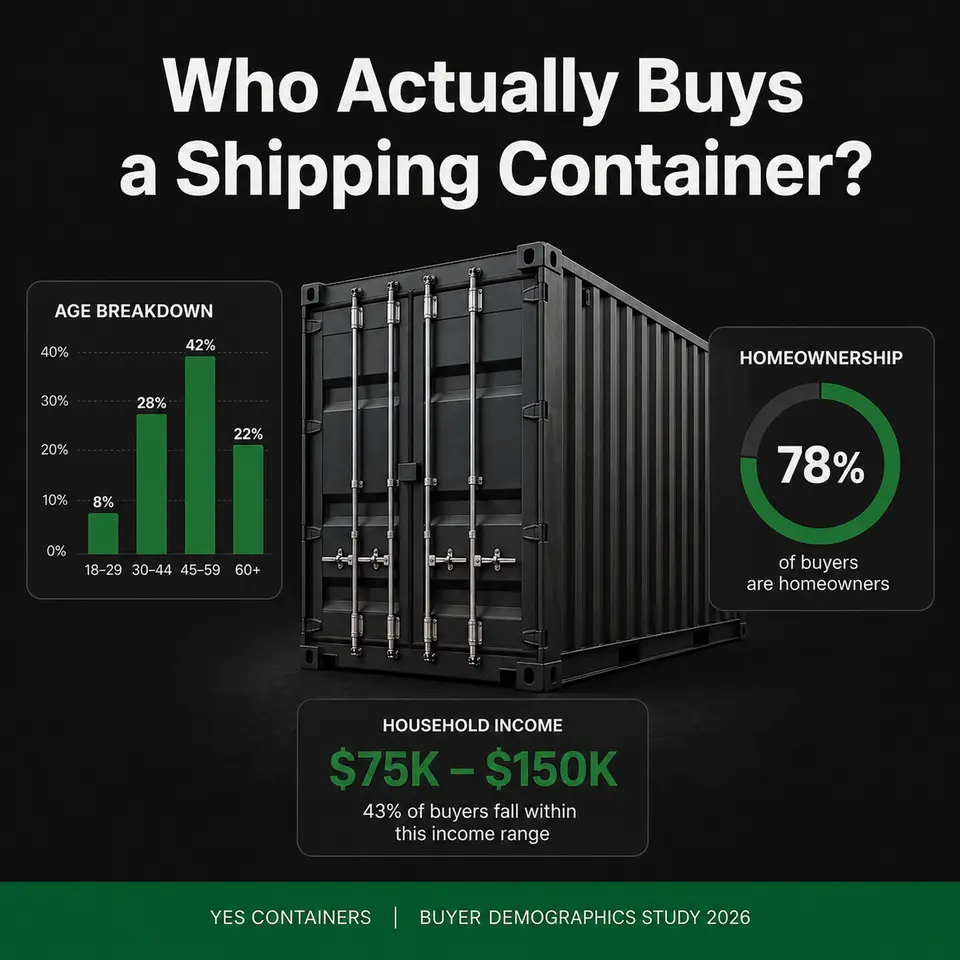
Homeownership — or more broadly, property control — is the single most reliable predictor of container purchase behavior. Placing a container requires land. That simple constraint eliminates most renters from the buyer pool immediately and concentrates demand among property owners, rural landowners, contractors, and businesses with owned or long-term-leased sites.
The Self Storage Association estimates that more than three-quarters of self-storage tenants in the U.S. are homeowners. Container buyers likely skew even higher than that figure since renting a storage unit requires only a credit card while buying a container requires somewhere to put it. For residential buyers specifically, the addressable market is effectively limited to homeowners with usable outdoor space.
U.S. homeownership rates vary significantly by state and create predictable demand patterns when mapped against container order data. States with high homeownership rates and meaningful rural populations — Indiana at 70.6%, Michigan at 73.2%, Minnesota at 72.2% — generate strong residential and agricultural container demand that their urban population share alone would not predict.
Homeownership Rates — Key Container Markets
Sources: U.S. Census Bureau QuickFacts 2024. City-level figures differ significantly from statewide rates — Newark illustrates how dense urban cores suppress residential container demand relative to their state averages.
The Newark figure illustrates a critical point about container buyer demographics at the city level. Newark's 24.4% owner-occupancy rate is less than half of New Jersey's statewide 63.8% — meaning the city generates almost no residential backyard container demand despite being a strong market for commercial and industrial purchases. City-level homeownership data is more predictive of residential container buyer demographics than state-level figures alone.
Income: Which Brackets Are Most Likely to Buy
Container buyer demographics skew toward middle and upper-middle income households rather than either extreme of the income distribution. The U.S. median household income was $80,734 as of the most recent Census Bureau five-year estimates. Container buyers likely over-index in the $60,000 to $150,000 range for several compounding reasons.
Below roughly $50,000 to $60,000, the upfront purchase cost of a container — even a used 20ft unit at $1,800 to $2,500 plus delivery — represents a significant capital outlay that monthly storage rental avoids. Buyers in this income range are more likely to continue renting storage or forgo structured storage entirely.
Above roughly $150,000 to $200,000, buyers are more likely to fund permanent structures — garages, sheds, or full additions — rather than container solutions, particularly in visible residential settings where HOA rules or neighborhood aesthetics create pressure toward traditional construction.
The sweet spot for residential container buyer demographics is the property-owning middle-income household that has a genuine storage or workspace need, enough capital to make a one-time purchase, and enough land to place a container without triggering zoning or HOA issues. This profile maps closely onto the suburban homeowner in a mid-sized metro — which aligns with YES Containers' strongest order markets: Charlotte ($82,068 median household income), Atlanta ($85,652), and Denver ($94,718).
Median Household Income vs. YES Containers Average Order Value — Key Cities
YES Containers order data Nov 2025–Apr 2026. Newark AOV reflects commercial/industrial buyer profile despite lower median income — a commercial buyer demographic rather than residential. Income figures: U.S. Census Bureau QuickFacts.
Newark's anomaly in the chart above is instructive. Despite having the lowest median household income of the cities listed, its average order value is among the highest. That reflects the difference between residential and commercial container buyer demographics: Newark's buyers are not homeowners purchasing backyard storage — they are commercial and industrial operators purchasing for logistics, port-adjacent storage, and job-site use, where unit size and condition requirements push transaction values higher regardless of local household income.
Age: Which Brackets Drive the Most Container Purchases
Exact age distribution data for container buyers is not publicly available. The strongest available proxy is homeowner renovation research. Houzz's 2024 U.S. Houzz and Home Study surveyed 32,615 respondents including 17,713 renovating homeowners — the demographic group most likely to overlap with container buyers undertaking backyard storage, workshop, or conversion projects.
Container buyer demographics by age likely concentrate in the 35 to 64 bracket for compounding reasons. Buyers under 35 have lower homeownership rates, smaller savings for lump-sum purchases, and less established property infrastructure to support a container placement. Buyers over 65 skew toward downsizing and simplification rather than adding structures. The 35 to 64 range captures peak homeownership years, peak small business ownership years, and peak career stage for contractors and trades — all strong container buyer profiles.
The remote work factor has expanded the upper end of the age bracket. Professionals aged 45 to 60 who transitioned to fully remote work during 2020 and have not returned to office are a growing sub-segment of conversion container buyers, seeking dedicated workspace on their property without the cost of a traditional home addition.
Buyer Type Breakdown: Residential, Commercial, and Agricultural
Container buyer demographics split across three broad buyer types, each with a distinct profile, purchase trigger, and container preference.
| Buyer Type | Typical Profile | Purchase Trigger | Preferred Container |
|---|---|---|---|
| Residential homeowner | Age 35–64, $60k–$150k income, suburban property owner | Storage overflow, renovation displacement, remote work | New 20ft standard, used 20ft standard |
| Contractor / small business | Business owner or operator, multi-site or repeat buyer | Job-site storage, inventory overflow, fleet deployment | Used 40ft standard, multi-unit orders |
| Agricultural / rural | Farm or rural land owner, practical storage need | Equipment storage, feed security, rural property use | Used 20ft or 40ft standard |
| Conversion buyer | Higher income, renovation-minded homeowner or developer | Backyard office, ADU, studio, container home project | New 40ft high cube, specialty configurations |
How Buyers Research and Make Purchase Decisions
Container buyer demographics shape the research path as much as the purchase itself. The buying journey is now overwhelmingly digital-first. Buyers browse live inventory online, submit ZIP-based quote requests, and compare dealer pricing before speaking to anyone. Container xChange markets over 10,000 units across North America through digital-first channels; YES Containers processes quotes and orders through an online system with delivery pricing adjusted by location.
Google Search is the dominant discovery channel for high-intent buyers. YouTube is the dominant research channel for buyers evaluating modifications, delivery logistics, and condition grades — searches for container inspection videos, insulation guides, and delivery preparation content attract buyers who are already committed in principle and working through execution details. Referrals from contractors, farm communities, and local business networks remain important but are less visible in data.
One signal that stands out in YES Containers' own traffic data: AI-generated referrals from ChatGPT and Google's AI Mode appeared as measurable traffic and quote sources in April 2026 — months before most businesses in the container space are even tracking AI as a channel. Container buyer demographics are shifting toward AI-assisted discovery faster than the industry has acknowledged.
What Deters Buyers From Completing a Purchase
Understanding container buyer demographics also means understanding what stops purchases from happening. The most common documented deterrents are not price — they are uncertainty. Buyers who abandon quotes most often cite delivery cost unpredictability, inability to inspect before payment, concern about condition not matching what was described, and uncertainty about site access and permitting requirements.
This is why YES Containers' pay-on-delivery option functions as a conversion tool as much as a payment option. It removes the single biggest trust barrier — paying before seeing — which disproportionately affects first-time buyers unfamiliar with how container grading and condition reporting works. Across 51 orders in the study period, YES Containers recorded zero returns, reflecting how effectively pre-purchase clarity reduces post-delivery disputes.
Key Findings
- Container buyer demographics are not publicly tracked — the profile in this study is modeled from homeownership data, renovation surveys, remote work statistics, and YES Containers order patterns.
- Homeownership is the single strongest demographic predictor of container purchase behavior, since placement requires property control. Residential buyers almost exclusively own the land where a container will sit.
- Income concentration likely falls in the $60,000 to $150,000 range — above the threshold where monthly storage rental is a better short-term option, below the threshold where traditional construction becomes the default solution.
- Age concentration is estimated at 35 to 64, capturing peak homeownership, peak small business activity, and peak contractor career stages.
- Commercial and industrial buyers skew demographic patterns significantly at the city level — Newark's high average order value despite low median household income reflects a commercial buyer profile, not residential.
- Purchase deterrents center on uncertainty rather than price: delivery cost unpredictability, inability to inspect before paying, and site access concerns are the most common documented friction points.
- AI-generated buyer discovery is an emerging and measurable channel as of early 2026, appearing in YES Containers' traffic data ahead of most industry awareness.
Individual city and state studies in the Shipping Container Studies series break down how buyer demographics shift across specific markets. Browse available containers by type at the YES Containers product catalog, or explore delivery options including the pay-on-delivery program for first-time buyers.