


Georgia Container Demand Study: How Atlanta Growth and Rural Counties Create Two Separate Markets
Written on May 1, 2026
by Gabriel B.
In the following categories: Shipping Container Studies
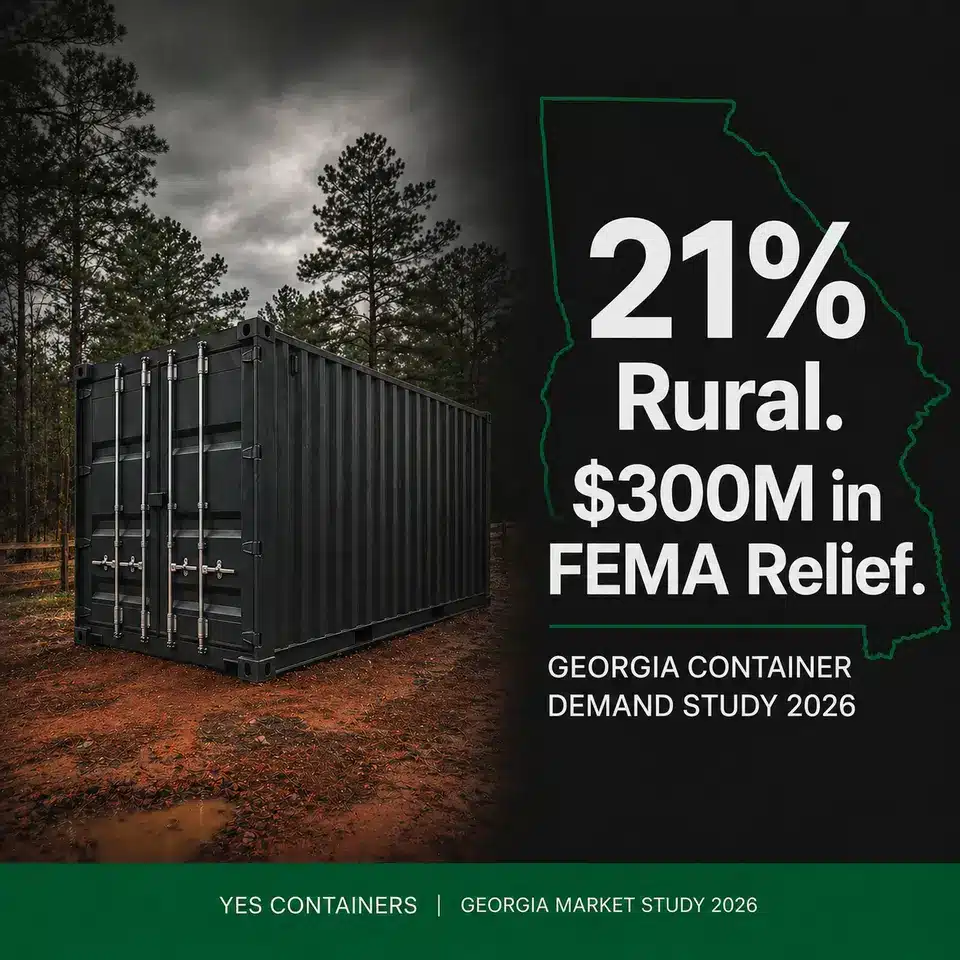
Georgia container demand operates across two largely separate markets that happen to share a state boundary. The first is Atlanta — a logistics and construction powerhouse with more than 2 million square feet of new self-storage delivered in 2025 alone, a median household income of $85,652, and one of the strongest commercial container buyer profiles in the Southeast. The second is rural Georgia — 21% of the state's population spread across agricultural counties south and east of the metro corridor, generating farm storage, equipment lockup, and storm-recovery purchasing that does not appear in any Atlanta-focused market analysis. This study examines both markets, maps the Hurricane Helene recovery demand that ran through 2025, and breaks down what Georgia's construction permits, homeownership data, and order patterns reveal about container demand across the state.
Georgia by the Numbers: The Market Foundation
Georgia — Key Market Indicators
Sources: U.S. Census Bureau QuickFacts 2024, StorageCafe 2025, FEMA disaster relief data, YES Containers order data Nov 2025–Apr 2026.
Atlanta: Self-Storage Capital, Logistics Hub, and Container Demand Engine
Atlanta is one of the strongest headline container markets in the Southeast by almost every available metric. StorageCafe reported that Atlanta led U.S. self-storage construction in 2025 with more than 2 million square feet of new self-storage delivered — a figure that reflects the scale of storage demand in the metro and provides a strong proxy for container demand in the same market. When self-storage supply is expanding at that rate, the addressable pool of buyers evaluating whether to own rather than rent is correspondingly large.
Atlanta's position as a major logistics and distribution hub amplifies commercial container demand beyond what its residential demographics alone would predict. The city sits at the intersection of I-75, I-85, and I-20, making it one of the most important freight distribution nodes in the eastern United States. Logistics operators, e-commerce fulfillment businesses, and contractors servicing the metro's continuous construction activity all generate job-site and commercial storage demand that runs independently of residential purchasing cycles.
The commercial demand story is reinforced by Atlanta's owner-occupancy rate of 46.4% — below the national average and well below Georgia's statewide 65.7%. Like Miami and Chicago, Atlanta proper has a large renter population that suppresses residential container purchasing within the city boundary. The residential container market in the Atlanta metro is concentrated in the outer suburbs — Alpharetta, Marietta, Kennesaw, Woodstock, Newnan, and the fast-growing exurban corridor toward Gainesville — where homeownership rates are higher and lot sizes support container placement.
YES Containers' Atlanta order data shows 5 units and $24,950 during the study period, with an average order value of $4,990 per unit — above the national dataset average of $4,733. That AOV premium reflects the metro's higher income level ($85,652 median) and a buyer mix weighted toward new containers for suburban residential and light commercial applications. Atlanta container buyers overwhelmingly select new 20ft standard containers — consistent with appearance-conscious suburban homeowners and small business operators rather than heavy industrial buyers.
Hurricane Helene Recovery: The Demand Event Most Market Analysis Missed
Hurricane Helene made landfall in Florida's Big Bend region in September 2024 but caused its most severe damage across western North Carolina, upstate South Carolina, and rural Georgia — an inland track that generated catastrophic flooding in areas not historically associated with hurricane damage. More than $300 million in FEMA relief funding flowed into Georgia in 2025 as a direct result of Helene's impact on the state's agricultural counties, rural infrastructure, and small communities in the Savannah River watershed and surrounding regions.
That relief funding created a sustained wave of post-disaster container purchasing across rural Georgia that extended well into 2025. Farm operations that lost outbuildings, equipment, and stored materials needed rapid replacement storage that permanent construction — still subject to normal permit timelines — could not provide quickly enough. Containers filled that gap. Recovery contractors deploying across affected counties needed job-site storage for materials and equipment in areas where existing infrastructure was damaged or destroyed. FEMA-adjacent staging operations required rapid-deployment container infrastructure at multiple points throughout the relief effort.
The Georgia Helene recovery demand is structurally different from the coastal Florida hurricane demand documented in the Florida study. Florida's storm purchasing is culturally embedded and somewhat anticipated — property owners in hurricane zones have thought through their preparedness posture before storm season. Georgia's Helene demand was unexpected, concentrated in rural agricultural communities with limited prior experience of hurricane-scale flooding, and compressed into a shorter purchasing window as recovery funds arrived and were deployed.
Savannah: Port Demand and Commercial Storage at Georgia's Coastal Gateway
Savannah occupies a distinct position in Georgia container demand that differs from Atlanta's logistics-and-residential mix. As home to the Port of Savannah — one of the busiest container ports on the East Coast — Savannah generates port-adjacent commercial container demand from freight handlers, import/export operators, and logistics businesses operating within the port's supply chain.
The irony of Savannah's position in the container market is that proximity to a major container port does not necessarily mean cheap or abundant containers for end-use buyers. Port containers are primarily in intermodal circulation and not available for direct retail purchase without going through a dealer channel. Savannah buyers sourcing containers for storage or commercial use go through the same dealer network as buyers anywhere else — they simply operate in a market where container logistics awareness is higher than average.
Savannah container demand concentrates in commercial and logistics applications close to the port corridor, with secondary residential demand in the historic district's surrounding suburban areas. Container placement in Savannah's historic zones faces additional design review constraints that push residential buyers toward less regulated suburban and exurban locations.
Rural Georgia: 21% of the Population, an Outsized Share of Agricultural Demand
Georgia's 21% rural population is concentrated in the southern and eastern counties — a broad agricultural belt stretching from the Fall Line southward to the Florida border and eastward toward the Savannah River. This region generates container demand for peanut and cotton storage, equipment lockup, poultry operation supply storage, and general farm property use that is entirely invisible in Atlanta-focused Georgia market analysis.
Rural Georgia counties affected by Hurricane Helene — including Burke, Jefferson, Jenkins, and Screven counties in the eastern agricultural belt — saw acute container demand spikes in late 2024 and early 2025 as Helene recovery funds enabled replacement purchasing. That demand layer is temporary in its emergency character but has a lasting residual component: property owners who purchased containers for storm recovery typically retain them for ongoing agricultural storage once the immediate recovery need has passed.
Delivery economics in rural Georgia present the standard rural challenge: longer drayage from depots to delivery sites, road access limitations on unpaved county roads, and soft ground conditions in the clay-heavy soils of the Georgia Coastal Plain. Buyers in these counties face higher total landed costs than Atlanta metro buyers despite often purchasing lower-cost used units — a cost structure that reinforces the rural price sensitivity pattern documented in the rural vs. urban demand study in this series.
| Market | Primary Demand Driver | Dominant Buyer Type | Preferred Container |
|---|---|---|---|
| Atlanta metro | Logistics, construction, suburban residential | Commercial, suburban homeowner | New 20ft standard |
| Savannah | Port adjacency, commercial logistics | Commercial, freight operator | Used 40ft standard |
| Rural south & east Georgia | Agricultural storage, storm recovery | Farm operator, rural landowner | Used 20ft or 40ft standard |
| Suburban Atlanta fringe | Backyard storage, remodeling displacement | Suburban homeowner | New 20ft standard |
Georgia Container Demand — Estimated Segment Breakdown
Modeled estimates based on YES Containers order data, StorageCafe, U.S. Census Bureau, and FEMA relief data. Not audited figures.
Key Findings
- Georgia container demand splits between two structurally different markets: an Atlanta metro market driven by logistics, construction, and suburban residential purchasing, and a rural market driven by agricultural storage and storm recovery that operates independently of Atlanta's economic cycles.
- Atlanta led U.S. self-storage construction in 2025 with more than 2 million square feet delivered — a storage demand signal that directly supports the container buyer pool evaluating ownership over monthly rental.
- Atlanta's 46.4% owner-occupancy rate limits residential container purchasing in the city proper — demand concentrates in outer suburbs where homeownership rates are higher and lot sizes support placement.
- Hurricane Helene generated more than $300 million in FEMA relief funding in Georgia in 2025, creating a concentrated rural container demand spike in agricultural counties affected by catastrophic inland flooding.
- Savannah's port adjacency generates commercial container demand from freight and logistics operators that is distinct from Atlanta's residential and construction-led demand profile.
- Rural Georgia's 21% population share generates an estimated 20% of state container demand through agricultural storage and storm recovery purchasing — a segment almost entirely absent from published market analysis focused on Atlanta.
- YES Containers' Atlanta average order value of $4,990 per unit exceeds the national dataset average of $4,733, reflecting higher metro income levels and a buyer mix weighted toward new containers.
State and city demand studies across the Southeast are covered throughout the Shipping Container Studies series. For Georgia container availability, visit the Georgia container page or browse metro inventory for Atlanta and Savannah. Current pricing across all container types is in the YES Containers product catalog.