


Illinois Container Demand Study: Why Chicago's Industrial Base and Suburban Ring Drive Two Different Markets
Written on May 3, 2026
by Gabriel B.
In the following categories: Shipping Container Studies
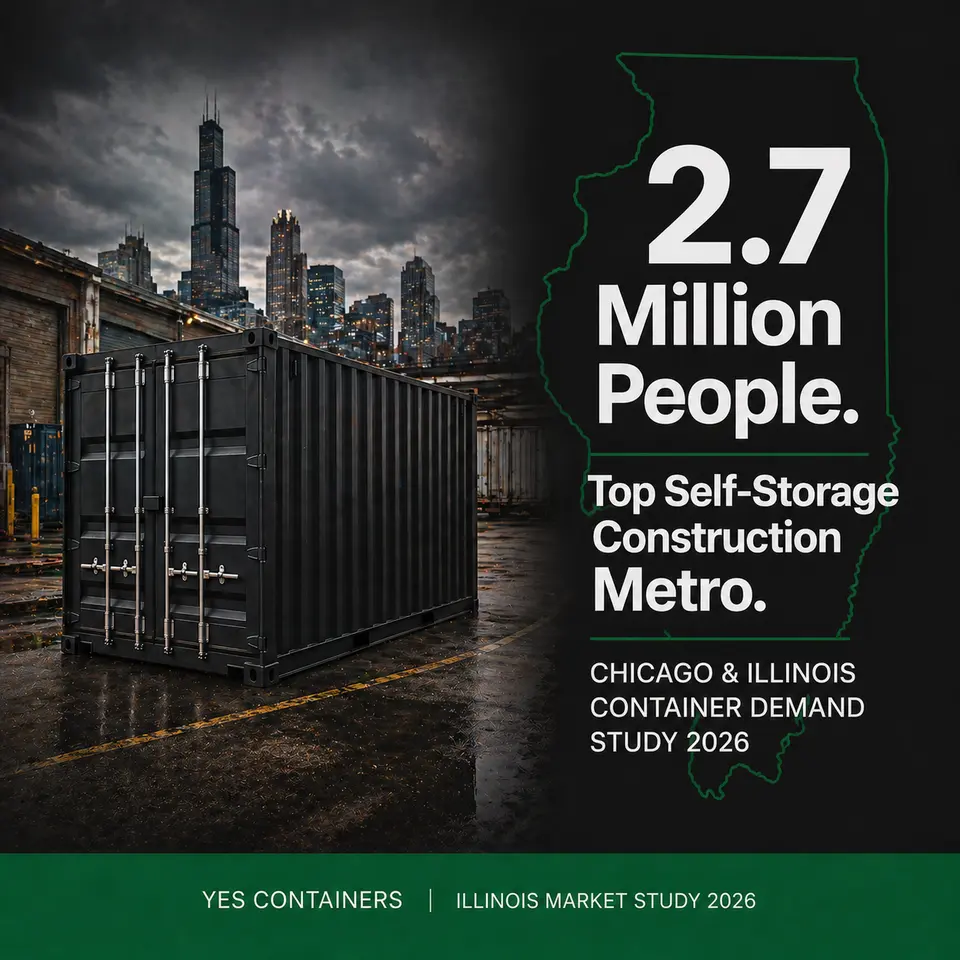
Illinois container demand is anchored by one of the most complex urban markets in the United States and surrounded by a suburban and industrial ring that operates by entirely different rules. Chicago's 2.7 million residents, dense logistics infrastructure, and position as a top self-storage construction metro in 2025 create strong commercial container demand at a scale that few Midwest cities approach. But Chicago's 46% owner-occupancy rate and tight urban placement constraints mean that the city's residential container market is structurally limited — and that the real residential and agricultural purchasing in Illinois happens in the suburban corridors and downstate counties that rarely appear in Chicago-focused market coverage. This study examines both markets, maps the industrial demand that connects them, and identifies where Illinois container demand is strongest relative to what the data currently shows.
Illinois by the Numbers: The Market Foundation
Illinois — Key Market Indicators
Sources: U.S. Census Bureau QuickFacts 2024, StorageCafe 2025 self-storage construction report.
Illinois's 67.1% statewide homeownership rate sits above the national average and above several coastal states with larger total populations. That figure is easy to miss when Chicago's 46% owner-occupancy dominates coverage of the state. The gap between Chicago city and Illinois statewide tells the market story: Illinois has a large, property-owning population that generates meaningful container demand — it just does not live primarily in the city. The suburban ring and downstate counties where Illinois homeownership is concentrated are where residential container demand actually lives.
Chicago: The Commercial Container Market That Dominates the City
Chicago container demand within the city boundary is almost entirely commercial and industrial. The combination of a 46% owner-occupancy rate and some of the most regulated urban placement conditions in the Midwest makes residential backyard container purchasing genuinely rare inside Chicago proper. What the city does generate — at significant scale — is job-site storage demand, logistics and distribution container use, industrial overflow storage, and commercial applications tied to the city's role as the largest freight hub in North America by rail volume.
Chicago sits at the intersection of six major railroad networks and is served by two major interstate airports and a dense highway system that makes it one of the most important logistics nodes in the country. That freight infrastructure concentration means a disproportionate share of Chicago's container demand comes from logistics operators, freight handlers, third-party logistics companies, and industrial businesses that use containers as flexible storage within supply chain operations — not as residential backyard boxes.
StorageCafe ranked Chicago among the top U.S. metros for self-storage construction in 2025, a signal that storage demand in the metro is outpacing existing supply across both residential and commercial segments. For container dealers, that storage demand overhang represents a conversion opportunity: buyers evaluating monthly self-storage costs against one-time container purchase costs in a metro where both options are available and comparably priced relative to space offered.
Chicago container buyers in the commercial segment favor used 40ft standard containers for maximum floor area at minimum cost. Condition grade is secondary to structural integrity and security features for job-site and industrial applications. Multi-unit orders appear more commonly in Chicago commercial purchasing than in residential-dominant markets like Charlotte or Cincinnati.
The Suburban Ring: Where Illinois Residential Container Demand Actually Lives
The Chicago suburban ring — DuPage, Lake, Will, Kane, McHenry, and Cook counties outside the city boundary — presents a fundamentally different Illinois container demand profile. Suburban homeownership rates in these counties run significantly above the city average, lot sizes support container placement without the density constraints that make urban placement impractical, and the demographic mix of middle-to-upper-income families and small business operators aligns closely with the residential container buyer profile documented in the buyer demographics study in this series.
Suburban Chicago buyers are more likely to purchase for backyard storage, renovation displacement, or small business inventory than for industrial applications. The income levels in collar counties — median household incomes frequently running $90,000 to $120,000 in DuPage and Lake counties — support purchases of new containers over used units, and suburban HOA presence drives appearance-conscious buyers toward one-trip units in better cosmetic condition.
The suburban ring also generates contractor and construction storage demand tied to the continuous renovation and new development activity in the outer Chicago metro. Suburban Chicago has experienced significant residential construction in its exurban fringe — communities like Plainfield, Oswego, and Huntley in Will and Kane counties — where tract home development generates job-site container demand at scale during active construction phases.
| Market Zone | Dominant Use Case | Buyer Profile | Preferred Container |
|---|---|---|---|
| Chicago city core | Industrial, logistics, job-site | Commercial operator, contractor | Used 40ft standard |
| Suburban collar counties | Backyard storage, renovation, small business | Suburban homeowner, small business | New 20ft standard |
| Exurban fringe (Will, Kane, McHenry) | Construction storage, residential backyard | Contractor, new homeowner | New or used 20ft standard |
| Downstate Illinois | Agricultural, rural property, farm storage | Farm operator, rural landowner | Used 20ft or 40ft standard |
Downstate Illinois: Agricultural Demand Across the Corn Belt
Downstate Illinois — the broad agricultural expanse south and west of the Chicago metro stretching to the Missouri and Kentucky borders — generates container demand that is structurally invisible in Chicago-focused market analysis. Illinois is one of the most productive agricultural states in the country, ranking consistently among the top three in corn and soybean production. That agricultural intensity translates to container demand for grain overflow storage, equipment lockup during off-season months, chemical and seed storage, and rural workshop use across dozens of downstate counties.
Illinois's 11.5% rural population is small in percentage terms relative to North Carolina's 40% or Indiana's 28% — but in absolute numbers, it represents roughly 1.4 million people distributed across a productive agricultural landscape where the practical container use case is clear and the purchasing decision is straightforward. Used 20ft and 40ft standard containers are the dominant choice in downstate agricultural markets, with condition grade secondary to structural integrity and weatherproofing for outdoor farm storage applications.
Delivery economics downstate diverge from the Chicago metro significantly. While Chicago and its suburbs benefit from dense depot coverage and short drayage distances, downstate buyers in counties like Vermilion, Sangamon, and Jefferson may face delivery distances exceeding 100 miles from the nearest depot — adding delivery cost premiums that rural buyers across the dataset consistently identify as the most significant friction in their purchase process.
Illinois Container Demand: The Self-Storage Conversion Opportunity
Chicago's position as a top U.S. self-storage construction metro creates a specific demand conversion opportunity that does not exist at comparable scale in most Midwest markets. When self-storage supply is actively expanding to meet excess demand — as StorageCafe's 2025 data shows for Chicago — it confirms that the metro has more buyers actively looking for storage solutions than existing facilities can serve. A portion of that overflow demand is addressable by container purchase rather than storage unit rental, particularly for buyers with suburban properties where placement is practical.
The financial case for switching from monthly self-storage rental to container ownership in the Chicago market is similar to the national pattern documented in the use case study in this series: buyers paying $150 to $250 per month for a 10x10 urban storage unit reach break-even on a used 20ft container purchase within 18 to 30 months, depending on delivery cost and container price. In suburban Chicago markets where delivery distances from depots are short and container pricing is competitive, that break-even timeline is at the lower end of the range.
Illinois Container Demand — Estimated Segment Breakdown
Modeled estimates based on U.S. Census Bureau data, StorageCafe, and market structure analysis. Not audited figures.
Severe Weather: Illinois's Underrated Container Demand Driver
Illinois sits in a significant severe weather corridor that generates episodic container demand spikes the state rarely receives credit for in market analysis focused on Gulf Coast hurricane exposure. Tornadoes, derecho wind events, hail storms, and Mississippi River flooding events affect Illinois on a recurring basis — with downstate counties in the central and southern regions most exposed to tornado and severe storm damage.
The April 2024 tornado outbreak that affected central Illinois, and the recurring derecho events that damage agricultural outbuildings across the corn belt, create short-window container demand for emergency storage and equipment protection that is structurally similar to the post-storm purchasing documented in the Texas and Florida studies — smaller in individual event scale but recurring across a geographic area larger than most people associate with severe weather exposure.
Key Findings
- Illinois container demand splits sharply between Chicago's commercial and industrial core and a suburban and downstate market where residential and agricultural purchasing dominates.
- Chicago's 46% owner-occupancy rate limits residential container purchasing within the city boundary — the city's container market is commercial and industrial first, with residential demand concentrated in the suburban collar counties.
- Chicago ranked among the top U.S. self-storage construction metros in 2025, confirming storage demand that exceeds existing supply — a conversion opportunity for container purchasing among buyers with suburban placement options.
- The suburban collar counties — DuPage, Lake, Will, Kane, and McHenry — are where Illinois residential container demand is concentrated, with income levels and homeownership rates well above the Chicago city average.
- Downstate Illinois generates agricultural container demand across one of the most productive corn and soybean farming landscapes in the country — a segment invisible in Chicago-focused market analysis but consistent in purchasing patterns across the corn belt counties.
- Illinois's 67.1% statewide homeownership rate substantially exceeds Chicago's 46% city rate — confirming that Illinois as a state is a stronger residential container market than Chicago's urban profile alone would suggest.
- Severe weather exposure in central and southern Illinois — tornadoes, derechos, and Mississippi River flooding — creates episodic container demand spikes that add a recurring storm-response layer to base agricultural and commercial purchasing.
For Illinois container availability, visit the Illinois container page or browse metro inventory for Chicago directly. The full Shipping Container Studies series covers market demand data across all major U.S. markets. Current pricing and availability across all container types is listed in the YES Containers product catalog.