


North Carolina Container Demand Study: Why the #1 Revenue State Has 40% of Its Population Outside City Limits
Written on May 2, 2026
by Gabriel B.
In the following categories: Shipping Container Studies
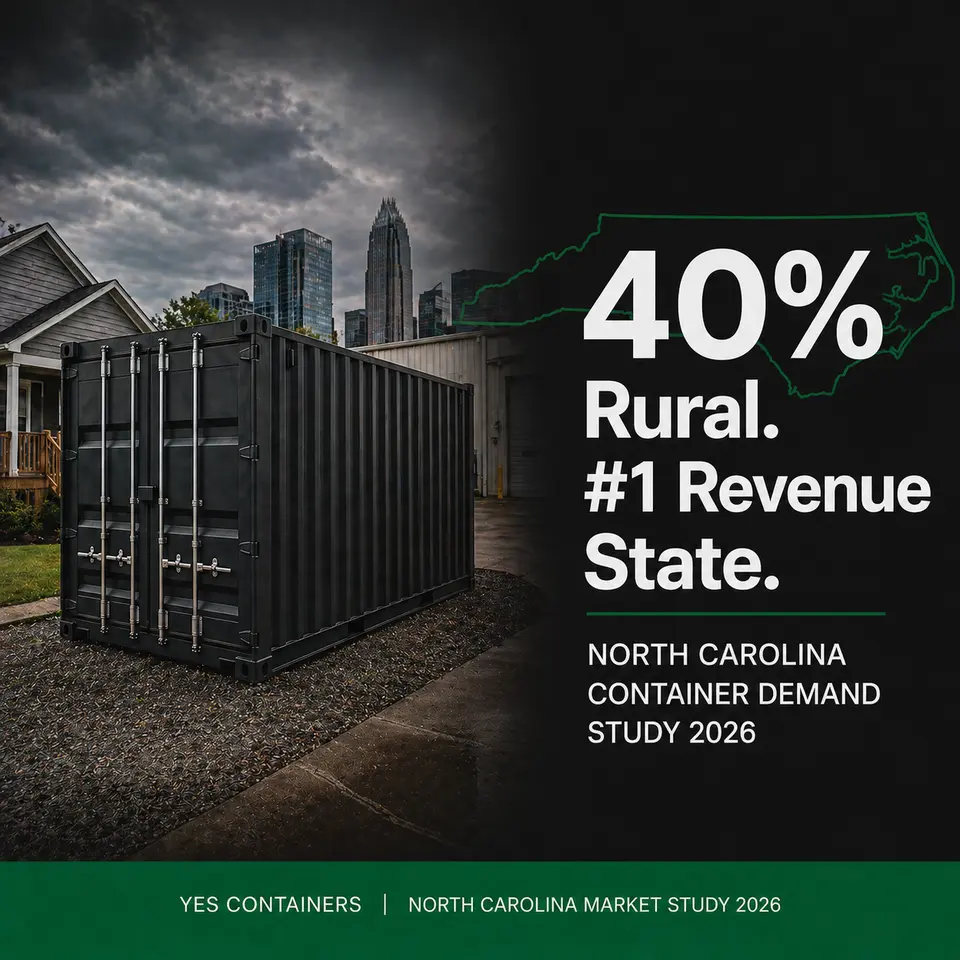
North Carolina container demand produced more revenue for YES Containers during the study period than any other state — 10 units and $35,292 from Charlotte alone, with additional rural and secondary market volume statewide. That performance did not come from a hurricane-prone coastline, a port logistics hub, or a tech-driven conversion market. It came from a state where 40% of residents live outside city limits, homeownership rates run above the national average, and a fast-growing major metro sits adjacent to some of the most active suburban expansion corridors in the Southeast. This study breaks down what drives North Carolina container demand, how Charlotte and the Piedmont Triad compare, what South Carolina adds to the picture, and why rural county purchasing is the segment most consistently underrepresented in published data.
North Carolina by the Numbers: The Market Foundation
North Carolina — Key Market Indicators
Sources: U.S. Census Bureau QuickFacts 2024, YES Containers order data Nov 2025–Apr 2026, Google Search Console data Apr 2026.
Two numbers in that chart define the North Carolina container opportunity more clearly than any market sizing estimate. First: $35,292 from Charlotte in six months — the highest revenue of any single city in the YES Containers dataset, achieved through a single repeat customer and organic product discovery without any city-specific content campaign. Second: 549 monthly Google Search impressions for South Carolina container queries at position 40.2 — zero clicks, zero conversions, and zero content targeting a state that borders YES Containers' top revenue market. The opportunity on both sides of that data is significant.
Charlotte: The #1 Revenue City and What Its Buyer Profile Reveals
Charlotte generated more YES Containers revenue during the study period than Houston, Atlanta, Cincinnati, and Miami combined on a per-city basis. The buyer profile behind that performance is instructive: almost entirely new 20ft standard containers, delivered to residential and light commercial addresses in the Charlotte metro, concentrated around a single high-volume repeat customer whose ordering pattern reflects small business or contractor use rather than one-time residential purchasing.
That repeat buyer concentration is important context. Charlotte's $35,292 in revenue came from 10 units — a per-unit average of $3,529 — which is below the national dataset average of $4,733 and reflects the new 20ft standard container's position as the most cost-effective new unit in the product range. The volume, not the unit value, is what makes Charlotte exceptional. And the volume is coming from a market with the demographic fundamentals to support it: $82,068 median household income, 51% owner-occupancy, and one of the fastest suburban expansion rates in the Southeast.
Charlotte's growth context matters for understanding why container demand is structurally high. The Charlotte metro has been one of the fastest-growing large metros in the United States for the past decade, attracting both corporate relocations and residential in-migration from higher-cost Northeast and Mid-Atlantic markets. That growth generates construction activity — and construction activity generates job-site container demand — at a sustained rate that slower-growing metros cannot match.
Charlotte container buyers split between three profiles: suburban homeowners in the outer ring using containers for backyard storage or renovation displacement, contractors servicing the metro's active residential construction market, and small businesses in the light industrial corridors of the south Charlotte and Steele Creek areas needing flexible on-site storage without a warehouse lease commitment.
The Rural North Carolina Market: 40% of the State's Population
North Carolina's 40% rural population share is one of the highest of any state in the YES Containers market footprint. That figure — drawn from North Carolina Office of State Budget and Management data — means that roughly 4 million North Carolinians live outside urban and suburban classifications, spread across the state's Piedmont foothills, western mountain counties, and eastern coastal plain.
Rural North Carolina container demand is driven by tobacco farming in the east, poultry and livestock operations across the Piedmont, timber and Christmas tree farming in the western mountains, and general agricultural storage across all three regions. These uses generate demand for used containers — primarily used 20ft and used 40ft standard units — where durability and cost efficiency matter more than cosmetic condition.
Hurricane activity adds a storm-recovery layer to rural North Carolina demand that most buyers outside the region do not associate with the state. Hurricane Florence (2018), Dorian (2019), and Helene (2024) all caused significant flooding and agricultural damage in eastern North Carolina — a region that is technically inland from the coast but sits in low-lying terrain that channels storm surge and rainfall flooding up river corridors into agricultural counties. Post-storm container purchasing in eastern NC follows the same three-phase pattern documented in the Florida study: preparedness, emergency, and recovery purchasing stretched across 12 to 36 months.
North Carolina Container Demand — By Region
Modeled estimates based on YES Containers order data, U.S. Census Bureau rural population data, and storm recovery purchasing patterns. Not audited figures.
Raleigh-Durham: The Research Triangle's Container Market
Raleigh-Durham presents a different North Carolina container demand profile from Charlotte. Where Charlotte is driven by financial services, construction, and suburban residential growth, the Research Triangle is anchored in technology, pharmaceuticals, and university-adjacent commercial activity — a buyer mix that skews more toward conversion projects, backyard offices, and small business storage than toward the contractor and repeat-commercial purchasing that defines Charlotte's profile.
The Research Triangle's higher concentration of technology sector workers — many of whom transitioned to remote work permanently during 2020 and have not returned to office — creates a meaningful backyard office conversion market that is growing faster in this corridor than in the Charlotte metro. New 40ft high cube containers are more common in Research Triangle conversion inquiries than in Charlotte's predominantly 20ft standard order pattern.
Raleigh's rapid growth — consistently ranked among the fastest-growing large cities in the U.S. — also generates strong contractor and construction storage demand as residential development expands outward from the city core into Wake, Johnston, and Chatham counties. That construction activity is less mature than Charlotte's but growing faster, which makes Raleigh-Durham an increasing share of North Carolina's total container demand going forward.
South Carolina: The Adjacent Market With 549 Monthly Impressions and Zero Content
South Carolina shares a border with YES Containers' top revenue state and generates 549 monthly Google Search impressions for container-related queries at an average position of 40.2 — near-zero visibility, zero clicks, and zero dedicated content targeting it. That combination is the clearest adjacent-market opportunity in the entire YES Containers search dataset.
South Carolina's container market fundamentals are strong independently of its proximity to North Carolina. The state has a 66% homeownership rate, a meaningful rural population in its Upstate and Lowcountry regions, active construction in the Charleston and Greenville-Spartanburg metros, and storm exposure along its Atlantic coastline that mirrors the eastern North Carolina hurricane-recovery demand pattern. South Carolina container demand is real, active, and currently being served entirely by competitors because no targeted content exists to capture it.
The Greer depot — visible in YES Containers' city page list — sits directly in the Greenville-Spartanburg metro, positioning YES Containers within delivery range of the fastest-growing manufacturing corridor in South Carolina. BMW, Michelin, and a dense automotive supplier network generate consistent industrial and contractor storage demand in that corridor that depot proximity should convert at a meaningful rate once content and visibility support it.
| Indicator | North Carolina | South Carolina |
|---|---|---|
| Homeownership rate | 66.6% | ~66% |
| Rural population share | ~40% | ~34% |
| Primary metro | Charlotte, Raleigh-Durham | Charleston, Greenville-Spartanburg |
| Storm exposure | Hurricane remnants, inland flooding | Atlantic coast hurricanes, coastal flooding |
| YES Containers GSC visibility | Strong — Charlotte converting | 549 impressions, position 40, zero clicks |
| Depot proximity | Charlotte depot serving metro | Greer depot serving Upstate SC |
| Dominant container use | Residential, contractor, agricultural | Industrial, residential, storm recovery |
Piedmont Triad: Greensboro, Winston-Salem, and High Point
The Piedmont Triad — Greensboro, Winston-Salem, and High Point — sits between Charlotte and Raleigh-Durham geographically and between them in market character. The region's legacy furniture and textile manufacturing base has partially transitioned to logistics, healthcare, and distribution, generating a container demand mix weighted toward commercial and industrial storage with secondary suburban residential purchasing in the outer suburbs of each city.
High Point's identity as the global furniture capital creates a distinct container use case: furniture market staging, sample storage, and showroom overflow storage tied to the twice-yearly International Home Furnishings Market attract commercial buyers who need flexible, short-term large-volume storage that warehouse rental cannot provide economically. This is a niche but recurring use case not replicated in other North Carolina markets.
Key Findings
- North Carolina is YES Containers' top revenue state, with Charlotte alone generating $35,292 and 10 units during the study period — the highest single-city performance in the dataset.
- Charlotte's performance is driven by a $82,068 median household income, 51% owner-occupancy, fast suburban expansion, and a repeat commercial buyer profile concentrated on new 20ft standard containers.
- North Carolina's 40% rural population — one of the highest in the YES Containers market footprint — generates substantial agricultural and storm-recovery container demand in eastern and western counties that is structurally separate from Charlotte's urban and suburban market.
- Hurricane remnants — Florence, Dorian, and Helene — have created recurring storm-recovery demand cycles in eastern North Carolina's low-lying agricultural counties, adding a disaster-response layer to base agricultural purchasing.
- South Carolina generates 549 monthly Google Search impressions for container queries at position 40 with zero clicks and zero dedicated content — the clearest adjacent-market gap in the YES Containers search dataset, supported by the Greer depot's positioning inside the Greenville-Spartanburg industrial corridor.
- Raleigh-Durham's technology and remote-work concentration is creating a growing backyard office and studio conversion demand that is distinct from Charlotte's contractor and residential storage profile.
- The Piedmont Triad generates niche furniture market staging demand tied to High Point's International Home Furnishings Market — a recurring commercial use case not present in other North Carolina markets.
South Carolina container availability is covered through the South Carolina container page and the Charleston and Greer city pages. For North Carolina availability, visit the North Carolina container page or browse the Charlotte product catalog directly. All container types and current pricing are listed in the YES Containers product catalog.