

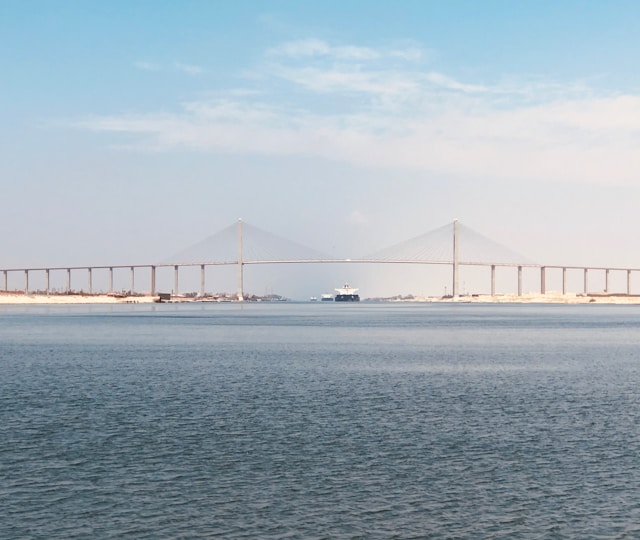

Why Red Sea and Suez Canal Rerouting Is Still Affecting US Supply Chains — and How Companies Are Adapting
Written on November 17, 2025
by Adrian Stan
In the following categories: Container Shipping Industry, News
When Houthi attacks on Red Sea shipping began in late 2023, most logistics analysts expected a short-term disruption. Vessels would reroute around the Cape of Good Hope for a few months, a diplomatic or military resolution would restore the Bab el-Mandeb Strait to normal traffic, and the freight market would normalize. That resolution has not materialized. Entering 2026, significant portions of Asia-Europe and Asia-US East Coast container traffic continue to move the long way around Africa, and the operational and pricing consequences have become embedded in how supply chains function rather than being treated as a temporary exception.
This article focuses on what has actually changed in supply chain behavior in response to sustained rerouting — and what that means for US buyers sourcing containers domestically.
Why the Disruption Has Lasted Longer Than Expected
Several factors have kept the Red Sea route impractical for many carriers even as the immediate intensity of attacks has fluctuated.
Insurance costs remain elevated. War risk insurance premiums for Red Sea transits surged dramatically when attacks began and have not fully returned to pre-disruption levels even during periods of reduced attack frequency. For carriers, the insurance premium alone makes Cape of Good Hope routing economically competitive on many voyages — which means the business case for returning to the Suez route requires both a security improvement and an insurance market normalization that has not yet occurred together.
Fleet deployment has been restructured. Carriers spent months adjusting their vessel deployment patterns to account for the longer voyages — repositioning ships, adjusting port call sequences, and modifying sailing schedules. These fleet deployments are not instantly reversible. A shipping line that has spent six months restructuring its Asia-Europe service to Cape routing does not simply flip a switch back to Suez routing when conditions partially improve.
Cargo has adjusted too. Importers who rerouted sourcing, shifted to air freight for time-sensitive goods, or restructured inventory holding strategies in response to the disruption have not fully returned to pre-disruption patterns. Supply chain adaptation, once made, tends to persist longer than the disruption that triggered it.
How US Supply Chains Have Adapted
The most significant supply chain adaptations to sustained Red Sea disruption have fallen into several categories:
Extended Inventory Holding
With Asia-Europe and Asia-US East Coast transit times extended by 10–14 days due to Cape rerouting, importers have had to hold more inventory to maintain the same service levels. A just-in-time inventory model built around 28-day ocean transit times does not work when transit times are 40 days. The practical response has been to increase safety stock and reorder earlier — which requires more warehouse and storage capacity to hold that additional inventory.
This is one of the structural drivers of increased container storage demand in the US that persisted through 2024 and into 2025. Importers who needed to buffer more inventory against extended transit times needed more on-site storage capacity, and shipping containers — purchased rather than rented — provided a cost-effective way to add that buffer capacity without committing to long-term warehouse lease obligations.
Sourcing Diversification Away from Single-Route Dependency
Companies that had concentrated supply chains in Asia-to-US-East-Coast flows faced the full brunt of the Red Sea disruption. The adaptation response — accelerated by tariff policy changes happening simultaneously — has been to diversify sourcing toward manufacturing in Mexico, Southeast Asia outside China, and in some cases domestic US production. Each of these diversification moves changes the container flow patterns that feed the secondary market.
Mexico-sourced goods move primarily by truck and rail rather than ocean container, which does not add ocean containers to the US secondary market but does increase demand for on-site storage containers at US manufacturing and distribution facilities near the southern border. Southeast Asia-sourced goods on transpacific routes are less affected by Red Sea disruption than China-to-East-Coast routes, which has shifted some container supply pressure from East Coast to West Coast depot markets.
West Coast Port Resurgence
When Red Sea disruption made East Coast routing via Suez more expensive and uncertain, some transpacific cargo that had been shifting to East Coast routing reversed course and returned to West Coast ports. The Los Angeles/Long Beach complex and Tacoma saw increased volumes in 2024 relative to the years of heavy East Coast rerouting. For West Coast container buyers, this meant improved used container supply as more containers completed their freight voyages through West Coast ports.
Freight Rate Normalization — Partial
The acute freight rate spike of 2024 — driven by the sudden capacity compression when a significant portion of global shipping rerouted simultaneously — has partially normalized as carriers adjusted fleet deployment and effective capacity adapted to the new routing patterns. However, freight rates on affected lanes have not returned to pre-disruption 2023 lows. The ongoing additional cost of Cape routing (fuel, insurance, vessel time) is now partially embedded in carrier cost structures and reflected in rates as a persistent rather than spike premium.
What This Means for US Container Buyers in 2026
The practical implications for buyers purchasing containers for storage or commercial use:
| Buyer Situation | Red Sea Disruption Relevance | Practical Guidance |
|---|---|---|
| Buying used container for domestic storage | Low — used pricing driven by regional depot supply | Shop by depot proximity and delivered cost; minimal global freight exposure |
| Buying new one-trip container | Moderate — new pricing reflects ongoing Cape routing cost premium | Current pricing reflects post-disruption baseline; not a spike, but not pre-2023 either |
| East Coast buyer sourcing new containers | Higher — East Coast–routed new containers most affected | Compare East Coast depot vs West Coast depot delivered costs if flexibility exists |
| Buyer needing expanded storage due to inventory buffer | Directly relevant — storage demand is a consequence of longer transit times | The case for on-site container storage is stronger when extended inventory holding is required |
The Storage Case: Containers as a Disruption Buffer
One underappreciated consequence of sustained supply chain disruption is the increased case for owned container storage. When transit times are unpredictable and longer, the cost of running out of inventory is higher. The response — holding more buffer stock — requires more storage capacity. Purchased shipping containers provide that capacity without the monthly cost of warehouse rental or the friction of off-site storage.
The break-even on a purchased container versus warehouse rental or self-storage moved significantly in favor of purchasing during the sustained disruption period, as importers who needed ongoing buffer storage capacity found that owning the storage asset outperformed monthly rental commitments over an 18–24 month horizon. The portable storage container cost comparison works through the break-even math in detail.
Browse Current Inventory by Region
YES Containers maintains depot-sourced inventory across 40+ US locations. Current availability for buyers in markets most relevant to the Red Sea disruption:
- East Coast: New Jersey, Virginia, Georgia
- West Coast: California, Washington
- Gulf Coast: Texas
- All locations: full product catalog
Call 1-800-223-4755 to confirm current pricing and availability at the depot nearest your delivery location. Pay on Delivery is available on qualifying orders.
Frequently Asked Questions
Is the Red Sea shipping situation improving?
The situation has stabilized at a lower intensity than the acute phase of 2024 but has not resolved. As of early 2026, significant portions of Asia-Europe container traffic continue on Cape of Good Hope routing rather than Suez Canal routing. The diplomatic and security conditions that would allow a full return to Red Sea routing have not yet been established. Carriers and logistics companies are treating the Cape routing as a persistent operational baseline rather than a temporary exception.
Why are freight rates still elevated if attacks have slowed?
Because the cost premium of Cape routing — additional fuel, longer vessel utilization, higher insurance — is now embedded in carrier cost structures even on voyages that do not face active attack risk. Returning to Suez routing requires both a security improvement and an insurance market normalization. Fleet deployments restructured for Cape routing also take months to reverse. These factors keep a cost premium in the freight rate baseline even during periods of reduced attack activity.
Do Red Sea disruptions affect US-to-US container purchases?
Indirectly and primarily through new one-trip container pricing. New containers come from Asian manufacturers and are affected by the freight costs of getting them to US ports. Used containers in domestic depot networks are much less sensitive — their pricing reflects regional US supply and demand rather than global freight rate movements. Buyers choosing used containers over new are largely insulated from Red Sea freight rate effects.
How can I lock in container pricing during a volatile freight market?
The most reliable approach is to buy from existing domestic depot inventory rather than waiting for inbound shipments. A container sitting in a US depot is not affected by ongoing freight market volatility — its price reflects current regional conditions rather than future international freight rates. For new container buyers monitoring the market, the freight rate indexes (Freightos Baltic Index, Drewry World Container Index) give advance signals of direction, with visible price changes typically lagging the rate movement by 4–8 weeks.