

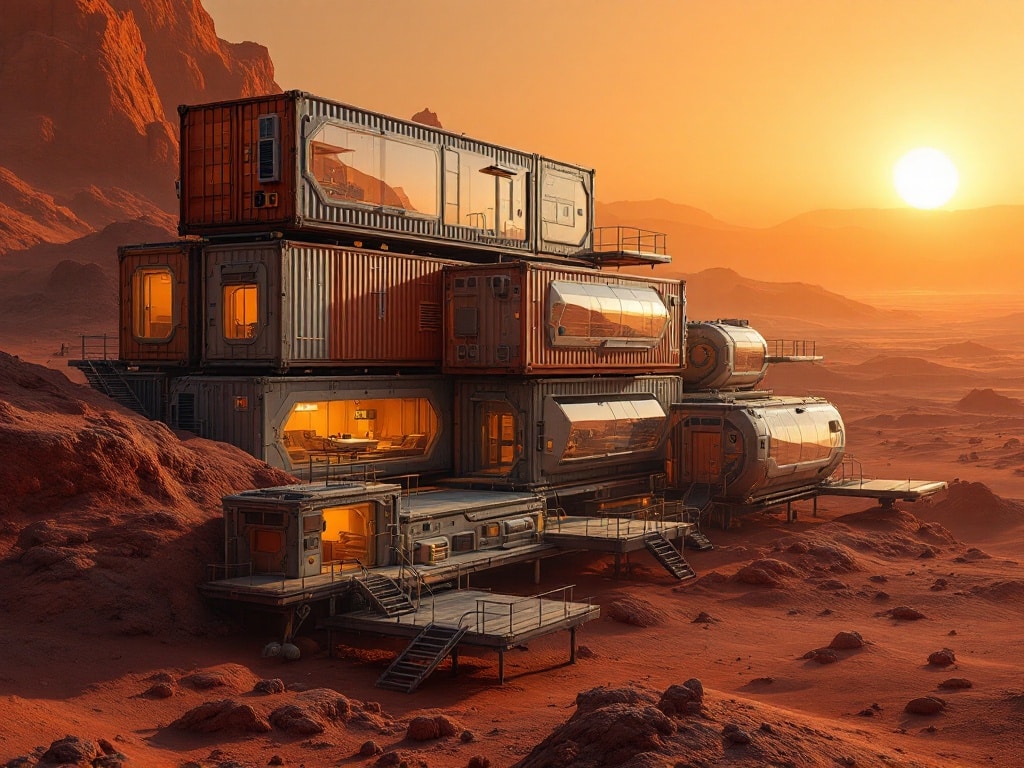

Shipping Containers in Space: The Real Engineering Behind the Far-Out Idea
Written on November 20, 2025
by Beatrice Zama
In the following categories: Shipping Container Architecture, Shipping Container Maintenance & Fabrication, Shipping Containers Innovation
The idea of using shipping container-style structures as space habitats sounds like science fiction. In some ways it still is. But the engineering logic behind it — standardized, modular, pressure-rated structures that can be transported, stacked, and assembled without custom construction — is exactly what space architects are working with right now. The concept isn't that containers should go to space in their current form. It's that the design principles containers represent have become the foundation for serious off-world habitat thinking.
Why Modularity Is Central to Space Habitat Design
The International Space Station is, in engineering terms, a modular system. Pressurized cylinders developed by different countries were launched separately and joined in orbit over more than a decade. The Zarya control module, the Unity node, Columbus, Kibo — each was built to interface with the others through standardized docking systems. The underlying philosophy is identical to what made containerization revolutionary in global shipping: if you standardize the connection interface, you can build the components anywhere and assemble them flexibly.
This parallel is why aerospace engineers and space architects have been drawn to container-inspired design thinking. ISO shipping containers aren't going to Mars — their steel is too heavy, their insulation too minimal, and their structural design optimized for stacking loads rather than pressure differentials. But the question container geometry asks — what if the module is a standard unit that can be transported, joined to other units, and used in multiple configurations — is exactly the right question for off-world habitation design.
What Real Space Habitat Research Actually Looks Like
NASA's Inflatable Module Experiments
NASA's Bigelow Expandable Activity Module (BEAM), attached to the ISS in 2016, was a test of inflatable habitat technology — a soft-shell pressurized structure that packs down for transport and expands on-site. BEAM has performed well enough that NASA extended its operational life multiple times. The design principle (compact transport, expand in place, modular connection to existing structures) is a different engineering path than rigid containers, but it answers the same operational question: how do you get habitable volume to space efficiently?
Lunar Surface Habitat Concepts
NASA's Artemis program and ESA's Moon Village concept both involve modular surface habitats that would be pre-deployed before crew arrival. The current leading approaches use either inflatable structures or pre-fabricated rigid modules — not steel containers, but structures sized and designed for robotic deployment and assembly. The engineering constraint that pushes habitat design away from steel containers is mass: every kilogram to lunar orbit costs approximately $1 million or more. A standard 20ft steel container weighs around 2,300 kg empty, which is an impossible mass budget for early lunar infrastructure.
Where Container Geometry Matters: Underground and In-Situ
The most plausible application for container-inspired design on Mars or the Moon isn't launching containers from Earth — it's using the modular box form for structures built or assembled on-site. 3D printing with regolith (the loose surface material on the Moon and Mars) is an active research area; printing container-geometry habitats from local material eliminates the launch mass problem. The structural logic of the container — corner-loaded, stackable, with a standard floor plate — translates to printed structures in ways that irregular shapes don't.
SpaceX's Starship is designed to land on Mars with cargo in its pressurized payload bay — which is, in effect, a very large modular container that touches down intact. Whether that payload bay eventually houses pre-configured habitat modules is a matter of payload design rather than fundamental engineering limitation.
The Engineering Problems That Aren't Solved Yet
The speculative quality of container-in-space concepts is real, and worth being specific about rather than hand-waving. Three genuine engineering challenges stand between the concept and any practical implementation:
Radiation Shielding
Earth's atmosphere and magnetic field block the high-energy particles that would damage human tissue on the lunar surface or in deep space. A steel container offers essentially no effective radiation shielding — steel at container thickness would need to be an order of magnitude thicker to provide meaningful protection, at which point the mass is prohibitive. The leading approaches involve either water walls (dense hydrogen content absorbs radiation), regolith burial (underground habitats), or polyethylene composites. Any container-inspired Mars habitat would need one of these solutions integrated, not just the steel shell.
Pressure Differential and Sealing
Shipping containers are designed to be wind and water tight, not air-tight under pressure differential. A habitat module needs to maintain internal pressure of around one atmosphere against a near-vacuum exterior — a very different engineering requirement. Container door seals aren't designed for this, and the corrugated wall geometry creates stress concentration points that pressurized cylinder or sphere geometry avoids. Container-inspired habitat designs would need fundamentally redesigned seals and wall structures.
Thermal Cycling
The Moon's surface experiences temperature swings of over 500°F between lunar day and night. Steel conducts heat aggressively, and a steel habitat without significant insulation would experience interior temperature swings that no life support system could manage efficiently. Multi-layer insulation systems, reflective coatings, and thermal mass management are all required — which is why NASA's habitat research focuses on insulated composite structures rather than metal boxes.
What This Means for Container Design on Earth
The space habitat research thread is interesting partly because of what it reveals about containers themselves. The limitations that make steel ISO containers impractical for space — high conductivity, inadequate sealing for pressure, radiation transparency, mass — are the same properties that require management when containers are used for human occupancy on Earth.
When container homes and converted workspaces are built well, they address exactly these challenges: spray foam insulation for thermal management, properly engineered door seals for weatherproofing, careful attention to floor chemistry and interior air quality. The engineering problems that space architects are trying to solve at the frontier of habitat design are the same problems that thoughtful container builders solve routinely.
If the speculative end of container design — the space habitats and Mars colonies — is interesting to you, the more immediately achievable applications are worth exploring. The container architecture and conversion guide covers what container specs actually mean for real build projects. And if the DIY end of container modification appeals, practical container upgrades you can actually do covers what's achievable without an engineering team.
YES Containers supplies new and used containers across all 48 contiguous states. Request a quote or call 800-223-4755 — no rocket required.

