

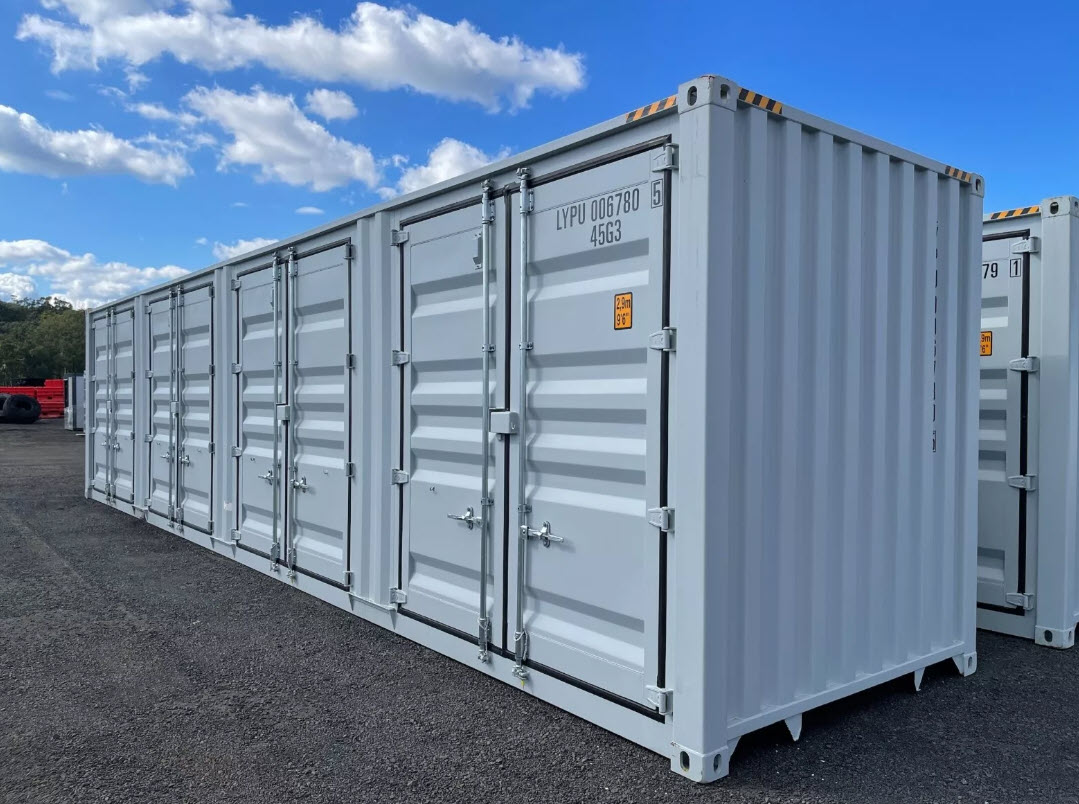

Military Conex Boxes: The Engineering History Behind Why They're Built to Last
Written on February 20, 2026
by Adrian Stan
In the following categories: Did you know?
The term "military Conex box" gets used loosely in the container market — sometimes as a synonym for any used steel container, sometimes to imply superior quality. Understanding where the term actually comes from, and what military engineering contributed to the containers sold today, helps buyers evaluate what they are getting when a seller invokes the military Conex name.
The Origin: Container Express in the Korean War Era
The original Conex — short for Container Express — was developed for the US Army in the early 1950s. The military faced a persistent logistics problem: moving enormous volumes of equipment, parts, and supplies across varied terrain using trucks, aircraft, and ships required constant repackaging as cargo moved between modes. Every transfer point was a potential point of loss, damage, and delay.
The solution was a standardized steel box that could move intact across all transport modes without the cargo inside being touched. The first Conex units were smaller than modern ISO containers — the Conex I measured roughly 8.5 feet long, 6.25 feet wide, and 6.5 feet tall — and were designed to be loaded by hand, stacked, and transported by vehicle, helicopter, or ship without modification.
During the Korean War and especially the Vietnam War, Conex boxes proved their value under conditions that no civilian logistics system had been designed to handle. They were dropped from aircraft, loaded onto vessels in monsoon conditions, stacked in jungle depots, and subjected to years of field use without shelter. The units that survived this treatment were extraordinarily well-built — and the engineering lessons from that experience directly shaped the ISO standard container specifications that define global trade today.
What Military Logistics Demanded — and What It Produced
Military procurement standards for Conex boxes were driven by a single overriding requirement: reliability under conditions that could not be controlled. The Army could not guarantee that a depot in Southeast Asia would have cranes, level ground, dry weather, or careful handling. The container had to survive everything.
The engineering responses to that requirement:
Corner Casting Design
The corner castings — the steel fittings at each of the eight corners of a container — had to accept lifting cables, twist-lock securing devices, and stacking loads from containers above, all from the same fitting. The solution was a forged steel oval-aperture casting that became the universal interface for container handling equipment worldwide. Modern ISO 1161 corner casting specifications descend directly from the military Conex design, which is why every crane, ship cell guide, and truck chassis in global logistics fits every ISO container.
Corrugated Steel Panels
Flat steel panels of the gauge required for structural integrity would be prohibitively heavy. The corrugated profile — the distinctive ribbed pattern on container walls — provides significantly higher bending resistance per unit weight than flat steel of the same thickness. This is a basic structural engineering principle, and it was the same solution used in military Conex construction: maximize strength without maximizing weight, because weight affects how many units a transport aircraft or vessel can carry.
Weatherproof Door Seals
Military field conditions include humidity extremes, blowing dust, torrential rain, and salt air. The rubber gasket door seals on Conex boxes were designed to maintain a weathertight closure through all of these conditions without requiring adjustment or replacement in the field. The same door seal design — a compression gasket running the full perimeter of the door frame — is the standard on every modern ISO container.
Hardwood Floors Rated for Mechanical Loading
Military cargo includes vehicles, weapons systems, ammunition, and heavy equipment. Conex floors were designed to support forklift loading and heavy point loads without failure. The tropical hardwood floors used in modern ISO containers — rated for 6,000 lb forklift axle loads — carry forward this design requirement unchanged.
How Military Conex Engineering Became the ISO Standard
The civilian containerization revolution began in earnest in 1956 when Malcolm McLean loaded 58 cargo containers onto the Ideal X for the first commercial container voyage from Newark to Houston. McLean's innovation was conceptual — the idea of keeping cargo sealed in a box across the full journey — but the engineering of the box itself built on military Conex experience.
By 1961, the International Organization for Standardization had begun work on what became ISO 668 — the standard defining container dimensions, corner casting specifications, and structural requirements. The military Conex's demonstrated engineering solutions — corner casting geometry, corrugated steel panels, door seal design — were incorporated into the ISO specification because they had been field-validated under conditions more demanding than any commercial shipping environment.
The result is that every modern ISO shipping container in the secondary market is built on military engineering principles. When a seller describes a container as "military grade," they are technically accurate in the sense that all ISO containers share this heritage — though they are not describing a specific upgraded product that differs from standard containers.
What "Military Grade" Actually Means for Buyers Today
In the secondary container market, "military Conex box" and "military grade container" are marketing terms that typically refer to standard used ISO dry freight containers. There are no containers in the civilian secondary market that were manufactured specifically for military use and then decommissioned into commercial availability at scale — actual surplus military Conex boxes from the Korean and Vietnam era are rare collectibles, not the units sold by container dealers.
What the military Conex heritage does mean for buyers is this: the engineering principles that produced the original Conex — forged corner castings, corrugated steel panels, compression door seals, hardwood floors — are present in every ISO-compliant container. The durability that made Conex boxes perform in military field conditions is the same durability that makes modern used containers perform in construction sites, farms, and commercial yards for 10–20 years with basic maintenance.
The grade of a used container — WWT, CW, or one-trip — reflects how much of that original engineering integrity remains after freight service. Grade is the more useful buying signal than any "military grade" marketing language. The WWT vs. CW decision guide explains what each grade actually certifies and when the distinction matters for your application.
The Conex Name in Modern Use
The Conex name has survived well beyond the specific military units that originated it. Today it functions as a general synonym for shipping container in much of the US, particularly in construction, military, and industrial contexts. The terminology cluster around the Conex name includes:
- Conex box — general term for a steel storage or shipping container, especially in construction and military circles
- Military Conex — emphasizes the rugged engineering heritage
- Shipping container — same physical unit, emphasizes transport origin
- ISO container — emphasizes standards compliance
- Sea can — informal Canadian usage for the same unit
For the full history of the Conex name and how it compares to modern container terminology, the Conex box history and buyer's guide covers the evolution in detail. The Conex vs. shipping container comparison addresses the most common terminology confusion directly.
Why Contractors and Industrial Buyers Prefer Military-Style Conex Terminology
In practice, buyers who specifically search for "military Conex boxes" tend to be looking for the same thing as buyers searching for "used shipping containers" — heavy-gauge steel storage units that will perform reliably in exposed, high-use environments. The military Conex framing signals that the buyer prioritizes durability over cosmetic condition and understands that a well-built steel box will outlast lighter alternatives by decades.
For construction site storage, industrial yards, remote operations, and any application where the container will be used hard and left outside year-round, a used WWT container in solid structural condition is exactly what these buyers need. The used container inspection guide covers what to verify when evaluating a used unit for these demanding applications.
Browse Military-Grade Conex Container Inventory
YES Containers stocks used and new containers built to the same ISO standards that descend from the original Conex engineering. Current inventory across depot locations nationwide:
- Used 20ft standard — compact, easy to deploy on constrained sites
- Used 40ft standard — maximum capacity for industrial and construction use
- Used 40ft high cube — extra height for equipment racking and workspace
For buyers who need the container inspection process explained before ordering remotely, the inspection at delivery guide covers what happens when your container arrives. Call 1-800-223-4755 to confirm current availability at the depot nearest your delivery location, or browse the full product catalog.
Frequently Asked Questions
Are actual military surplus Conex boxes available for purchase?
Genuine surplus military Conex boxes from the original Korean and Vietnam War era are rare and typically found through military surplus auctions rather than container dealers. The containers sold by commercial dealers as "military Conex" or "military grade" are standard ISO commercial containers — not decommissioned military units. This is not a drawback: modern ISO containers share the same engineering principles as the original Conex and are built to equivalent or superior specifications.
Is a military Conex box the same as a shipping container?
In practice, yes. The term refers to the same ISO standard steel dry freight container. "Military Conex" emphasizes the rugged engineering heritage and durability — not a separate product category. Every ISO container sold commercially is built on the same structural engineering principles as the original military Conex box.
How long do military-style Conex containers last?
A well-maintained used container in WWT or CW grade typically performs reliably for 10–20 years after purchase. New one-trip containers can last 25 years or more with basic maintenance. The lifespan is primarily determined by exterior coating condition, placement (on supports vs. directly on soil), and climate — not by the age of the container when purchased. The container lifespan and maintenance guide covers what actually determines longevity.
What size Conex container should I buy for a construction site?
For most construction sites, the 20ft standard is the workhorse choice — it fits on most sites, delivers easily, and holds a full crew's worth of tools and equipment. The 40ft standard is better when inventory volume requires it and site access permits the longer delivery clearance. For job site office use, the 40ft high cube is the most comfortable configuration. The size selection guide covers the full decision framework.