

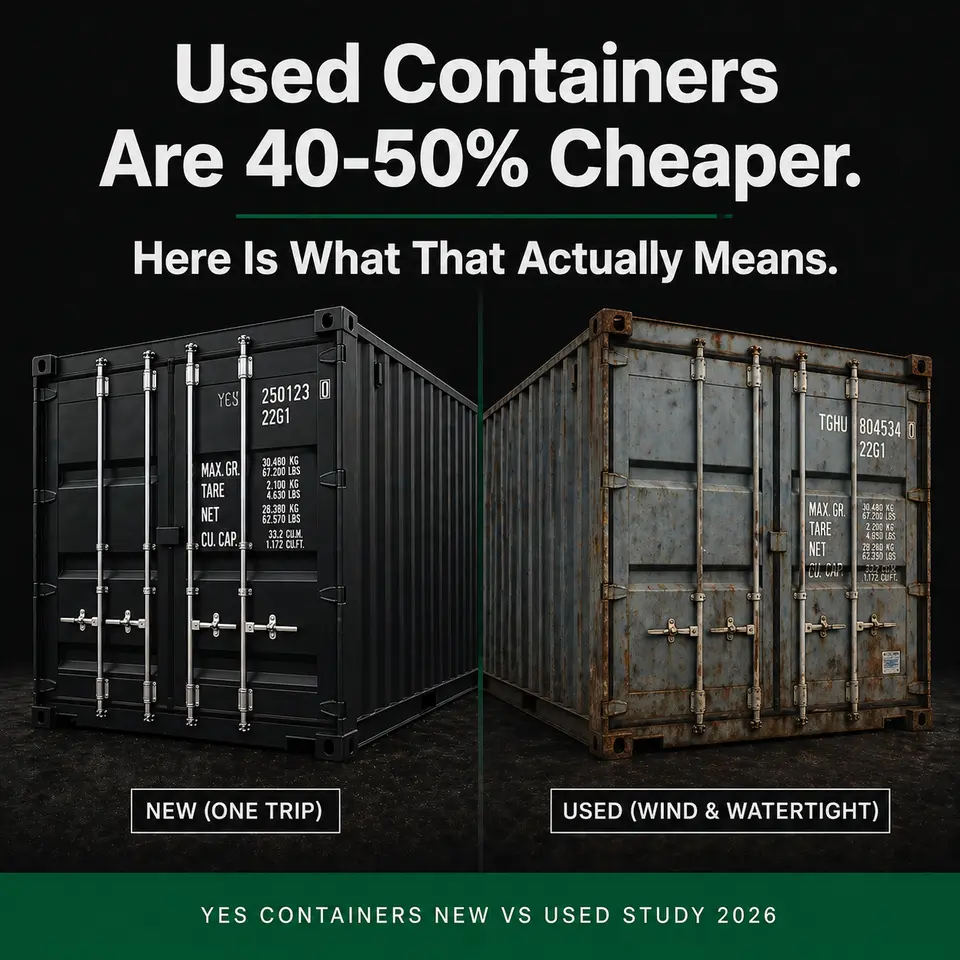

New vs Used Container Price Study: What the 40 to 50 Percent Gap Actually Means for Buyers
Written on May 7, 2026
by Gabriel B.
In the following categories: Shipping Container Studies
New vs used container price is the first comparison most buyers make and often the last thing they fully understand before purchasing. The gap between a new one-trip container and a comparable used unit is consistently 35 to 50 percent across all standard sizes — a difference large enough to change which size a buyer can afford, which use case is financially viable, and whether a container purchase makes economic sense at all relative to self-storage rental. This study documents the current price gap using 2025 U.S. market data, explains what the difference in cost reflects in terms of actual container condition, and maps which buyer scenarios favor new containers over used and vice versa.
The Current U.S. Price Gap: New vs Used Container by Size
Container pricing in the U.S. is ZIP-code specific and varies by local inventory levels, depot proximity, and market demand. The benchmark ranges below are drawn from Container xChange 2025 U.S. market data, cross-referenced against dealer pricing from multiple national sources and validated against YES Containers' own transaction data from the November 2025 to April 2026 study period.
New vs Used Container Price Gap by Size — 2025 U.S. Market
$1,500 to $3,000
$2,500 to $5,000
$2,000 to $4,500
$3,500 to $6,500
$2,500 to $5,000
$4,000 to $7,000
Sources: Container xChange 2025 U.S. market data, YES Containers transaction data Nov 2025 to Apr 2026. Ranges reflect national variation — local pricing differs by ZIP code, inventory, and depot proximity.
What the Price Gap Actually Reflects
The new vs used container price gap is frequently misunderstood as a quality difference when it is more accurately described as a condition and history difference. A used container graded as wind and watertight — the standard WWT grade — has passed an inspection confirming that it keeps water out, the doors function correctly, and the structural integrity is sufficient for continued use. It is not a damaged container. It is a container that has done its original job and is now available for a second life as on-site storage or a project shell.
What a used container may have, and a new one-trip container will not, falls into three categories. First, cosmetic wear: surface rust, paint fading, dents and dings from loading and unloading cycles, and general weathering from years of outdoor exposure in working environments. Second, floor condition variation: used container floors are typically tropical hardwood that has been exposed to forklift traffic, moisture, and cargo weight. Floor condition ranges from serviceable to delaminated depending on the container's specific history. Third, residual cargo history: containers that carried agricultural products, chemicals, or perishables can retain odors that are not covered by WWT grading.
A new or one-trip container — sometimes called a one-way or single-use unit — has made a single voyage from the manufacturing facility, typically in China, to the United States. It arrives in near-factory condition: clean interior, minimal exterior wear, original floor in full condition, no cargo history odor. The price premium reflects that clean condition history rather than any structural superiority — the ISO specifications for structural strength are identical across both grades.
Understanding Container Condition Grades
| Grade | What It Means | Best For | Relative Price |
|---|---|---|---|
| New / one-trip | One voyage from factory, near-factory condition inside and out | Conversion, residential, appearance-sensitive placement | Highest |
| IICL grade | High-quality used, meets International Institute of Container Lessors standards | Premium storage, light conversion, visible placement | High |
| Cargo worthy (CW) | Structurally sound and certified for continued cargo use | Storage, farm use, commercial applications | Medium-high |
| Wind and watertight (WWT) | Keeps wind and water out, doors functional, structurally intact | Outdoor storage, job site, farm, rural property | Medium |
| As-is | Sold without grade guarantee, condition varies significantly | Non-structural use only, buyer assumes condition risk | Lowest |
How the Price Gap Changes the Size Decision
One of the less obvious effects of the new vs used container price gap is how it changes the size decision for cost-conscious buyers. A buyer with a $3,500 budget choosing between a new 20ft standard container and a used 40ft standard container is not comparing the same use case — they are comparing a smaller, cleaner unit against a larger, functionally equivalent unit at the same total cost.
The used 40ft standard container at $2,000 to $4,500 — plus delivery — frequently overlaps in total landed cost with a new 20ft standard at $2,500 to $5,000 plus delivery. A buyer who chooses the new 20ft gets a cleaner interior and better cosmetic condition. A buyer who chooses the used 40ft gets double the floor space at a comparable or lower price. That trade-off is the most consequential financial decision in the container purchase process — and it is one that many buyers never explicitly model because they default to comparing same-size containers across condition grades rather than considering what the same budget buys across both dimensions simultaneously.
YES Containers' order data illustrates this pattern by market. Houston buyers — commercial operators prioritizing floor area and cost efficiency — select used 40ft standard containers at an average of approximately $2,994 per unit. Charlotte buyers — suburban homeowners prioritizing appearance — select new 20ft standard containers at approximately $3,529 per unit. Both buyer groups are spending roughly the same total amount but making opposite choices about what that budget buys.
New vs Used Container Price by Market: How Geography Affects the Gap
The new vs used container price gap is consistent in percentage terms nationally but varies in absolute dollars by local market conditions. Several geographic factors affect where within the national pricing ranges a specific buyer lands.
Port proximity. Markets near major container ports — Houston, Long Beach, Newark, Savannah — tend to have more abundant used container inventory sourced directly from port stock. Greater inventory availability compresses used container prices in these markets relative to inland locations where used containers must be transported further from their port origin. New containers are less affected by port proximity since they are delivered directly from the manufacturing source regardless of location.
Regional demand intensity. High-growth metros with active construction markets — Dallas, Charlotte, Nashville, Denver — see stronger demand for both new and used containers, which can narrow the effective price gap as used inventory tightens. Markets with lower construction activity and slower population growth tend to have more used container availability and softer pricing.
Delivery distance from depot. Delivery cost affects total landed cost equally for new and used containers — but because delivery is a fixed or distance-based fee applied to both, it has a proportionally larger impact on lower-priced used containers. A $700 delivery fee represents 32% of a $2,200 used container purchase but only 18% of a $3,800 new container purchase. Rural buyers paying higher delivery costs find the effective price premium of new over used narrows in total landed cost terms relative to the sticker price gap alone.
YES Containers Average Order Value by City — New vs Used Pattern
YES Containers order data Nov 2025 to Apr 2026. AOV reflects dominant container type selected in each market rather than a straight new vs used price comparison.
Which Use Cases Favor New Containers
The new vs used container price gap resolves clearly in favor of new containers for a defined set of use cases where condition, appearance, and interior cleanliness create value that justifies the premium.
- Backyard offices and studios. A converted container used as a workspace needs a clean interior, odor-free environment, and floor condition that supports finished flooring installation. New one-trip containers eliminate all three potential problem areas that used containers introduce. New 40ft high cube units are the dominant choice for this use case.
- Residential placement in visible locations. A container placed in a front yard, side yard visible from the street, or suburban property governed by HOA aesthetic standards benefits from the better exterior condition of a new unit. Surface rust and weathering on a used container can create HOA compliance issues or neighbor friction that a new container avoids.
- Food and consumable storage. Buyers storing food products, organic materials, or consumables where prior cargo odor is a genuine contamination risk need the clean cargo history of a new one-trip unit.
- ADU and habitable conversions. Building permits for habitable container structures often specify minimum condition standards that used WWT containers may not meet without remediation. New containers enter the permitting process with fewer condition-related complications.
Which Use Cases Favor Used Containers
For the majority of container use cases by volume, used WWT containers are the financially superior choice with no meaningful functional disadvantage.
- Outdoor equipment and tool storage. A farm property storing tractors, implements, or irrigation equipment has no use for a pristine interior. A used container keeps water and animals out — which is the entire functional requirement — at 40 to 50 percent less than a new equivalent.
- Job-site material lockup. Construction sites need containers that are secure and weatherproof. Cosmetic condition is irrelevant in an active construction environment where the container will be scratched and dented further during site use regardless of its starting condition.
- High-volume or multi-unit purchases. Buyers purchasing two, three, or more containers for commercial, agricultural, or multi-site applications find the price gap compounds significantly across units. A three-unit commercial purchase saving $1,500 per unit on used versus new represents $4,500 in total savings — enough to fund significant modifications on the used units if needed.
- Rural and agricultural storage. Rural buyers already managing delivery cost premiums from long drayage distances find that the used container's lower base price partially offsets the elevated delivery cost, keeping total landed cost within a viable range for practical storage applications.
The 60-40 Split: What YES Containers Order Data Shows
Across YES Containers' 51-order study period dataset, approximately 60% of units sold were new or one-trip and 40% were used. That split reflects the suburban and residential-dominant buyer profile in the dataset — markets like Charlotte, Cincinnati, and Atlanta where homeowners purchasing for residential or light commercial applications favor new containers for appearance and condition reasons.
A dataset weighted more heavily toward industrial, port-adjacent, and commercial markets — Houston, Newark, Long Beach — would likely show the inverse split, with used containers dominating. The 60-40 new-to-used ratio in YES Containers' data is a function of which markets have been most active during the study period rather than a reflection of national buyer behavior across all market types.
Key Findings
- The new vs used container price gap is consistently 35 to 50 percent across standard container sizes in the 2025 U.S. market — a difference large enough to change size decisions, use case viability, and break-even timelines relative to self-storage rental.
- The price gap reflects condition and cargo history differences, not structural differences — used WWT containers meet the same ISO structural specifications as new units and are fully functional for outdoor storage applications.
- For cost-sensitive buyers, comparing a used 40ft container against a new 20ft container at the same budget often reveals that the used option provides double the floor space at equivalent or lower total landed cost.
- New containers are the better choice for conversions, residential visible placement, food storage, and habitable ADU applications where cleanliness, odor history, and floor condition create genuine functional differences.
- Used WWT containers are the financially superior choice for the majority of outdoor storage use cases — job sites, farms, rural property, commercial storage — where functional requirements are met by WWT grade without the cosmetic and condition premium of new units.
- Port proximity, regional demand intensity, and delivery distance all affect where within national price ranges a specific buyer lands, with rural buyers finding the effective new-to-used price premium narrower in total landed cost terms than sticker price alone suggests.
- YES Containers' 60-40 new-to-used split during the study period reflects a residential and suburban-dominant buyer mix rather than national market averages across all buyer types.
Compare current new and used container pricing and availability across all sizes at the YES Containers product catalog. Browse used 20ft standard, used 40ft standard, new 20ft standard, and new 40ft high cube containers with location-specific pricing. The full Shipping Container Studies series covers pricing economics, buyer demographics, and regional demand data across the U.S. market.